Grendel: Difference between revisions
Robyn.Blaber (talk | contribs) Created page with "{{Infobox strain | title = Grendel | subtitle = Player Strain | caption = The Grendel (🔊 GREN-duhl) are often characterized as a savage strain, though would agree that this supposition is based on their arguably brutish looks. | strain = Grendel | scientific = Homo Orcus | plural = Grendel | possessive = Grendel | substrains = Kalas Grendel, Maerc Grendel, Sogis Grendel | image = https://imagedelivery.net/TNzzP2IqyQLYoHEs2ZN5aQ/bb4466cc..." |
Robyn.Blaber (talk | contribs) No edit summary |
||
| (One intermediate revision by the same user not shown) | |||
| Line 15: | Line 15: | ||
| weight = | | weight = | ||
| wingspan = | | wingspan = | ||
| skin_color = | | skin_color = Blue, Light Blue, Green, Gray | ||
| hair_color = | | hair_color = Black, White, Gray | ||
| feathers = | | feathers = | ||
| eye_color = | | eye_color = | ||
| build = | | build = Muscular | ||
| distinctions = | | distinctions = | ||
| language = Common, Orc | | language = Common, Orc | ||
| climate = | | climate = Alpine/Polar,Temperate | ||
| terrain = | | terrain = Hills,Plains,Coastal | ||
| location = [[ | | location = [[Maercland]] | ||
| disposition = | | disposition = Resentful. | ||
}} | }} | ||
The [[Grendel]] are often characterised as a savage strain. Experts agree that this supposition is based on their arguably brutish appearance. An average [[Grendel]] stands taller and more muscular than all but the largest of humans. The bone structure of the [[Grendel]] face tends to make them appear to be agitated, at least to [[Human]]s. | The [[Grendel]] (Homo Orcus) are often characterised as a savage strain. Experts agree that this supposition is based on their arguably brutish appearance. An average [[Grendel]] stands taller and more muscular than all but the largest of humans. The bone structure of the [[Grendel]] face tends to make them appear to be agitated, at least to [[Human]]s. | ||
These suppositions of their savagery, however, could not be further from the truth. [[Grendel]] society is no more brutish than any of the other strains on [[Otan]]. Their moral codes are roughly equivalent to those of other strains. Their technology in some areas is unmatched, even by humans. On many other societal measures, from piety to hospitality to cleanliness, the [[Grendel]] are not lacking. | These suppositions of their savagery, however, could not be further from the truth. [[Grendel]] society is no more brutish than any of the other strains on [[Otan]]. Their moral codes are roughly equivalent to those of other strains. Their technology in some areas is unmatched, even by humans. On many other societal measures, from piety to hospitality to cleanliness, the [[Grendel]] are not lacking. | ||
| Line 35: | Line 35: | ||
== Society and Culture == | == Society and Culture == | ||
{{LoreImage|#.png|350px|left}} | {{LoreImage|https://imagedelivery.net/TNzzP2IqyQLYoHEs2ZN5aQ/4141fe0c-96d5-4076-e953-cd1d8fbf5500/wiki#.png|350px|left}} | ||
The [[Grendel]] exist in a state of perpetual environmental struggle, inhabiting a "frozen swamp" that offers almost no arable land and is plagued by disease. This geographic misfortune has trapped the population in a cycle of poverty that persists even by the standards of [[Otan]], forcing many [[Grendel]] into living conditions that neighboring nations would perceive as squalor. | |||
For over two hundred years, their [[Sop]]hists have labored to make sense of this plight, yet no definitive answer has emerged to explain or alleviate their environmental hardship. In the wake of this struggle, [[Grendel]] society is currently defined by a tension between fading traditions and a rising tide of religious zealotry. | |||
The ancient [[Woden]]ist ways, centered on a social contract that begins with absolute hospitality and concludes with swift violence if that trust is betrayed, are being steadily eclipsed by the worship of [[Otoy]], the goddess of Redemption. While it is not yet clear how this spiritual shift will ultimately reshape their identity, it is evident that the "Old Ways" are dying out as the people embrace a new, more militant sense of divine purpose. | |||
Despite their material poverty, the [[Grendel]] possess a culture that deeply prizes physical and technological power. Their public festivities are centered on rigorous tests of strength and combat, which, while non-lethal, are intense enough to be unsettling for non-[[Grendel]] observers. Parallel to this physical prowess is a sophisticated mastery of metallurgy; they have successfully produced [[Grendel]] steel, widely regarded as the hardest steel in [[Otan]]. While their engineers and [[Tinker]]s continue to seek new applications for this material, it stands as a testament to their innovation and a primary source of cultural pride amidst their environmental challenges. | |||
{{-}} | |||
== Physical Characteristics == | == Physical Characteristics == | ||
{{LoreImage|#.png|350px|left}} | {{LoreImage|https://imagedelivery.net/TNzzP2IqyQLYoHEs2ZN5aQ/9c3059bf-37c7-424d-264f-aa6306832600/wiki#.png|350px|left}} | ||
Physically, the [[Grendel]] are a formidable strain, distinguished by their massive frames and distinct pigmentation. The majority of the population exhibits green skin, a trait shared with their diminutive cousins, the [[Kuulik]]. However, variations are common, with gray and blue-skinned individuals appearing frequently; centuries of occasional cross-breeding have further produced a wide spectrum of intermediate skin tones. | |||
Standing an average of 2 to 4 Kul (hands) taller than a typical human, their height is matched by a significantly greater physical bulk. Their ears are pointed, though this feature is notably less pronounced than the sharp, elongated ears of the [[Aelf]]es or the [[Kuulik]]. The [[Grendel]] biology is exceptionally resilient, specifically adapted to survive in the most punishing climates of [[Otan]]. They possess an innate resistance to inclement weather, a trait most evident in their ability to operate in polar conditions while wearing what other strains would consider summer garments, often with substantial flesh left bared to the freezing air. | |||
This environmental hardiness allows them to endure the "frozen swamp" of their homeland, where disease and bitter cold are constant threats. While their standard lifespan and specific gravity preferences align with the broader human baseline, their physical endurance far exceeds it. They also seem to exhibit an unusually high tolerance to disease, undoubtedly a result of their long exposure to swamp insects. | |||
In terms of raw power, the [[Grendel]] are universally recognized as unusually strong due to their sheer size and muscle density. However, there is a distinct biological tier within their population known as [[Brute]]s. While the average [[Grendel]] is powerful, only those who manifest as [[Brute]]s possess truly "unnatural" strength, a transformative state that tips the scales of battle. Like the [[Brute]]s found in other strains, such as the [[Aelf]]es or the [[Aydahar]], [[Grendel]] [[Brute]]s are the heavy-hitters of their society, providing the martial muscle that historically fueled the [[Grendel]] War and continues to define their strength-based festivities today. | |||
{{-}} | {{-}} | ||
=== Natural and Latent Abilities === | === Natural and Latent Abilities === | ||
{{LoreImage|#.png|350px|right}} | {{LoreImage|https://imagedelivery.net/TNzzP2IqyQLYoHEs2ZN5aQ/f80b7ec4-8623-49b0-6361-67bc77c13400/wiki#.png|350px|right}} | ||
Like other human strains, the [[Grendel]] possess no inherently magical or supernatural abilities, though their physiology has been profoundly shaped by the environments they inhabit. Their survival in a disease-ridden, frozen marshland has fostered a robust natural resistance to both extreme cold and common pathogens. While this hardiness is a defining trait of the strain, it is often viewed by their own [[Sop]]hists as an adaptive biological response, one that any human population might theoretically develop if subjected to the same punishing living conditions for several generations. | |||
In the field, this manifests as a remarkable tolerance for sub-zero temperatures. It is common to see [[Grendel]] laborers or warriors operating in polar conditions with bared flesh, dressed in what other nations would consider light summer garments. This innate resilience allows them to maintain their legendary strength and productivity in climates that would quickly incapacitate more temperate-dwelling strains. Their resistance to disease is equally notable, serving as a vital defense against the various blights that fester in the stagnant, thawing sections of their swampy homeland. | |||
{{-}} | {{-}} | ||
== History == | == History == | ||
{{LoreImage|#.png|350px|right}} | {{LoreImage|https://imagedelivery.net/TNzzP2IqyQLYoHEs2ZN5aQ/04b6664f-c73d-4e23-3650-e6991478e000/wiki#.png|350px|right}} | ||
In the decades following the Great Erasure, the [[Grendel]] found themselves adrift in a hostile world, struggling to define their place among the shifting powers of [[Otan]]. Their initial approach was one of diplomacy; they sought to secure their future through tireless negotiations with their human neighbors, dispatching envoys to establish formal trade deals and secure resources for their resource-poor frozen marshland. However, these efforts were met with systemic indifference. Most [[Grendel]] embassies returned with empty hands, as the surrounding nations remained wary of the strain’s imposing physical presence and alien customs. | |||
During this period of isolation, [[Grendel]] leadership was governed by the Kosbassi, a title held by a leader chosen by right of might in single combat. Unlike a typical kratocracy, the [[Grendel]] evolved a sophisticated set of rules to ensure that strength was paired with leadership; only the most meritorious individuals, those who had proven their service and strategic value, were permitted to challenge for the position. | |||
As the "Old Ways" of tradition and isolationist survival seemed doomed to fail against the rising pressures of the outside world, the tide shifted toward total conflict. The [[Grendel]] War erupted as an armed uprising led by the warlock Zorhan Zhanat, whose fanatical leadership and mastery of destructive magic turned a struggle for resources into a crusade for [[Grendel]] liberation. This war saw the rise of legendary figures like Batil Zhurek, who earned his status as a war hero in the defense of [[Ortalyk]] before eventually ascending to the position of Tsar. | |||
The conflict eventually reached its breaking point, leading to the capitulation of the [[Grendel]] forces and a definitive end to the bloodshed. Peace was formalized through the signing of the Treaty of Kala Astanals, an agreement named for the imperial city and educational heart of [[Otan]] where the terms were likely negotiated. Today, the [[Grendel]] remain at peace with their neighbors, though the scars of the war and the strictures of the treaty continue to influence their trade-heavy relationship with nations like the [[Ungirsi]] Federation. This peace has allowed for the slow transition of [[Grendel]] culture, as the militant zealotry born in the fires of the war begins to settle into the structured worship of [[Otoy]]. | |||
{{-}} | {{-}} | ||
== [[Grendel]] Substrains == | == [[Grendel]] Substrains == | ||
=== [[ | === [[Kalas Grendel]] Substrain === | ||
{{LoreImage|#.png|350px|right}} | {{LoreImage|https://imagedelivery.net/TNzzP2IqyQLYoHEs2ZN5aQ/abfdf4ff-a632-45e3-7743-dbff1b784400/wiki#.png|350px|right}} | ||
'''Description:'''The [[ | '''Description:'''The [[Kalas Grendel]] (🔊 KAL-as GREN-duhl) are the backbone of [[Grendel]] society, making up the population of cities. They are the traders responsible for fueling the economy. | ||
'''Overview:'''The [[Kalas Grendel]] (Homo Orcus Urbanus) represent the only nationally organized substrain of their kind. Whether or not they form the majority population in a given settlement, they are the undisputed architects of the [[Grendel]] world, responsible for the sophisticated planning of everything from intricate plumbing systems to formidable defensive walls. Their civilization is anchored by their greatest inland stronghold, [[Sogis]] Kalasi, a capital situated far from the reach of coastal incursions to ensure the safety of their urban heartland. | |||
Despite their inland focus, the Kalas maintain a specialized navy comprised of small, swift attack vessels. These ships are not designed for protracted broadsides or naval endurance; rather, they serve as delivery systems intended to bring [[Grendel]] boarding parties into immediate, devastating contact with enemy crews. | |||
This martial readiness exists alongside a complicated political landscape. Since the conclusion of the [[Grendel]] War, their former revolutionary leader, Zorhan Zhanat, has retreated from public life entirely to join the mysterious Council of Nine. In his absence, the Kalas have adopted a restless political cycle, undergoing a rigorous selection process to choose a new leader at the close of every year before entering the Holy Days. | |||
Modern Kalas society is a study in dualities, split between pragmatism and lingering resentment. While a significant portion of the population works tirelessly to open and stabilize international trade routes, others, some in secret, others with increasing boldness, vow to ignite a fresh war to reclaim perceived lost glory. This tension is mirrored in their spiritual life: while they remain traditional [[Woden]]ists at their core, the streets of [[Sogis]] Kalasi see more and more [[Otoy]] zealotry each year. This rising redemptive fervor threatens to fully eclipse the old ways of hospitality and vengeance, pushing the Homo Orcus Urbanus toward an uncertain, militant future. | |||
{{-}} | {{-}} | ||
=== [[Maerc Grendel]] Substrain === | === [[Maerc Grendel]] Substrain === | ||
{{LoreImage|#.png|350px|right}} | {{LoreImage|https://imagedelivery.net/TNzzP2IqyQLYoHEs2ZN5aQ/a0c548e0-2926-468f-781b-87b75f906600/wiki#.png|350px|right}} | ||
'''Description:'''The [[Maerc Grendel]] (🔊 MARK GREN-duhl) are the most numerous of the [[Grendel]] strain, though they are the least seen; making their homes in the inhospitable swamplands. | '''Description:'''The [[Maerc Grendel]] (🔊 MARK GREN-duhl) are the most numerous of the [[Grendel]] strain, though they are the least seen; making their homes in the inhospitable swamplands. | ||
'''Overview:''' | '''Overview:'''The [[Maerc Grendel]] (Homo Orcus Palustris) are living anomalies within the [[Grendel]] strain. While their Kalas and [[Sogis]] cousins display more common natural pigmentations, the Maerc possess a striking blue skin tone, ranging from pale azure to a deep, evening horizon blue, a coloration rarely found in the natural world. Physiologically, they share the same massive frames and pointed ears as their kin, yet their unique adaptation allows them to thrive in an environment that most land mammals would find utterly unbearable. | ||
They inhabit the dense, disease-ridden swamps of [[Maercland]], a terrain of constant murk and unstable ground. To survive the rising waters and predatory mire, the Maerc have mastered the art of elevated construction, using stilts, piles, and living trees to suspend their small, tight-knit communities above the swamp floor. This precarious lifestyle requires a constant maintenance of their structures and a deep understanding of the marshland’s shifting topography, cementing their reputation as the most environmentally resilient of the [[Grendel]] substrains. | |||
Their survival strategies shift dramatically with the seasons. During the humid summer months, they navigate the waterways in light skiffs, utilizing specialized non-traditional hunting techniques to harvest the bounty of the marsh. However, it is during the frozen winters that the Maerc display their most fearsome traits; they deliberately rouse swamp beasts and other lethal creatures from their hibernation to hunt them. In these winter forays, they are often seen working in tandem with Woolly Rhinos and trained wolves, turning the frozen swamp into a coordinated theater of high-stakes predation. | |||
{{-}} | |||
=== [[Sogis Grendel]] Substrain === | |||
{{LoreImage|https://imagedelivery.net/TNzzP2IqyQLYoHEs2ZN5aQ/75fefbd5-a859-4a8c-98eb-eeb5b4dad200/wiki#.png|350px|right}} | |||
'''Description:'''The [[Sogis Grendel]] (🔊 SOH-jiss GREN-duhl) are the hill-folk of the [[Grendel]] strain. They make up the bulk of [[Maercland]]'s military might by providing the most warriors. | |||
'''Overview:'''The [[Sogis Grendel]] (Homo Orcus Collinus) are the rugged hill-folk of the [[Grendel]] strain and the primary source of the nation’s terrestrial power. While their metropolitan cousins handle the administration of the state, the [[Sogis]] provide the overwhelming bulk of the military might, fielding the vast majority of the warriors that defend the [[Grendel]] borders. Unlike the urbanized Kalas, they avoid traditional settlements entirely, preferring a decentralized, rural existence scattered across the harsh elevations of the hills. | |||
[[Sur]]vival for the Homo Orcus Collinus is a matter of constant labor, as the difficult terrain makes traditional agriculture nearly impossible. Instead, they sustain themselves by hunting wild game and foraging for whatever plant protein the highlands offer. They are most famous, however, for their mastery of animal husbandry; the [[Sogis]] have a unique penchant for raising and breeding Woolly Rhinos in captivity, utilizing these massive beasts as both beasts of burden and formidable assets in times of conflict. | |||
Though they value their independence, the [[Sogis Grendel]] regularly seek out brief, intense moments of community. They gather periodically for great congregations where they feast, trade news, and share gossip. These gatherings serve as essential hubs for education and training, featuring rigorous games and spectacles that test their physical strength, riding skills, and prowess at the forge. In these congregations, leadership is informal and fleeting; they acknowledge no permanent rulers, instead paying deference to the "strongest" among them, who acts as a temporary leader and arbiter for the duration of the assembly. | |||
{{-}} | {{-}} | ||
== [[Grendel]] Occupied Regions == | == [[Grendel]] Occupied Regions == | ||
=== [[Maercland]] === | |||
{{LoreImage|https://imagedelivery.net/TNzzP2IqyQLYoHEs2ZN5aQ/13625508-a4b7-49e7-bdc4-97cf69914b00/wiki#.png|350px|right}} | |||
'''Description:''' [[Maercland]] (🔊 MARK-land) sits on the northern coast, with the [[Ungirsi]] Federation on its southern border and [[Soltustik]] to the west. It is [[Grendel]] territory. | |||
'''Overview:''' Coming Soon | |||
{{-}} | |||
{{Copyright notice}} | {{Copyright notice}} | ||
[[Category:Strains]] | [[Category:Strains]] | ||
Latest revision as of 18:45, 3 March 2026

| Strain | Grendel |
|---|---|
| Scientific name | Homo Orcus |
| Plural | Grendel |
| Possessive | Grendel |
| Substrains | Kalas Grendel, Maerc Grendel, Sogis Grendel |
| Location | Maercland |
| Language | Common, Orc |
| Climate | Alpine/Polar,Temperate |
| Terrain | Hills,Plains,Coastal |
| Skin Color | Blue, Light Blue, Green, Gray |
| Hair Color | Black, White, Gray |
| Build | Muscular |
| Disposition | Resentful. |
The Grendel (Homo Orcus) are often characterised as a savage strain. Experts agree that this supposition is based on their arguably brutish appearance. An average Grendel stands taller and more muscular than all but the largest of humans. The bone structure of the Grendel face tends to make them appear to be agitated, at least to Humans.
These suppositions of their savagery, however, could not be further from the truth. Grendel society is no more brutish than any of the other strains on Otan. Their moral codes are roughly equivalent to those of other strains. Their technology in some areas is unmatched, even by humans. On many other societal measures, from piety to hospitality to cleanliness, the Grendel are not lacking.
Their reputation for savagery is truly earned on the battlefield. The Grendel can often best Humans when outnumbered by as much as three to one. This fact is an important one for any Human general to memorize. The Grendel War was costly to all participants.
Society and Culture
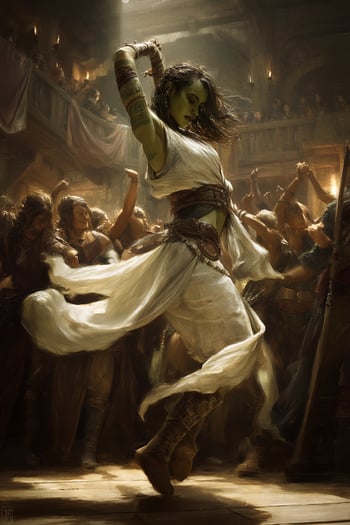
The Grendel exist in a state of perpetual environmental struggle, inhabiting a "frozen swamp" that offers almost no arable land and is plagued by disease. This geographic misfortune has trapped the population in a cycle of poverty that persists even by the standards of Otan, forcing many Grendel into living conditions that neighboring nations would perceive as squalor.
For over two hundred years, their Sophists have labored to make sense of this plight, yet no definitive answer has emerged to explain or alleviate their environmental hardship. In the wake of this struggle, Grendel society is currently defined by a tension between fading traditions and a rising tide of religious zealotry.
The ancient Wodenist ways, centered on a social contract that begins with absolute hospitality and concludes with swift violence if that trust is betrayed, are being steadily eclipsed by the worship of Otoy, the goddess of Redemption. While it is not yet clear how this spiritual shift will ultimately reshape their identity, it is evident that the "Old Ways" are dying out as the people embrace a new, more militant sense of divine purpose.
Despite their material poverty, the Grendel possess a culture that deeply prizes physical and technological power. Their public festivities are centered on rigorous tests of strength and combat, which, while non-lethal, are intense enough to be unsettling for non-Grendel observers. Parallel to this physical prowess is a sophisticated mastery of metallurgy; they have successfully produced Grendel steel, widely regarded as the hardest steel in Otan. While their engineers and Tinkers continue to seek new applications for this material, it stands as a testament to their innovation and a primary source of cultural pride amidst their environmental challenges.
Physical Characteristics
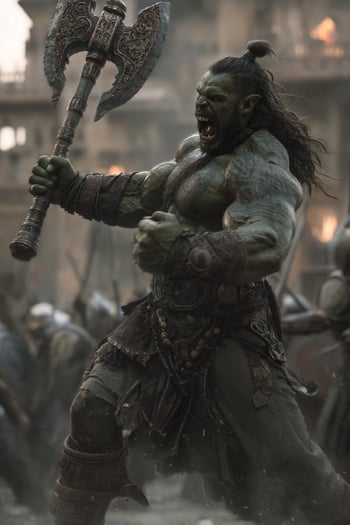
Physically, the Grendel are a formidable strain, distinguished by their massive frames and distinct pigmentation. The majority of the population exhibits green skin, a trait shared with their diminutive cousins, the Kuulik. However, variations are common, with gray and blue-skinned individuals appearing frequently; centuries of occasional cross-breeding have further produced a wide spectrum of intermediate skin tones.
Standing an average of 2 to 4 Kul (hands) taller than a typical human, their height is matched by a significantly greater physical bulk. Their ears are pointed, though this feature is notably less pronounced than the sharp, elongated ears of the Aelfes or the Kuulik. The Grendel biology is exceptionally resilient, specifically adapted to survive in the most punishing climates of Otan. They possess an innate resistance to inclement weather, a trait most evident in their ability to operate in polar conditions while wearing what other strains would consider summer garments, often with substantial flesh left bared to the freezing air.
This environmental hardiness allows them to endure the "frozen swamp" of their homeland, where disease and bitter cold are constant threats. While their standard lifespan and specific gravity preferences align with the broader human baseline, their physical endurance far exceeds it. They also seem to exhibit an unusually high tolerance to disease, undoubtedly a result of their long exposure to swamp insects.
In terms of raw power, the Grendel are universally recognized as unusually strong due to their sheer size and muscle density. However, there is a distinct biological tier within their population known as Brutes. While the average Grendel is powerful, only those who manifest as Brutes possess truly "unnatural" strength, a transformative state that tips the scales of battle. Like the Brutes found in other strains, such as the Aelfes or the Aydahar, Grendel Brutes are the heavy-hitters of their society, providing the martial muscle that historically fueled the Grendel War and continues to define their strength-based festivities today.
Natural and Latent Abilities
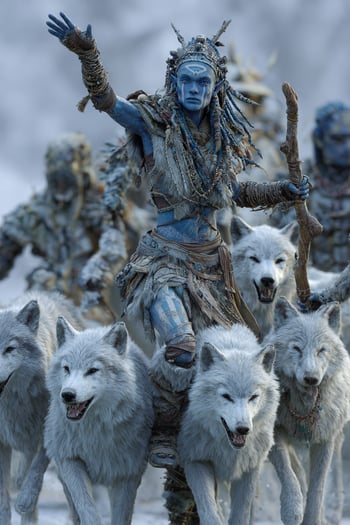
Like other human strains, the Grendel possess no inherently magical or supernatural abilities, though their physiology has been profoundly shaped by the environments they inhabit. Their survival in a disease-ridden, frozen marshland has fostered a robust natural resistance to both extreme cold and common pathogens. While this hardiness is a defining trait of the strain, it is often viewed by their own Sophists as an adaptive biological response, one that any human population might theoretically develop if subjected to the same punishing living conditions for several generations.
In the field, this manifests as a remarkable tolerance for sub-zero temperatures. It is common to see Grendel laborers or warriors operating in polar conditions with bared flesh, dressed in what other nations would consider light summer garments. This innate resilience allows them to maintain their legendary strength and productivity in climates that would quickly incapacitate more temperate-dwelling strains. Their resistance to disease is equally notable, serving as a vital defense against the various blights that fester in the stagnant, thawing sections of their swampy homeland.
History
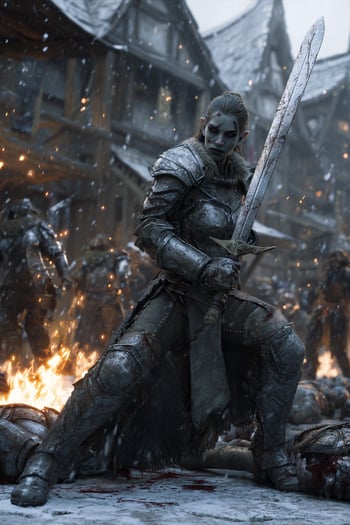
In the decades following the Great Erasure, the Grendel found themselves adrift in a hostile world, struggling to define their place among the shifting powers of Otan. Their initial approach was one of diplomacy; they sought to secure their future through tireless negotiations with their human neighbors, dispatching envoys to establish formal trade deals and secure resources for their resource-poor frozen marshland. However, these efforts were met with systemic indifference. Most Grendel embassies returned with empty hands, as the surrounding nations remained wary of the strain’s imposing physical presence and alien customs.
During this period of isolation, Grendel leadership was governed by the Kosbassi, a title held by a leader chosen by right of might in single combat. Unlike a typical kratocracy, the Grendel evolved a sophisticated set of rules to ensure that strength was paired with leadership; only the most meritorious individuals, those who had proven their service and strategic value, were permitted to challenge for the position.
As the "Old Ways" of tradition and isolationist survival seemed doomed to fail against the rising pressures of the outside world, the tide shifted toward total conflict. The Grendel War erupted as an armed uprising led by the warlock Zorhan Zhanat, whose fanatical leadership and mastery of destructive magic turned a struggle for resources into a crusade for Grendel liberation. This war saw the rise of legendary figures like Batil Zhurek, who earned his status as a war hero in the defense of Ortalyk before eventually ascending to the position of Tsar.
The conflict eventually reached its breaking point, leading to the capitulation of the Grendel forces and a definitive end to the bloodshed. Peace was formalized through the signing of the Treaty of Kala Astanals, an agreement named for the imperial city and educational heart of Otan where the terms were likely negotiated. Today, the Grendel remain at peace with their neighbors, though the scars of the war and the strictures of the treaty continue to influence their trade-heavy relationship with nations like the Ungirsi Federation. This peace has allowed for the slow transition of Grendel culture, as the militant zealotry born in the fires of the war begins to settle into the structured worship of Otoy.
Grendel Substrains
Kalas Grendel Substrain
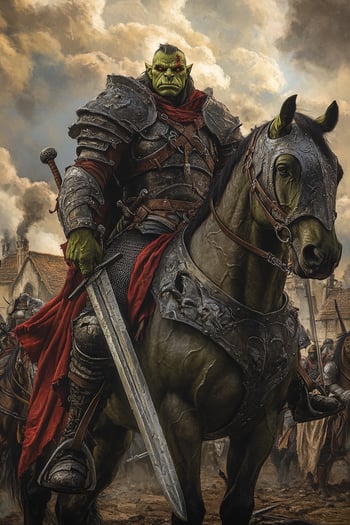
Description:The Kalas Grendel (🔊 KAL-as GREN-duhl) are the backbone of Grendel society, making up the population of cities. They are the traders responsible for fueling the economy.
Overview:The Kalas Grendel (Homo Orcus Urbanus) represent the only nationally organized substrain of their kind. Whether or not they form the majority population in a given settlement, they are the undisputed architects of the Grendel world, responsible for the sophisticated planning of everything from intricate plumbing systems to formidable defensive walls. Their civilization is anchored by their greatest inland stronghold, Sogis Kalasi, a capital situated far from the reach of coastal incursions to ensure the safety of their urban heartland.
Despite their inland focus, the Kalas maintain a specialized navy comprised of small, swift attack vessels. These ships are not designed for protracted broadsides or naval endurance; rather, they serve as delivery systems intended to bring Grendel boarding parties into immediate, devastating contact with enemy crews.
This martial readiness exists alongside a complicated political landscape. Since the conclusion of the Grendel War, their former revolutionary leader, Zorhan Zhanat, has retreated from public life entirely to join the mysterious Council of Nine. In his absence, the Kalas have adopted a restless political cycle, undergoing a rigorous selection process to choose a new leader at the close of every year before entering the Holy Days.
Modern Kalas society is a study in dualities, split between pragmatism and lingering resentment. While a significant portion of the population works tirelessly to open and stabilize international trade routes, others, some in secret, others with increasing boldness, vow to ignite a fresh war to reclaim perceived lost glory. This tension is mirrored in their spiritual life: while they remain traditional Wodenists at their core, the streets of Sogis Kalasi see more and more Otoy zealotry each year. This rising redemptive fervor threatens to fully eclipse the old ways of hospitality and vengeance, pushing the Homo Orcus Urbanus toward an uncertain, militant future.
Maerc Grendel Substrain
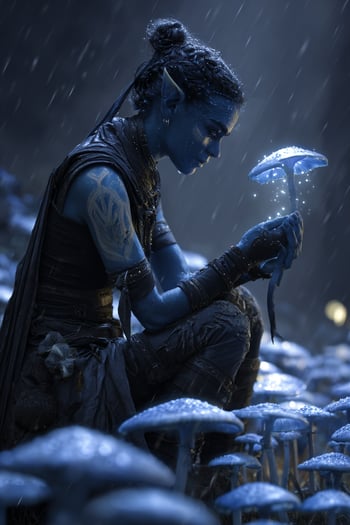
Description:The Maerc Grendel (🔊 MARK GREN-duhl) are the most numerous of the Grendel strain, though they are the least seen; making their homes in the inhospitable swamplands.
Overview:The Maerc Grendel (Homo Orcus Palustris) are living anomalies within the Grendel strain. While their Kalas and Sogis cousins display more common natural pigmentations, the Maerc possess a striking blue skin tone, ranging from pale azure to a deep, evening horizon blue, a coloration rarely found in the natural world. Physiologically, they share the same massive frames and pointed ears as their kin, yet their unique adaptation allows them to thrive in an environment that most land mammals would find utterly unbearable.
They inhabit the dense, disease-ridden swamps of Maercland, a terrain of constant murk and unstable ground. To survive the rising waters and predatory mire, the Maerc have mastered the art of elevated construction, using stilts, piles, and living trees to suspend their small, tight-knit communities above the swamp floor. This precarious lifestyle requires a constant maintenance of their structures and a deep understanding of the marshland’s shifting topography, cementing their reputation as the most environmentally resilient of the Grendel substrains.
Their survival strategies shift dramatically with the seasons. During the humid summer months, they navigate the waterways in light skiffs, utilizing specialized non-traditional hunting techniques to harvest the bounty of the marsh. However, it is during the frozen winters that the Maerc display their most fearsome traits; they deliberately rouse swamp beasts and other lethal creatures from their hibernation to hunt them. In these winter forays, they are often seen working in tandem with Woolly Rhinos and trained wolves, turning the frozen swamp into a coordinated theater of high-stakes predation.
Sogis Grendel Substrain
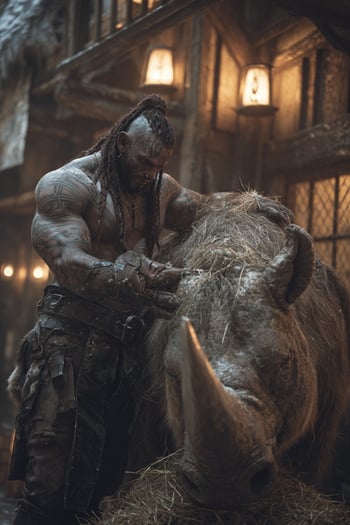
Description:The Sogis Grendel (🔊 SOH-jiss GREN-duhl) are the hill-folk of the Grendel strain. They make up the bulk of Maercland's military might by providing the most warriors.
Overview:The Sogis Grendel (Homo Orcus Collinus) are the rugged hill-folk of the Grendel strain and the primary source of the nation’s terrestrial power. While their metropolitan cousins handle the administration of the state, the Sogis provide the overwhelming bulk of the military might, fielding the vast majority of the warriors that defend the Grendel borders. Unlike the urbanized Kalas, they avoid traditional settlements entirely, preferring a decentralized, rural existence scattered across the harsh elevations of the hills.
Survival for the Homo Orcus Collinus is a matter of constant labor, as the difficult terrain makes traditional agriculture nearly impossible. Instead, they sustain themselves by hunting wild game and foraging for whatever plant protein the highlands offer. They are most famous, however, for their mastery of animal husbandry; the Sogis have a unique penchant for raising and breeding Woolly Rhinos in captivity, utilizing these massive beasts as both beasts of burden and formidable assets in times of conflict.
Though they value their independence, the Sogis Grendel regularly seek out brief, intense moments of community. They gather periodically for great congregations where they feast, trade news, and share gossip. These gatherings serve as essential hubs for education and training, featuring rigorous games and spectacles that test their physical strength, riding skills, and prowess at the forge. In these congregations, leadership is informal and fleeting; they acknowledge no permanent rulers, instead paying deference to the "strongest" among them, who acts as a temporary leader and arbiter for the duration of the assembly.
Grendel Occupied Regions
Maercland
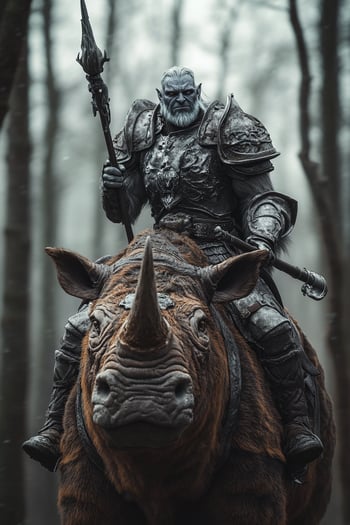
Description: Maercland (🔊 MARK-land) sits on the northern coast, with the Ungirsi Federation on its southern border and Soltustik to the west. It is Grendel territory.
Overview: Coming Soon
| Copyright © 2021-2026 by Robyn Blaber and Will to Power Games. All rights reserved. Content on this website may not be reproduced without written permission of the copyright owner. |
