Kalas Grendel: Difference between revisions
Robyn.Blaber (talk | contribs) Created page with "{{Infobox substrain | name = Kalas Grendel | strain = Grendel | image = https://imagedelivery.net/TNzzP2IqyQLYoHEs2ZN5aQ/89f4b41b-36ab-451a-a5b9-f2e27e310a00/wiki#.png | caption = The Kalas Grendel (🔊 KAL-as GREN-duhl) are the backbone of Grendel society, making up the population of cities. They are the traders responsible for fueling the economy. | scientific = Homo Orcus Urbanus | plural = Kalas Grendel | p..." |
Robyn.Blaber (talk | contribs) No edit summary |
||
| Line 2: | Line 2: | ||
| name = [[Kalas Grendel]] | | name = [[Kalas Grendel]] | ||
| strain = [[Grendel]] | | strain = [[Grendel]] | ||
| image = https://imagedelivery.net/TNzzP2IqyQLYoHEs2ZN5aQ/ | | image = https://imagedelivery.net/TNzzP2IqyQLYoHEs2ZN5aQ/0e1ddaa5-ea59-47e8-ca95-741c68bd5c00/wiki#.png | ||
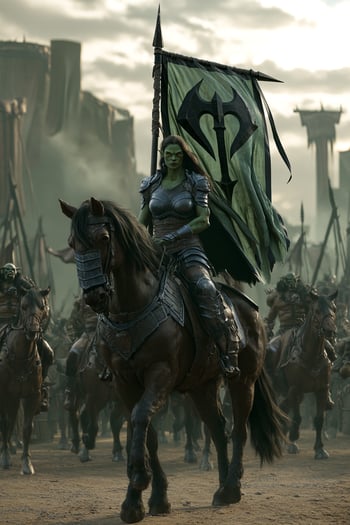
| caption = The [[Kalas Grendel]] (🔊 KAL-as GREN-duhl) are the backbone of [[Grendel]] society, making up the population of cities. They are the traders responsible for fueling the economy. | | caption = The [[Kalas Grendel]] (🔊 KAL-as GREN-duhl) are the backbone of [[Grendel]] society, making up the population of cities. They are the traders responsible for fueling the economy. | ||
| scientific = Homo Orcus Urbanus | | scientific = Homo Orcus Urbanus | ||
| Line 36: | Line 36: | ||
== Physical Characteristics == | == Physical Characteristics == | ||
{{LoreImage|#.png|350px|left}} | {{LoreImage|https://imagedelivery.net/TNzzP2IqyQLYoHEs2ZN5aQ/a3f3b216-59a8-44e7-75a7-53fa98593800/wiki#.png|350px|left}} | ||
The [[Kalas Grendel]] share the formidable physicality of the wider [[Grendel]] strain. They are massive compared with humans, standing an average of two to four Kul taller and carrying considerably greater bulk and muscle. Their skin is most commonly green, though gray and blue tones occur among the broader [[Grendel]] population, with centuries of occasional interbreeding producing other shades. Their ears are pointed, but less dramatically so than those of [[Aelf]]es or [[Kuulik]]. | |||
Kalas physiology is built for the same harsh world as their kin. They possess an unusual tolerance for cold, allowing them to work in freezing conditions with remarkably little protection, and their long exposure to the diseased swamps of [[Maercland]] has given them a strong resistance to common pathogens. They are naturally powerful even without the specialized transformation of the [[Grendel]] [[Brute]], although [[Brute]]s among the Kalas provide the same extraordinary physical strength found elsewhere in the strain. | |||
The Kalas are also distinguished less by any unique biological mutation than by what they do with the physical advantages they share with other [[Grendel]]. Their size and strength make them effective laborers and warriors, while their patience and aptitude for engineering have made them exceptional builders, smiths, and [[Tinker]]s. Kalas steel is among the strongest produced by the [[Grendel]], and their smiths are particularly well equipped to turn that material toward weapons and the defense of their cities. | |||
{{-}} | {{-}} | ||
== [[Kalas Grendel]] Culture == | == [[Kalas Grendel]] Culture == | ||
{{LoreImage|#.png|350px|left}} | {{LoreImage|https://imagedelivery.net/TNzzP2IqyQLYoHEs2ZN5aQ/cf285ebe-7c58-4979-4e10-193ab87ec400/wiki#.png|350px|left}} | ||
The Kalas are the city folk of the [[Grendel]], and much of [[Grendel]] civilization would simply not function without them. They are the architects, builders, traders, engineers, and organizers who turn a hostile homeland into something that can support millions of people. Their work ranges from plumbing and public infrastructure to walls, fortifications, gun emplacements, and the machinery of war. When the [[Grendel]] are under threat, Kalas leaders traditionally step forward to coordinate the nation. | |||
Their technological culture is particularly strong. Kalas [[Tinker]]s developed and employed cannons during the [[Grendel]] War, while [[Wizard]]s, [[Knight]]s, and [[Brute]]s defended the cities behind them. During the war, [[Human]] forces that managed to penetrate [[Grendel]] defensive lines sometimes discovered that the city itself was only the beginning of the fight. Kalas gun crews, fortified positions, and magical defenders could turn streets and towers into another battlefield. | |||
Metalworking is another source of Kalas pride. [[Grendel]] steel is renowned across [[Otan]] for its exceptional strength, and Kalas smiths produce steel equal in quality to that of the [[Sogis]], if somewhat less refined. The result is a natural partnership between the Kalas appetite for engineering and their mastery of metallurgy: weapons, armor, cannons, fortifications, and other machines are all opportunities to make something stronger than it was yesterday. | |||
Yet Kalas society is not defined entirely by war. They are the [[Grendel]] traders, and a substantial part of their modern effort is directed toward establishing international commerce and securing the resources their homeland cannot easily provide. At the same time, memories of the [[Grendel]] War remain close to the surface. Some Kalas see renewed trade as the path forward, while others still speak openly or quietly of another war and the recovery of what they believe the [[Grendel]] lost. Their traditional [[Woden]]ist hospitality and its harsh expectation of vengeance when trust is broken now compete with the growing worship of [[Otoy]], particularly among younger [[Grendel]]. | |||
This tension reaches into Kalas politics. The Kosbassi has traditionally been chosen through a system of single combat governed by rules intended to ensure that physical strength is accompanied by military service, loyalty, and strategic ability. Serious challenges for the position are generally the province of the Kalas, making leadership contests as much a test of political worth as physical power. Since Zorhan Zhanat's departure from public life, the Kalas have continued to wrestle with what kind of leadership should guide the [[Grendel]] into the future. | |||
{{-}} | {{-}} | ||
== [[Kalas Grendel]] Geography == | == [[Kalas Grendel]] Geography == | ||
{{LoreImage|#.png|350px|right}} | {{LoreImage|https://imagedelivery.net/TNzzP2IqyQLYoHEs2ZN5aQ/35c0ab59-e788-4c6f-691c-b25a25a8a100/wiki#.png|350px|right}} | ||
The [[Kalas Grendel]] are primarily an urban people, concentrated in the cities and strongholds of [[Maercland]]. Their homeland is one of the harshest environments in [[Otan]]: cold swampland dominates the south, while colder hill country occupies the north. Rather than retreat from this landscape, the Kalas answered it with construction. They continually build cities, fortifications, and other strongholds intended to make the territory defensible and livable. | |||
Their greatest center is [[Sogis Kalasi]], the inland capital described as the heart of Kalas civilization. Its position away from the coast reflects a practical concern for survival. The Kalas may maintain a navy, but their primary strength lies on land, where walls, artillery, engineering, and carefully planned cities allow them to turn difficult territory into defensible ground. | |||
Kalas settlements are therefore more than places where [[Grendel]] happen to live. They are expressions of the substrain's central purpose. [[Road]]s, walls, workshops, towers, plumbing, and defensive positions are all part of the same philosophy: if the land itself cannot be trusted to protect the [[Grendel]], the [[Grendel]] will build something that can. This approach has allowed the Kalas to establish the urban centers that form the backbone of [[Grendel]] society despite the poverty and environmental hardship of [[Maercland]]. | |||
The Kalas also maintain a limited maritime presence despite their inland orientation. Their vessels are small and fast, intended primarily to deliver [[Grendel]] boarding parties rather than fight prolonged naval engagements. The ships extend Kalas influence beyond their walls, but they remain another tool of the same defensive and martial culture that shapes their cities: get close, hit hard, and let someone else worry about building the ship afterward. | |||
{{-}} | {{-}} | ||
{{Copyright notice}} | {{Copyright notice}} | ||
[[Category:Substrains]] | [[Category:Substrains]] | ||
[[Category:Grendel Substrains]] | [[Category:Grendel Substrains]] | ||
Latest revision as of 22:20, 15 September 2026
| Scientific Name | Homo Orcus Urbanus |
|---|---|
| Plural | Kalas Grendel |
| Possessive | Kalas Grendel |
The Kalas Grendel (Homo Orcus Urbanus) represent the only nationally organized substrain of their kind. Whether or not they form the majority population in a given settlement, they are the undisputed architects of the Grendel world, responsible for the sophisticated planning of everything from intricate plumbing systems to formidable defensive walls. Their civilization is anchored by their greatest inland stronghold, Sogis Kalasi, a capital situated far from the reach of coastal incursions to ensure the safety of their urban heartland.
Despite their inland focus, the Kalas maintain a specialized navy comprised of small, swift attack vessels. These ships are not designed for protracted broadsides or naval endurance; rather, they serve as delivery systems intended to bring Grendel boarding parties into immediate, devastating contact with enemy crews.
This martial readiness exists alongside a complicated political landscape. Since the conclusion of the Grendel War, their former revolutionary leader, Zorhan Zhanat, has retreated from public life entirely to join the mysterious Council of Nine. In his absence, the Kalas have adopted a restless political cycle, undergoing a rigorous selection process to choose a new leader at the close of every year before entering the Holy Days.
Modern Kalas society is a study in dualities, split between pragmatism and lingering resentment. While a significant portion of the population works tirelessly to open and stabilize international trade routes, others, some in secret, others with increasing boldness, vow to ignite a fresh war to reclaim perceived lost glory. This tension is mirrored in their spiritual life: while they remain traditional Wodenists at their core, the streets of Sogis Kalasi see more and more Otoy zealotry each year. This rising redemptive fervor threatens to fully eclipse the old ways of hospitality and vengeance, pushing the Homo Orcus Urbanus toward an uncertain, militant future.
Physical Characteristics
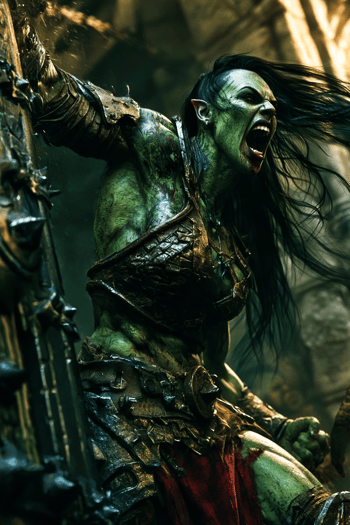
The Kalas Grendel share the formidable physicality of the wider Grendel strain. They are massive compared with humans, standing an average of two to four Kul taller and carrying considerably greater bulk and muscle. Their skin is most commonly green, though gray and blue tones occur among the broader Grendel population, with centuries of occasional interbreeding producing other shades. Their ears are pointed, but less dramatically so than those of Aelfes or Kuulik.
Kalas physiology is built for the same harsh world as their kin. They possess an unusual tolerance for cold, allowing them to work in freezing conditions with remarkably little protection, and their long exposure to the diseased swamps of Maercland has given them a strong resistance to common pathogens. They are naturally powerful even without the specialized transformation of the Grendel Brute, although Brutes among the Kalas provide the same extraordinary physical strength found elsewhere in the strain.
The Kalas are also distinguished less by any unique biological mutation than by what they do with the physical advantages they share with other Grendel. Their size and strength make them effective laborers and warriors, while their patience and aptitude for engineering have made them exceptional builders, smiths, and Tinkers. Kalas steel is among the strongest produced by the Grendel, and their smiths are particularly well equipped to turn that material toward weapons and the defense of their cities.
Kalas Grendel Culture
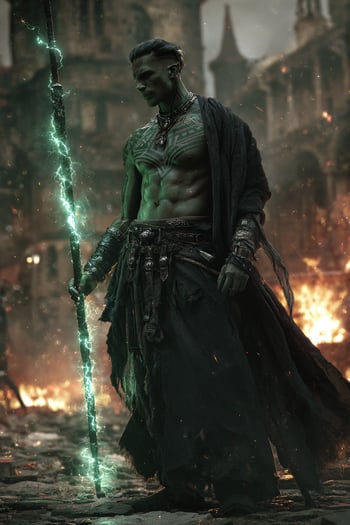
The Kalas are the city folk of the Grendel, and much of Grendel civilization would simply not function without them. They are the architects, builders, traders, engineers, and organizers who turn a hostile homeland into something that can support millions of people. Their work ranges from plumbing and public infrastructure to walls, fortifications, gun emplacements, and the machinery of war. When the Grendel are under threat, Kalas leaders traditionally step forward to coordinate the nation.
Their technological culture is particularly strong. Kalas Tinkers developed and employed cannons during the Grendel War, while Wizards, Knights, and Brutes defended the cities behind them. During the war, Human forces that managed to penetrate Grendel defensive lines sometimes discovered that the city itself was only the beginning of the fight. Kalas gun crews, fortified positions, and magical defenders could turn streets and towers into another battlefield.
Metalworking is another source of Kalas pride. Grendel steel is renowned across Otan for its exceptional strength, and Kalas smiths produce steel equal in quality to that of the Sogis, if somewhat less refined. The result is a natural partnership between the Kalas appetite for engineering and their mastery of metallurgy: weapons, armor, cannons, fortifications, and other machines are all opportunities to make something stronger than it was yesterday.
Yet Kalas society is not defined entirely by war. They are the Grendel traders, and a substantial part of their modern effort is directed toward establishing international commerce and securing the resources their homeland cannot easily provide. At the same time, memories of the Grendel War remain close to the surface. Some Kalas see renewed trade as the path forward, while others still speak openly or quietly of another war and the recovery of what they believe the Grendel lost. Their traditional Wodenist hospitality and its harsh expectation of vengeance when trust is broken now compete with the growing worship of Otoy, particularly among younger Grendel.
This tension reaches into Kalas politics. The Kosbassi has traditionally been chosen through a system of single combat governed by rules intended to ensure that physical strength is accompanied by military service, loyalty, and strategic ability. Serious challenges for the position are generally the province of the Kalas, making leadership contests as much a test of political worth as physical power. Since Zorhan Zhanat's departure from public life, the Kalas have continued to wrestle with what kind of leadership should guide the Grendel into the future.
Kalas Grendel Geography
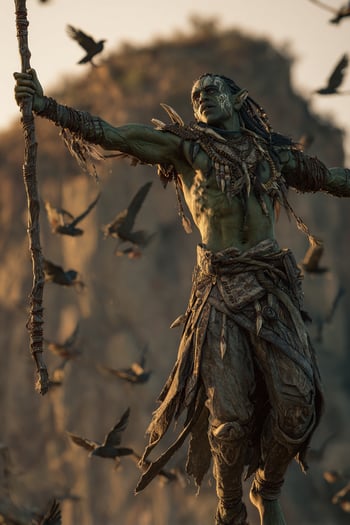
The Kalas Grendel are primarily an urban people, concentrated in the cities and strongholds of Maercland. Their homeland is one of the harshest environments in Otan: cold swampland dominates the south, while colder hill country occupies the north. Rather than retreat from this landscape, the Kalas answered it with construction. They continually build cities, fortifications, and other strongholds intended to make the territory defensible and livable.
Their greatest center is Sogis Kalasi, the inland capital described as the heart of Kalas civilization. Its position away from the coast reflects a practical concern for survival. The Kalas may maintain a navy, but their primary strength lies on land, where walls, artillery, engineering, and carefully planned cities allow them to turn difficult territory into defensible ground.
Kalas settlements are therefore more than places where Grendel happen to live. They are expressions of the substrain's central purpose. Roads, walls, workshops, towers, plumbing, and defensive positions are all part of the same philosophy: if the land itself cannot be trusted to protect the Grendel, the Grendel will build something that can. This approach has allowed the Kalas to establish the urban centers that form the backbone of Grendel society despite the poverty and environmental hardship of Maercland.
The Kalas also maintain a limited maritime presence despite their inland orientation. Their vessels are small and fast, intended primarily to deliver Grendel boarding parties rather than fight prolonged naval engagements. The ships extend Kalas influence beyond their walls, but they remain another tool of the same defensive and martial culture that shapes their cities: get close, hit hard, and let someone else worry about building the ship afterward.
| Copyright © 2021-2026 by Robyn Blaber and Will to Power Games. All rights reserved. Content on this website may not be reproduced without written permission of the copyright owner. |
