Tozakh: Difference between revisions
Robyn.Blaber (talk | contribs) Created page with "{{Infobox strain | title = Tozakh | subtitle = Player Strain | caption = The Tozakh (🔊 toe-ZAK) differ most notably from other humans in their propensity to grow horns and antlers. | strain = Tozakh | scientific = Homo Cornutus | plural = Tozakh | possessive = Tozakhi | substrains = Faun Tozakh, Infernal Tozakh | image = https://imagedelivery.net/TNzzP2IqyQLYoHEs2ZN5aQ/2b581ab1-3639-4df6-9213-13b4a6697900/wiki#.png | eyesight = | hearing =..." |
Robyn.Blaber (talk | contribs) No edit summary |
||
| (2 intermediate revisions by the same user not shown) | |||
| Line 8: | Line 8: | ||
| possessive = [[Tozakh]]i | | possessive = [[Tozakh]]i | ||
| substrains = [[Faun Tozakh]], [[Infernal Tozakh]] | | substrains = [[Faun Tozakh]], [[Infernal Tozakh]] | ||
| image = https://imagedelivery.net/TNzzP2IqyQLYoHEs2ZN5aQ/ | | image = https://imagedelivery.net/TNzzP2IqyQLYoHEs2ZN5aQ/0c7e048c-712a-470d-6141-81f556fe0300/wiki#.png | ||
| eyesight = | | eyesight = | ||
| hearing = | | hearing = | ||
| smell = | | smell = | ||
| height = | | height = 10-12 Kol (150-180 cm) | ||
| weight = | | weight = 6-8 Tas (60-80 kg) | ||
| wingspan = | | wingspan = | ||
| skin_color = | | skin_color = Fair, Porcelain, Medium | ||
| hair_color = | | hair_color = Black, Brown, Blonde, Red, Gray, White | ||
| feathers = | | feathers = | ||
| eye_color = | | eye_color = Brown, Blue, Grey, Hazel, Green | ||
| build = | | build = Average | ||
| distinctions = | | distinctions = Antlers or horns. | ||
| language = | | language = [[Tozakh]]i,[[Otan]]i | ||
| climate = | | climate = Alpine/Polar | ||
| terrain = | | terrain = Coastal,Mountains,Hills | ||
| location = | | location = [[Shuwalu]] | ||
| disposition = | | disposition = Insular | ||
}} | }} | ||
The [[Tozakh]] (Homo Cornutus) are a resilient northern people who have adapted to the harshest arctic conditions of [[Otan]]. While they appear physically indistinguishable from baseline humans in most respects, they are defined by a singular cranial abnormality: the growth of horns. This trait manifests in two distinct ways that divide their population by their sleep cycles. The diurnal [[Faun Tozakh]] are characterized by elegant, branching antler-like horns, while the nocturnal [[Infernal Tozakh]] possess thick, helical ram horns. | |||
This biological split has given rise to one of the most efficient economies in the world. The [[Tozakh]] occupy the same geographic spaces, but their settlements undergo a total transformation at sundown. A storefront managed by a Faun shopkeeper during the day will be staffed by an Infernal counterpart once the moon rises. Because every building, bed, and tool is utilized twenty-four hours a day, the [[Tozakh]] have mastered a dual-use society that minimizes waste and maximizes productivity. This seamless transition between day and night cycles allows their country, [[Shuwalu]], to operate with a mechanical precision that fascinates foreign merchants. | |||
Despite their industrious nature, the [[Tozakh]] are frequently the target of superstition. Outsiders have dubbed them "hellspawn," believing their horns to be the mark of a curse or a connection to the Nether World. Rather than fighting these labels, the insular [[Tozakh]] have leaned into the mystery to discourage unwanted visitors. They even named their homeland [[Shuwalu]], an ancient pseudonym for the Nether World, preferring to let frightening rumors flourish if it means being left to their own devices in the frozen north. | |||
Beyond their "infernal" reputation, the [[Tozakh]] maintain a profound closeness to the natural world, a bond many believe is linked to the sensory or spiritual capacity of their horns. This connection makes them the preeminent masters of animal husbandry in [[Otan]]. They breed and train some of the finest riding mounts in existence, and their horses are prized by knights across the continent for their unparalleled stamina, intelligence, and ability to thrive in extreme conditions. | |||
== Society and Culture == | == Society and Culture == | ||
{{LoreImage|#.png|350px|left}} | {{LoreImage|https://imagedelivery.net/TNzzP2IqyQLYoHEs2ZN5aQ/82b5b7a4-d41e-4df9-b5ad-0f3396b8d500/wiki#.png|350px|left}} | ||
[[Tozakh]] society is built upon a fundamental temporal divide: the diurnal Faun occupy the light of day while the nocturnal Infernal claim the dark of night. This split was adopted almost immediately following the Great Erasure and has remained virtually unchanged for centuries. Because their sleep cycles typically last eight hours or less, there is a natural window of overlap every twenty-four hours. | |||
This "crossover period" is the heartbeat of their civilization, allowing day-timers and night-timers to exchange information, update ledgers, and maintain the continuity of their shared lives. Their continuously roused existence makes the [[Tozakh]] a terrifying military prospect. While other nations utilize night raids or rotate weary sentries, an invader of [[Shuwalu]] must be prepared for "round-the-clock" warfare against fresh, fully awake ranks of soldiers at any hour. | |||
To sustain their relentless pace, the [[Tozakh]] utilize specialized galley wagons that prepare hot meals for front-line troops in the heat of battle, ensuring their warriors are at peak physical condition for non-stop carnage. For most of [[Otan]], the advice to leave this insular strain alone is not merely a suggestion; it is a survival tactic. | |||
The inner life of the [[Tozakh]] is reflected in art and music that carries a distinct "hint of the wild." Their music is notably louder and more percussive than that of any other strain, punctuated by driving rhythms that mirror the heartbeat of the frozen north. Similarly, their poetry eschews the flowery metaphors of the [[Aelf]]en for a style that is startlingly direct and to the point. While this raw, aggressive aesthetic is often a "nightmare" for [[Aelf]]en sensibilities, many human listeners find it astonishing and even praiseworthy for its unvarnished honesty. | |||
At the core of an individual’s life is the practice of "pairing." During their early years, [[Tozakh]] seek out a counterpart from the opposite cycle who shares their interests or professional goals. These day/night pairs, whether business partnerships or marriages, typically last a lifetime, as each individual becomes almost completely dependent on their partner to manage the "other half" of their shared existence. The loss of a partner in such a pairing is considered the most traumatic experience a [[Tozakh]] can endure; the survivor often faces a recovery period of many years, and some never truly regain their footing in a world that now feels half-empty. | |||
{{-}} | |||
== Physical Characteristics == | == Physical Characteristics == | ||
{{LoreImage|#.png|350px|left}} | {{LoreImage|https://imagedelivery.net/TNzzP2IqyQLYoHEs2ZN5aQ/ee15cef4-caf2-4685-eeed-cbbde3022400/wiki#.png|350px|left}} | ||
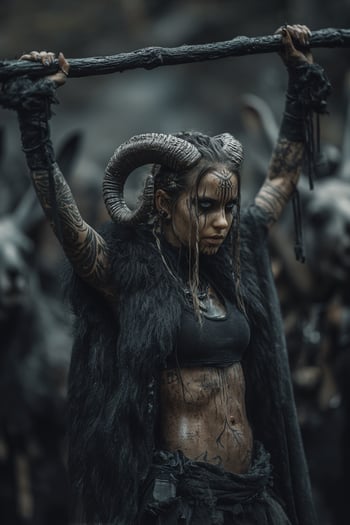
Physically, the [[Tozakh]] are indistinguishable from baseline humans in every respect save for the prominent horns that crown their heads. These structures are the defining mark of their lineage, though the biological rules governing them differ sharply between the two substrains. For the nocturnal [[Infernal Tozakh]], their helical ram-like horns are permanent fixtures grown over the course of a lifetime. While these horns continue to grow slowly throughout their years, they do not possess regenerative properties; if a horn is chipped or snapped in a frozen mountain accident or during the heat of battle, the broken segment is lost forever, leaving a permanent record of the individual's history on their head. | |||
In contrast, the [[Faun Tozakh]] undergoes a cyclic process of renewal that is as grueling as it is remarkable. Roughly once every decade, a Faun will "molt," a period where their antler-like horns are shed in a process that is notably painful and physically taxing. This is immediately followed by a second phase of significant discomfort as the new set begins to push through the skin. | |||
This regrowth period is a time of extreme vulnerability; if the soft, developing horn is damaged before it has fully hardened, it will fail to reach its full potential size, resulting in a stunted or asymmetrical rack for the duration of the following decade. Despite the biological cost of maintaining these structures, the [[Tozakh]] view their horns with immense pride, seeing them as a physical manifestation of their resilience against the arctic elements. Their skin, hair, and eye colors follow the same diverse patterns found in human populations, though the harsh northern climate of [[Shuwalu]] often results in a ruddy complexion from wind-burn and cold. | |||
{{-}} | {{-}} | ||
== Natural and Latent Abilities == | == Natural and Latent Abilities == | ||
{{LoreImage|#.png|350px|right}} | {{LoreImage|https://imagedelivery.net/TNzzP2IqyQLYoHEs2ZN5aQ/5d04bf19-3503-4454-6edc-0fd3adc32b00/wiki#.png|350px|right}} | ||
While the [[Tozakh]] lack wings or the powerful advantages of other strains, they possess a collection of environmental and cultural proficiencies that make them a formidable force in the northern wastes. To the eternal chagrin of the [[Aelf]]es, the [[Tozakh]] are the only culture in the world that views itself as artistically superior to the [[Aelf]]es. They dismiss the "stayed and metered" forms of [[Aelf]]en art as rigid and lifeless, preferring their own wild, raw expression. While this profound self-assurance is technically a social attitude, many outsiders view it as a functional ability; it provides the [[Tozakh]] with a mental fortification and cultural ego that makes them nearly impossible to intimidate or culturally assimilate. | |||
Physiologically, the [[Tozakh]] are built for the climate extremes of [[Shuwalu]]. Both the Faun and Infernal substrains possess a natural resistance to arctic weather, allowing them to remain active and precise in temperatures that would freeze a human or [[Aelf]] in their tracks. The nocturnal [[Infernal Tozakh]] further benefit from superior low-light vision, enabling them to navigate the treacherous, ice-slicked terrain of the north with the same confidence a daytime traveler has under a clear sun. | |||
Perhaps their most valuable latent ability is a deep, instinctual mastery of animal husbandry. This connection to the beasts of the field and stable is a core part of their identity, allowing them to raise some of the most exceptional livestock and riding mounts in [[Otan]]. A [[Tozakh]] trainer possesses a wordless rapport with their animals, resulting in horses and beasts of burden that are more loyal, hardy, and intelligent than those bred anywhere else. This talent ensures that while the [[Tozakh]] may be insular, the rest of the world will always be knocking at their frozen doors to trade for their legendary stallions. | |||
{{-}} | {{-}} | ||
== History == | == History == | ||
{{LoreImage|#.png|350px|right}} | {{LoreImage|https://imagedelivery.net/TNzzP2IqyQLYoHEs2ZN5aQ/889efd6f-c112-4422-de9f-509b73673f00/wiki#.png|350px|right}} | ||
The history of the [[Tozakh]] began in the immediate aftermath of the Great Erasure. As they rouse from the fog of the past, they quickly identified what outsiders perceived as a debilitating weakness, half the population being strictly nocturnal, and realized it could be leveraged into their greatest civilizational strength. By leaning into their natural rhythms, they established the dual-cycle economy that defines them today. | |||
[[Tozakh]] history is also shaped by a deliberate embrace of their insular instincts; rather than viewing their isolationism as a drawback, they treated it as a "feature" of their national identity. This led to a firm decision against maintaining an expansive navy. While [[Shuwalu]] allows foreign trade to enter its ports, few [[Tozakh]] feel the urge to leave their homeland on indefinite voyages. However, they have put a few highly capable ships to sea to patrol their coastline, manned by day/night crews that make these vessels functionally tireless. | |||
Despite their formidable military preparations, the [[Tozakh]] have never officially been to war since the Great Erasure. While they have successfully repelled various raiders crossing their borders, their standing military and border patrols have never seen full field combat. This lack of a combat record does not imply weakness; rather, it reflects a society so efficiently guarded that few find it worth the risk of a full-scale invasion. They remain a mystery to the rest of [[Otan]], a silent power that watches the world from behind an impenetrable wall of ice and suspicion. | |||
During the [[Grendel]] War, the [[Tozakh]] were approached by embassies from both [[Maercland]] and [[Soltustik]], representing the [[Grendel]] and [[Human]] interests, respectively. The [[Tozakh]] were notably surprised by the [[Grendel]] embassy; despite their "hellspawn" nickname, they are biologically much closer to humans. The diplomats from [[Maercland]] attempted to stir resentment, suggesting that the [[Tozakh]] had been "forced" into the absolute worst, most frozen territory of [[Otan]]. | |||
Coming to terms with their geography raised existential questions that still haunt [[Tozakh]] [[Sophist]]s: Were they exiled to the north, or did their own insular nature lead them to migrate there voluntarily before the Great Erasure? Ultimately, they found no answers in their fragmented history. Choosing caution over conflict, they sat out the [[Grendel]] War entirely, though they paid incredibly close attention to the shifting tides of power beyond their borders. | |||
{{-}} | {{-}} | ||
| Line 57: | Line 83: | ||
=== [[Faun Tozakh]] Substrain === | === [[Faun Tozakh]] Substrain === | ||
{{LoreImage|#.png|350px|right}} | {{LoreImage|https://imagedelivery.net/TNzzP2IqyQLYoHEs2ZN5aQ/6be2d934-bc5a-4de1-af1c-fa9eda103300/wiki#.png|350px|right}} | ||
'''Description:'''The [[ | '''Description:'''The [[Faun Tozakh]] (🔊 toe-ZAK) are a satyr-like substrain of the [[Tozakh]]. The most notable difference between the Faun and humans is their antlers, found on both men and women. | ||
'''Overview:'''The [[Faun Tozakh]] (Homo Cornutus Cervinus) are the diurnal stewards of [[Shuwalu]], defined by their majestic, antler-like horns and their tireless dedication to the daylit hours of the arctic north. They share the same physical hardiness as their Infernal kin, yet they are distinguished by the unique decennial molting of their antlers, a painful cycle of shedding and regrowth that serves as a recurring rite of passage. Because they are the face of the [[Tozakh]] most often encountered by foreign traders and diplomats, they act as the primary ambassadors of their culture, managing the markets, ports, and horse stables that bring the wealth of the world into their frozen territory. | |||
In a significant departure from the traditional [[Wodenism]] practiced by many of their neighbors, the [[Faun Tozakh]] have largely embraced the [[Cult of Personality]], specifically the worship of the centaur god [[Bloncamann]]. This theological shift is deeply rooted in their cultural identity as master equestrians and animal husbandmen. To a [[Faun Tozakh]], [[Bloncamann]] represents the ultimate synthesis of the rider and the mount, a divine ideal of the bond they share with their legendary horses. This devotion often manifests in their art and public iconography, where the image of the centaur god is elevated as the protector of the hearth and the patron of the northern fields. | |||
Within the dual-use structure of [[Tozakh]] society, the Faun are responsible for the vital groundwork of the nation. They manage the logistics of the day, ensuring that when the sun dips below the horizon and their Infernal partners wake, the transition is seamless. Their spiritual life under [[Bloncamann]] reinforces this sense of duty and physical excellence; for a Faun, the workday is a form of worship, and the health of their livestock is a direct reflection of their devotion. | |||
{{-}} | {{-}} | ||
=== [[Infernal Tozakh]] Substrain === | === [[Infernal Tozakh]] Substrain === | ||
{{LoreImage|#.png|350px|right}} | {{LoreImage|https://imagedelivery.net/TNzzP2IqyQLYoHEs2ZN5aQ/a848307f-983b-4ac1-b68a-5ccdae2af400/wiki#.png|350px|right}} | ||
'''Description:'''The [[Infernal Tozakh]] (🔊 toe-ZAK) live in the northernmost areas of [[Otan]]. They resemble humans in almost every way except their distinctive ram-like horns. | '''Description:'''The [[Infernal Tozakh]] (🔊 toe-ZAK) live in the northernmost areas of [[Otan]]. They resemble humans in almost every way except their distinctive ram-like horns. | ||
'''Overview:''' | '''Overview:'''The [[Infernal Tozakh]] (Homo Cornutus Caprinus) are the nocturnal heartbeat of [[Shuwalu]], distinguished by their thick, helical ram-like horns that grow continuously throughout their lives. As the guardians of the night, they wake as the sun sets to take over the shops, forges, and watchtowers vacated by their Faun partners. This permanent nocturnal lifestyle has granted them a natural comfort with the dark and a stoic temperament. Because their horns do not molt but instead carry the permanent scars and chips of their life’s struggles, the [[Infernal Tozakh]] are often viewed as the more grizzled and battle-hardened half of the [[Tozakh]] pairing. | ||
Spiritually, the [[Infernal Tozakh]] have remained steadfast in their adherence to [[Wodenism]], though their practice focuses almost exclusively on the figure of [[Loki]]. [[Un]]like other cultures that might view the Trickster with suspicion, the [[Infernal Tozakh]] revere him as the "Tortured God." Their theology is built upon the somber assumption that [[Loki]] suffers every moment at the hands of the other gods, enduring an eternal, agonizing imprisonment. | |||
This focus on divine suffering resonates deeply with the [[Infernal Tozakh]], who see their own survival in the unforgiving, freezing darkness as a reflection of [[Loki]]’s endurance. To them, the "Tortured God" is not a villain, but a sympathetic figure of resilience whose silent pain mirrors the hardships of the arctic night. This religious outlook deeply influences their cultural behavior, leading to a society that values silence, endurance, and the ability to carry heavy burdens without complaint. | |||
While their Faun counterparts celebrate the vitality of [[Bloncamann]] during the day, the [[Infernal Tozakh]] spend their hours in the moonlit forges or on the windswept borders, often performing silent rituals of solidarity with their shackled god. Their poetry and songs, usually performed in the low hum of the night-markets, frequently dwell on themes of hidden strength and the nobility of enduring what cannot be changed. | |||
{{-}} | |||
== [[Tozakh]]i Occupied Regions == | |||
=== [[Shuwalu]] === | |||
{{LoreImage|https://imagedelivery.net/TNzzP2IqyQLYoHEs2ZN5aQ/14b14d60-990d-4d55-96b7-b44bcd72bc00/wiki#.png|350px|right}} | |||
'''Description:''' The [[Shuwalu]] (🔊 shoo-WALL-oo) Brotherhood is a frozen northern refuge for the [[Tozakh]] people. It borders the [[Batis]] and [[Soltustik]] nations. | |||
'''Overview:''' There is a popular belief across [[Otan]] that [[Shuwalu]] is the gateway to the Nether Lands and the [[Tozakh]] are Daemons, put on the world to usher the living and the dead to the next life. The [[Tozakh]] who inhabit [[Shuwalu]] don't often see the upside of visitors, especially raiders, and would much rather keep [[Shuwalu]] free of them. They do little, if anything, to dissipate these rumors, preferring the protective shield of superstition to foreign interference. | |||
Further adding to these rumors is the very real nature of their settlements, which tend to shock the first-time visitor. Their cities are built in concentric rings dug deep into the earth, an architectural design engineered specifically to protect from northern predators and potential invaders, as only one ring of the city can ever be attacked at once. The outer ring houses most of the settlement's heavy defenses, while the core business and civic infrastructure are found closer to the central hubs. Visitors, awestruck by the shadowy earthen architecture, frequently compare this design to cities seen or imagined in the Nether World. | |||
The other striking difference is that [[Tozakh]] settlements are aggressively alive every hour of the day. Some metropolitan cities across [[Otan]] claim they never sleep, but in [[Shuwalu]] this is both a literal truth and a governing maxim. Not a single settlement, business, or public endeavor ever halts its work, except perhaps on sacred holy days. | |||
{{-}} | {{-}} | ||
{{Copyright notice}} | {{Copyright notice}} | ||
[[Category:Strains]] | [[Category:Strains]] | ||
Latest revision as of 18:53, 28 July 2026
| Strain | Tozakh |
|---|---|
| Scientific name | Homo Cornutus |
| Plural | Tozakh |
| Possessive | Tozakhi |
| Substrains | Faun Tozakh, Infernal Tozakh |
| Location | Shuwalu |
| Language | Tozakhi,Otani |
| Climate | Alpine/Polar |
| Terrain | Coastal,Mountains,Hills |
| Height | 10-12 Kol (150-180 cm) |
| Weight | 6-8 Tas (60-80 kg) |
| Skin Color | Fair, Porcelain, Medium |
| Hair Color | Black, Brown, Blonde, Red, Gray, White |
| Eye Color | Brown, Blue, Grey, Hazel, Green |
| Build | Average |
| Distinctions | Antlers or horns. |
| Disposition | Insular |
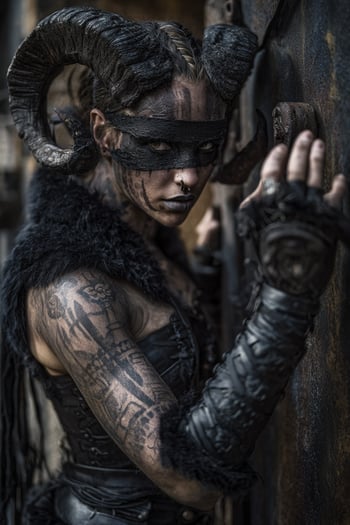
The Tozakh (Homo Cornutus) are a resilient northern people who have adapted to the harshest arctic conditions of Otan. While they appear physically indistinguishable from baseline humans in most respects, they are defined by a singular cranial abnormality: the growth of horns. This trait manifests in two distinct ways that divide their population by their sleep cycles. The diurnal Faun Tozakh are characterized by elegant, branching antler-like horns, while the nocturnal Infernal Tozakh possess thick, helical ram horns.
This biological split has given rise to one of the most efficient economies in the world. The Tozakh occupy the same geographic spaces, but their settlements undergo a total transformation at sundown. A storefront managed by a Faun shopkeeper during the day will be staffed by an Infernal counterpart once the moon rises. Because every building, bed, and tool is utilized twenty-four hours a day, the Tozakh have mastered a dual-use society that minimizes waste and maximizes productivity. This seamless transition between day and night cycles allows their country, Shuwalu, to operate with a mechanical precision that fascinates foreign merchants.
Despite their industrious nature, the Tozakh are frequently the target of superstition. Outsiders have dubbed them "hellspawn," believing their horns to be the mark of a curse or a connection to the Nether World. Rather than fighting these labels, the insular Tozakh have leaned into the mystery to discourage unwanted visitors. They even named their homeland Shuwalu, an ancient pseudonym for the Nether World, preferring to let frightening rumors flourish if it means being left to their own devices in the frozen north.
Beyond their "infernal" reputation, the Tozakh maintain a profound closeness to the natural world, a bond many believe is linked to the sensory or spiritual capacity of their horns. This connection makes them the preeminent masters of animal husbandry in Otan. They breed and train some of the finest riding mounts in existence, and their horses are prized by knights across the continent for their unparalleled stamina, intelligence, and ability to thrive in extreme conditions.
Society and Culture
Tozakh society is built upon a fundamental temporal divide: the diurnal Faun occupy the light of day while the nocturnal Infernal claim the dark of night. This split was adopted almost immediately following the Great Erasure and has remained virtually unchanged for centuries. Because their sleep cycles typically last eight hours or less, there is a natural window of overlap every twenty-four hours.
This "crossover period" is the heartbeat of their civilization, allowing day-timers and night-timers to exchange information, update ledgers, and maintain the continuity of their shared lives. Their continuously roused existence makes the Tozakh a terrifying military prospect. While other nations utilize night raids or rotate weary sentries, an invader of Shuwalu must be prepared for "round-the-clock" warfare against fresh, fully awake ranks of soldiers at any hour.
To sustain their relentless pace, the Tozakh utilize specialized galley wagons that prepare hot meals for front-line troops in the heat of battle, ensuring their warriors are at peak physical condition for non-stop carnage. For most of Otan, the advice to leave this insular strain alone is not merely a suggestion; it is a survival tactic.
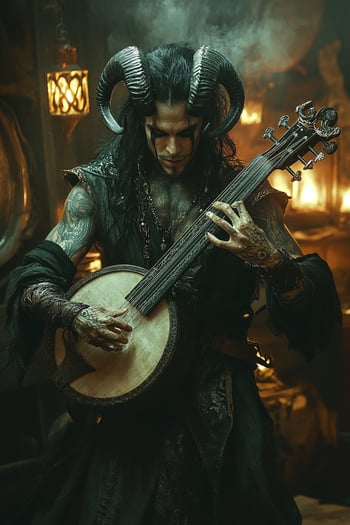
The inner life of the Tozakh is reflected in art and music that carries a distinct "hint of the wild." Their music is notably louder and more percussive than that of any other strain, punctuated by driving rhythms that mirror the heartbeat of the frozen north. Similarly, their poetry eschews the flowery metaphors of the Aelfen for a style that is startlingly direct and to the point. While this raw, aggressive aesthetic is often a "nightmare" for Aelfen sensibilities, many human listeners find it astonishing and even praiseworthy for its unvarnished honesty.
At the core of an individual’s life is the practice of "pairing." During their early years, Tozakh seek out a counterpart from the opposite cycle who shares their interests or professional goals. These day/night pairs, whether business partnerships or marriages, typically last a lifetime, as each individual becomes almost completely dependent on their partner to manage the "other half" of their shared existence. The loss of a partner in such a pairing is considered the most traumatic experience a Tozakh can endure; the survivor often faces a recovery period of many years, and some never truly regain their footing in a world that now feels half-empty.
Physical Characteristics
Physically, the Tozakh are indistinguishable from baseline humans in every respect save for the prominent horns that crown their heads. These structures are the defining mark of their lineage, though the biological rules governing them differ sharply between the two substrains. For the nocturnal Infernal Tozakh, their helical ram-like horns are permanent fixtures grown over the course of a lifetime. While these horns continue to grow slowly throughout their years, they do not possess regenerative properties; if a horn is chipped or snapped in a frozen mountain accident or during the heat of battle, the broken segment is lost forever, leaving a permanent record of the individual's history on their head.
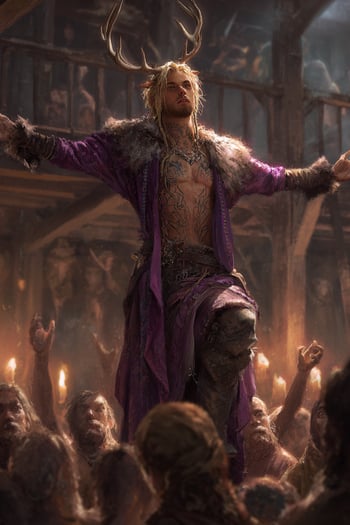
In contrast, the Faun Tozakh undergoes a cyclic process of renewal that is as grueling as it is remarkable. Roughly once every decade, a Faun will "molt," a period where their antler-like horns are shed in a process that is notably painful and physically taxing. This is immediately followed by a second phase of significant discomfort as the new set begins to push through the skin.
This regrowth period is a time of extreme vulnerability; if the soft, developing horn is damaged before it has fully hardened, it will fail to reach its full potential size, resulting in a stunted or asymmetrical rack for the duration of the following decade. Despite the biological cost of maintaining these structures, the Tozakh view their horns with immense pride, seeing them as a physical manifestation of their resilience against the arctic elements. Their skin, hair, and eye colors follow the same diverse patterns found in human populations, though the harsh northern climate of Shuwalu often results in a ruddy complexion from wind-burn and cold.
Natural and Latent Abilities
While the Tozakh lack wings or the powerful advantages of other strains, they possess a collection of environmental and cultural proficiencies that make them a formidable force in the northern wastes. To the eternal chagrin of the Aelfes, the Tozakh are the only culture in the world that views itself as artistically superior to the Aelfes. They dismiss the "stayed and metered" forms of Aelfen art as rigid and lifeless, preferring their own wild, raw expression. While this profound self-assurance is technically a social attitude, many outsiders view it as a functional ability; it provides the Tozakh with a mental fortification and cultural ego that makes them nearly impossible to intimidate or culturally assimilate.
Physiologically, the Tozakh are built for the climate extremes of Shuwalu. Both the Faun and Infernal substrains possess a natural resistance to arctic weather, allowing them to remain active and precise in temperatures that would freeze a human or Aelf in their tracks. The nocturnal Infernal Tozakh further benefit from superior low-light vision, enabling them to navigate the treacherous, ice-slicked terrain of the north with the same confidence a daytime traveler has under a clear sun.
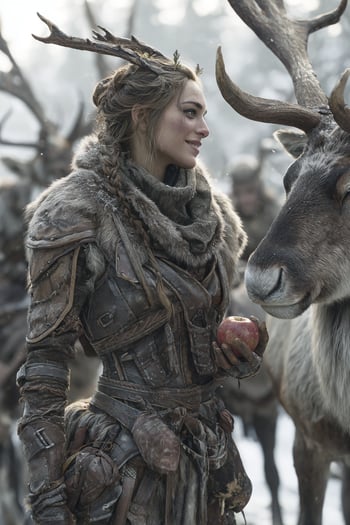
Perhaps their most valuable latent ability is a deep, instinctual mastery of animal husbandry. This connection to the beasts of the field and stable is a core part of their identity, allowing them to raise some of the most exceptional livestock and riding mounts in Otan. A Tozakh trainer possesses a wordless rapport with their animals, resulting in horses and beasts of burden that are more loyal, hardy, and intelligent than those bred anywhere else. This talent ensures that while the Tozakh may be insular, the rest of the world will always be knocking at their frozen doors to trade for their legendary stallions.
History
The history of the Tozakh began in the immediate aftermath of the Great Erasure. As they rouse from the fog of the past, they quickly identified what outsiders perceived as a debilitating weakness, half the population being strictly nocturnal, and realized it could be leveraged into their greatest civilizational strength. By leaning into their natural rhythms, they established the dual-cycle economy that defines them today.
Tozakh history is also shaped by a deliberate embrace of their insular instincts; rather than viewing their isolationism as a drawback, they treated it as a "feature" of their national identity. This led to a firm decision against maintaining an expansive navy. While Shuwalu allows foreign trade to enter its ports, few Tozakh feel the urge to leave their homeland on indefinite voyages. However, they have put a few highly capable ships to sea to patrol their coastline, manned by day/night crews that make these vessels functionally tireless.
Despite their formidable military preparations, the Tozakh have never officially been to war since the Great Erasure. While they have successfully repelled various raiders crossing their borders, their standing military and border patrols have never seen full field combat. This lack of a combat record does not imply weakness; rather, it reflects a society so efficiently guarded that few find it worth the risk of a full-scale invasion. They remain a mystery to the rest of Otan, a silent power that watches the world from behind an impenetrable wall of ice and suspicion.
During the Grendel War, the Tozakh were approached by embassies from both Maercland and Soltustik, representing the Grendel and Human interests, respectively. The Tozakh were notably surprised by the Grendel embassy; despite their "hellspawn" nickname, they are biologically much closer to humans. The diplomats from Maercland attempted to stir resentment, suggesting that the Tozakh had been "forced" into the absolute worst, most frozen territory of Otan.
Coming to terms with their geography raised existential questions that still haunt Tozakh Sophists: Were they exiled to the north, or did their own insular nature lead them to migrate there voluntarily before the Great Erasure? Ultimately, they found no answers in their fragmented history. Choosing caution over conflict, they sat out the Grendel War entirely, though they paid incredibly close attention to the shifting tides of power beyond their borders.
Tozakhi Substrains
Faun Tozakh Substrain
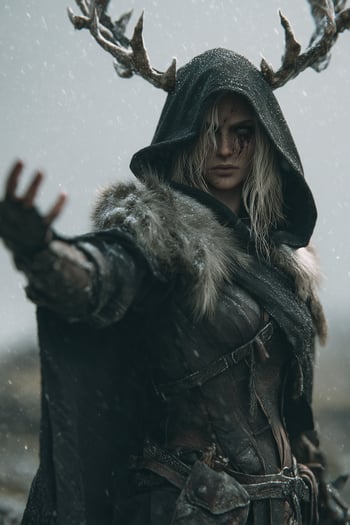
Description:The Faun Tozakh (🔊 toe-ZAK) are a satyr-like substrain of the Tozakh. The most notable difference between the Faun and humans is their antlers, found on both men and women.
Overview:The Faun Tozakh (Homo Cornutus Cervinus) are the diurnal stewards of Shuwalu, defined by their majestic, antler-like horns and their tireless dedication to the daylit hours of the arctic north. They share the same physical hardiness as their Infernal kin, yet they are distinguished by the unique decennial molting of their antlers, a painful cycle of shedding and regrowth that serves as a recurring rite of passage. Because they are the face of the Tozakh most often encountered by foreign traders and diplomats, they act as the primary ambassadors of their culture, managing the markets, ports, and horse stables that bring the wealth of the world into their frozen territory.
In a significant departure from the traditional Wodenism practiced by many of their neighbors, the Faun Tozakh have largely embraced the Cult of Personality, specifically the worship of the centaur god Bloncamann. This theological shift is deeply rooted in their cultural identity as master equestrians and animal husbandmen. To a Faun Tozakh, Bloncamann represents the ultimate synthesis of the rider and the mount, a divine ideal of the bond they share with their legendary horses. This devotion often manifests in their art and public iconography, where the image of the centaur god is elevated as the protector of the hearth and the patron of the northern fields.
Within the dual-use structure of Tozakh society, the Faun are responsible for the vital groundwork of the nation. They manage the logistics of the day, ensuring that when the sun dips below the horizon and their Infernal partners wake, the transition is seamless. Their spiritual life under Bloncamann reinforces this sense of duty and physical excellence; for a Faun, the workday is a form of worship, and the health of their livestock is a direct reflection of their devotion.
Infernal Tozakh Substrain
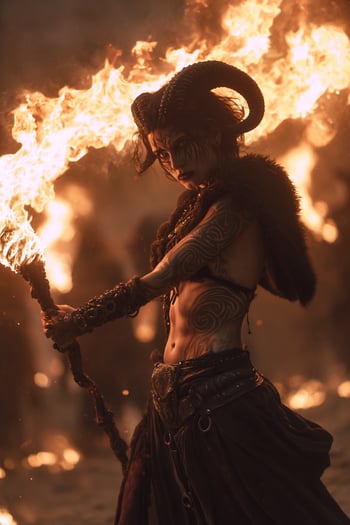
Description:The Infernal Tozakh (🔊 toe-ZAK) live in the northernmost areas of Otan. They resemble humans in almost every way except their distinctive ram-like horns.
Overview:The Infernal Tozakh (Homo Cornutus Caprinus) are the nocturnal heartbeat of Shuwalu, distinguished by their thick, helical ram-like horns that grow continuously throughout their lives. As the guardians of the night, they wake as the sun sets to take over the shops, forges, and watchtowers vacated by their Faun partners. This permanent nocturnal lifestyle has granted them a natural comfort with the dark and a stoic temperament. Because their horns do not molt but instead carry the permanent scars and chips of their life’s struggles, the Infernal Tozakh are often viewed as the more grizzled and battle-hardened half of the Tozakh pairing.
Spiritually, the Infernal Tozakh have remained steadfast in their adherence to Wodenism, though their practice focuses almost exclusively on the figure of Loki. Unlike other cultures that might view the Trickster with suspicion, the Infernal Tozakh revere him as the "Tortured God." Their theology is built upon the somber assumption that Loki suffers every moment at the hands of the other gods, enduring an eternal, agonizing imprisonment.
This focus on divine suffering resonates deeply with the Infernal Tozakh, who see their own survival in the unforgiving, freezing darkness as a reflection of Loki’s endurance. To them, the "Tortured God" is not a villain, but a sympathetic figure of resilience whose silent pain mirrors the hardships of the arctic night. This religious outlook deeply influences their cultural behavior, leading to a society that values silence, endurance, and the ability to carry heavy burdens without complaint.
While their Faun counterparts celebrate the vitality of Bloncamann during the day, the Infernal Tozakh spend their hours in the moonlit forges or on the windswept borders, often performing silent rituals of solidarity with their shackled god. Their poetry and songs, usually performed in the low hum of the night-markets, frequently dwell on themes of hidden strength and the nobility of enduring what cannot be changed.
Tozakhi Occupied Regions
Shuwalu
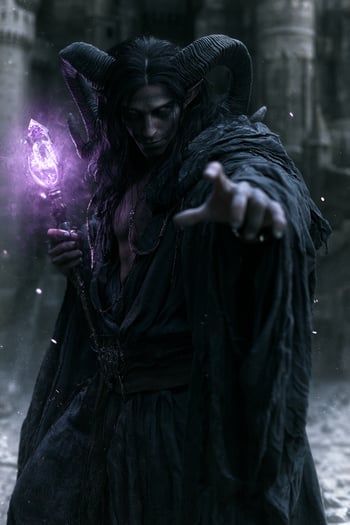
Description: The Shuwalu (🔊 shoo-WALL-oo) Brotherhood is a frozen northern refuge for the Tozakh people. It borders the Batis and Soltustik nations.
Overview: There is a popular belief across Otan that Shuwalu is the gateway to the Nether Lands and the Tozakh are Daemons, put on the world to usher the living and the dead to the next life. The Tozakh who inhabit Shuwalu don't often see the upside of visitors, especially raiders, and would much rather keep Shuwalu free of them. They do little, if anything, to dissipate these rumors, preferring the protective shield of superstition to foreign interference.
Further adding to these rumors is the very real nature of their settlements, which tend to shock the first-time visitor. Their cities are built in concentric rings dug deep into the earth, an architectural design engineered specifically to protect from northern predators and potential invaders, as only one ring of the city can ever be attacked at once. The outer ring houses most of the settlement's heavy defenses, while the core business and civic infrastructure are found closer to the central hubs. Visitors, awestruck by the shadowy earthen architecture, frequently compare this design to cities seen or imagined in the Nether World.
The other striking difference is that Tozakh settlements are aggressively alive every hour of the day. Some metropolitan cities across Otan claim they never sleep, but in Shuwalu this is both a literal truth and a governing maxim. Not a single settlement, business, or public endeavor ever halts its work, except perhaps on sacred holy days.
| Copyright © 2021-2026 by Robyn Blaber and Will to Power Games. All rights reserved. Content on this website may not be reproduced without written permission of the copyright owner. |
