Basic Rules: Difference between revisions
Robyn.Blaber (talk | contribs) Created page with "At Will to Power Games, we understand that purchasing a new game is not just a monetary commitment, but a commitment in time and effort as well. To this end, we offer you a Free-to-Use set of Basic Rules. As a Game Master, you can instruct your players to navigate to http://willtopowergames.com Players can register or sign into the new Player's Workshop, free of charge, and create one or more characters to sample the game. As a GM, we'll offer a basic scenario, or you..." |
Robyn.Blaber (talk | contribs) No edit summary |
||
| (15 intermediate revisions by the same user not shown) | |||
| Line 1: | Line 1: | ||
{{Infobox basic rules| title = [[Basic Rules]] | |||
| subtitle = The [[Basic Rules]] of the Game | |||
| caption = Whether you're new to [[Will to Power]] Games or role-playing games altogether, we have the rules and explanations to get you started. | |||
| image = https://imagedelivery.net/TNzzP2IqyQLYoHEs2ZN5aQ/38536471-cd16-4571-1e98-dae241325500/wiki#.png | |||
}} | |||
Players can register or sign | At [[Will to Power]] Games, we understand that purchasing a new game is not just a monetary commitment, but a commitment in time and effort as well. To this end, we offer you a Free-to-Use set of [[Basic Rules]]. As a Game Master, you can direct your players to navigate to http://willtopowergames.com | ||
[[Players]] can register or sign in to the new Player's Workshop, free of charge, and create one or more characters to sample the game. As a GM, we'll offer a basic scenario, or you can create your own with the free rules offered on this site. The rules available here are enough for skill checks, basic ground combat, and replenishing health and power. In theory, those who prefer a rules-light game can use our free rules indefinitely, though we can assure you that the complete rules set is the best ever written. | |||
== Role Playing Games == | |||
{{LoreImage|https://imagedelivery.net/TNzzP2IqyQLYoHEs2ZN5aQ/80cf5c2d-8d41-4f29-365e-6c0f2e1d0e00/wiki#.png|350px|left}} | |||
This game is a TTRPG, or Tabletop Role-Playing Game. Its origins come from a long history of role-play exercises and tabletop simulations created to better understand and even prepare for war. The combination of these two genres began in earnest in the 1970s, centered around the creation of the game Dungeons & Dragons. This was perhaps the first time that the intrigue of storytelling and role-play scenarios was resolved with wargame-style rules. The result is a new genre that has been played by ever-increasing numbers to this day. | |||
As the name implies, these games were originally played much like any other board game, with a group of players situated around a table, moving figurines and rolling dice. Over time, the format of play has changed drastically with the advent of new technology and the influence of the Covid pandemic. During the pandemic, role-playing games underwent a renaissance, surging in the number of active players. Technologies like Zoom enabled online play for those quarantined and unable to meet. | |||
Whether a group meets in person or online, there are two schools of thought on how the game is best played: using the "theatre of the imagination" or tabletop miniatures. The miniatures option is not available online, but technology has stepped in with the Virtual Tabletop, or VTT, enabling players to better see the scenarios as they play out. The option of using real miniatures sometimes gives way to the VTT due to the expense and storage needs for any serious quantity of miniatures, so even "in person" games might be played using a VTT. | |||
{{-}} | |||
== Physical Setups == | |||
{{LoreImage|https://imagedelivery.net/TNzzP2IqyQLYoHEs2ZN5aQ/fc410a20-305f-4e36-0769-6a9fd2214800/wiki#.png|350px|left}} | |||
For purists, in-person play around a table is ideal. For most working adults, this creates scheduling issues, but the payoff is usually worth the trouble. In-person, the GM typically sits at the head of a gaming or dining table behind a GM screen, from which they describe and run the campaign's scenarios. The players sitting around the table will equip themselves with pen and paper, or optionally their game device (phone or tablet). | |||
There are basically three popular setups possible in a physical setting: theater-of-the-imagination, tabletop miniatures, or virtual tabletop (VTT) setups. All three setups have a series of advantages and disadvantages. Some setups are difficult to manage, while others may make it difficult for certain players to visualize the game. | |||
'''The [[Theater]] of the Imagination'''<br>In this setup, the GM will describe a "scene" and place the characters, both player and [[NPC]], into the scene using little more than descriptive language. A GM might play music or sound effects to better set the scene, but effectively, the players will need their imaginations. Once the scene is set, players will reposition themselves in the scene by vocally describing what their character is going to do, e.g., "My character (I) will walk to the bar and order a drink." | |||
These verbal phrases establish a shared vision of what is happening in the room. While one player is at the bar, another might send their character to the gaming table, while another might go to warm up near the hearth. As the scene is established in people's minds, the GM will begin to run the game, establishing challenges, initiating combat if need be, or providing narratives from other characters ([[NPC]]s) in the scene. | |||
'''Tabletop Miniatures'''<br>In this gaming setup, the Game Master will have invested in various maps and figurines to place on the table before the players. By using tabletop miniatures, there is much less ambiguity and second-guessing, such as "I said I was going to the bar; I did not say I was at the bar." | |||
In games where the GM likes to use elaborate traps, for example, the exact placement of a figurine can mean the difference between life and death for a player. There is no room for ambiguity when life is on the line. The greatest upside to the tabletop miniature setup is the feeling of immersion and realism in the game. The downsides to the tabletop miniature setup are many, from the time and resources required to build it to the setup being moot if the party decides to pass by it completely. Hours of painting miniatures can be lost if players simply turn around and walk out of the scene. | |||
'''Virtual Tabletop'''<br>Various VTTs can be quickly adapted to run a [[Will to Power]] at this time: Roll20, Foundry VTT, and Owlbear Rodeo, to name a few. Many GMs may already have heavy investments in VTTs for other games, and the assets in those VTTs - maps, monsters, furniture, and player tokens would be easy to leverage for a [[Will to Power]] game. Dice rolling can happen within the VTT or in the real world. | |||
{{-}} | |||
== Virtual Setups == | |||
{{LoreImage|https://imagedelivery.net/TNzzP2IqyQLYoHEs2ZN5aQ/f4ddddb3-07f0-4ca4-8e2f-5438c6053600/wiki#.png|350px|right}} | |||
Playing in person is ideal, but not always possible. Since the pandemic, millions of people have discovered online RPG groups, and they have several advantages over real-life groups. Scheduling is easier, for one, making players less likely to miss a session. In an ongoing campaign, it is considered "ideal" if every player can attend every session for the duration of the campaign. There are methods for running a session with a missing player, but they are rarely satisfying. | |||
'''Imagination vs. VTT'''<br>In a virtual session, the players and GM will congregate on Zoom, [[Dis]]cord, or a similar platform. Depending on their Internet bandwidth, this may include both voice and video, but video is better, although not absolutely necessary. The outstanding variable is whether or not to employ a VTT. Some players find VTTs to steal from the feeling of "immersion," making the game feel more like a video game than a TTRPG, while others have serious trouble with spatial awareness and feel lost when monsters and characters move from room to room. | |||
In the decision between Imagination vs. VTT, the GM must "read the room". Clearly, there is no need for a VTT for the rhetorical parts of the game. Visiting a shop to haggle over a potion can be played out without the need for a map or virtual figures. Ultimately, VTT setups are easier for players to follow the flow in combat, but require more setup for the GM. | |||
Note: The paid version of the [[Will to Power]] TTRPG will ultimately have VTT support for some of its adventure modules. | |||
{{-}} | |||
== [[Players]] == | |||
{{LoreImage|#.png|350px|right}} | |||
[[Players]] may create one or many characters by navigating to our main website and registering: https://willtopowergames.com/ords/r/rpggame/landing-page/register1 | |||
There are two distinct types of TTRPG players: [[Players]] and [[Game Masters]]. This section deals with [[Players]]. Imagine making a movie (an analogy we use often in these rules). The Game Master is akin to a director, behind the camera, setting scenes, checking with the SFX department to make sure the animatronic beast is working. The [[Players]] are akin to the leading actors of the film. [[Players]] will assume the role of a character. [[Un]]like the movie analogy, their character is created by them. They will choose its name, its looks, its powers, its hair color, and its tragic backstory, all without the interference of writers. | |||
Like actors in a movie, there is no one way to play a character. Some will create a new voice, complete with an accent, to play their characters. Some will use their natural voice. Some will act using their personal sensibilities. Some will have distinctly different sensibilities for their characters. What they won't have is a script. When the GM sets a scene, each player will, in turn, improvise their actions for that scene. The options available to them are limited only by the character they chose to play, but few other limitations exist. [[Players]] may choose for their characters to interact heavily with the scenery, run away, confer with other players, challenge the beast, hide from the beast, or use one or more of their special powers (described later). | |||
These acts of player agency combine to create the overall story. The [[Players]] will act; the GM will formulate reactions. The back-and-forth cycle repeats until the scenario is played out, i.e., the beast is dead, the beast has fled, the players have defeated the beast at checkers. Whatever the outcome, there is usually an obvious time for the GM and the players to move on to the next scenario. | |||
{{-}} | |||
== [[Game Masters]] == | |||
{{LoreImage|#.png|350px|right}} | |||
{{-}} | |||
== [[Sessions]] == | |||
{{LoreImage|#.png|350px|right}} | |||
{{-}} | |||
== [[Scenarios]] == | |||
{{LoreImage|#.png|350px|right}} | |||
{{-}} | |||
== [[Narrative Tests]] == | |||
{{LoreImage|#.png|350px|right}} | |||
{{-}} | |||
== [[Campaigns]] == | |||
{{LoreImage|#.png|350px|right}} | |||
{{-}} | |||
== Next Concept == | |||
''[[Players]]'' | |||
[[Players]] may create one or many characters by navigating to our main website and registering: https://willtopowergames.com/ords/r/rpggame/landing-page/register1 | |||
{{-}} | |||
{{Copyright notice}} | |||
[[Category:Basic Rules]] | |||
Latest revision as of 05:14, 14 September 2026
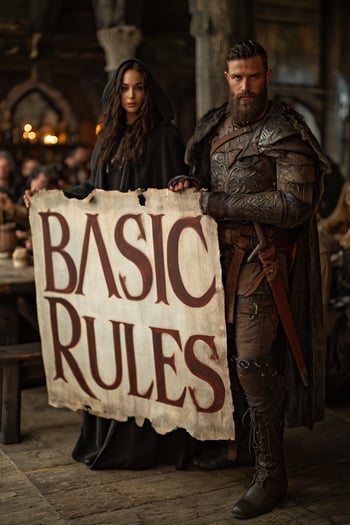
At Will to Power Games, we understand that purchasing a new game is not just a monetary commitment, but a commitment in time and effort as well. To this end, we offer you a Free-to-Use set of Basic Rules. As a Game Master, you can direct your players to navigate to http://willtopowergames.com
Players can register or sign in to the new Player's Workshop, free of charge, and create one or more characters to sample the game. As a GM, we'll offer a basic scenario, or you can create your own with the free rules offered on this site. The rules available here are enough for skill checks, basic ground combat, and replenishing health and power. In theory, those who prefer a rules-light game can use our free rules indefinitely, though we can assure you that the complete rules set is the best ever written.
Role Playing Games
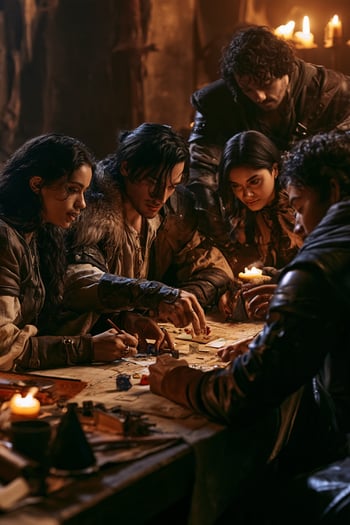
This game is a TTRPG, or Tabletop Role-Playing Game. Its origins come from a long history of role-play exercises and tabletop simulations created to better understand and even prepare for war. The combination of these two genres began in earnest in the 1970s, centered around the creation of the game Dungeons & Dragons. This was perhaps the first time that the intrigue of storytelling and role-play scenarios was resolved with wargame-style rules. The result is a new genre that has been played by ever-increasing numbers to this day.
As the name implies, these games were originally played much like any other board game, with a group of players situated around a table, moving figurines and rolling dice. Over time, the format of play has changed drastically with the advent of new technology and the influence of the Covid pandemic. During the pandemic, role-playing games underwent a renaissance, surging in the number of active players. Technologies like Zoom enabled online play for those quarantined and unable to meet.
Whether a group meets in person or online, there are two schools of thought on how the game is best played: using the "theatre of the imagination" or tabletop miniatures. The miniatures option is not available online, but technology has stepped in with the Virtual Tabletop, or VTT, enabling players to better see the scenarios as they play out. The option of using real miniatures sometimes gives way to the VTT due to the expense and storage needs for any serious quantity of miniatures, so even "in person" games might be played using a VTT.
Physical Setups
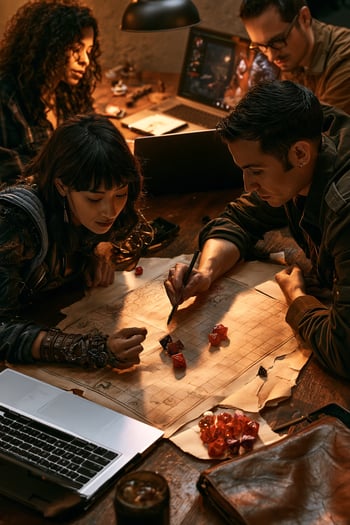
For purists, in-person play around a table is ideal. For most working adults, this creates scheduling issues, but the payoff is usually worth the trouble. In-person, the GM typically sits at the head of a gaming or dining table behind a GM screen, from which they describe and run the campaign's scenarios. The players sitting around the table will equip themselves with pen and paper, or optionally their game device (phone or tablet).
There are basically three popular setups possible in a physical setting: theater-of-the-imagination, tabletop miniatures, or virtual tabletop (VTT) setups. All three setups have a series of advantages and disadvantages. Some setups are difficult to manage, while others may make it difficult for certain players to visualize the game.
The Theater of the Imagination
In this setup, the GM will describe a "scene" and place the characters, both player and NPC, into the scene using little more than descriptive language. A GM might play music or sound effects to better set the scene, but effectively, the players will need their imaginations. Once the scene is set, players will reposition themselves in the scene by vocally describing what their character is going to do, e.g., "My character (I) will walk to the bar and order a drink."
These verbal phrases establish a shared vision of what is happening in the room. While one player is at the bar, another might send their character to the gaming table, while another might go to warm up near the hearth. As the scene is established in people's minds, the GM will begin to run the game, establishing challenges, initiating combat if need be, or providing narratives from other characters (NPCs) in the scene.
Tabletop Miniatures
In this gaming setup, the Game Master will have invested in various maps and figurines to place on the table before the players. By using tabletop miniatures, there is much less ambiguity and second-guessing, such as "I said I was going to the bar; I did not say I was at the bar."
In games where the GM likes to use elaborate traps, for example, the exact placement of a figurine can mean the difference between life and death for a player. There is no room for ambiguity when life is on the line. The greatest upside to the tabletop miniature setup is the feeling of immersion and realism in the game. The downsides to the tabletop miniature setup are many, from the time and resources required to build it to the setup being moot if the party decides to pass by it completely. Hours of painting miniatures can be lost if players simply turn around and walk out of the scene.
Virtual Tabletop
Various VTTs can be quickly adapted to run a Will to Power at this time: Roll20, Foundry VTT, and Owlbear Rodeo, to name a few. Many GMs may already have heavy investments in VTTs for other games, and the assets in those VTTs - maps, monsters, furniture, and player tokens would be easy to leverage for a Will to Power game. Dice rolling can happen within the VTT or in the real world.
Virtual Setups
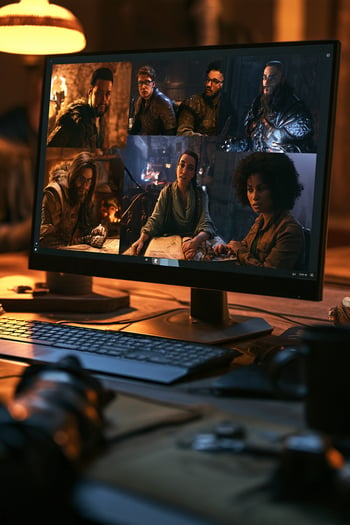
Playing in person is ideal, but not always possible. Since the pandemic, millions of people have discovered online RPG groups, and they have several advantages over real-life groups. Scheduling is easier, for one, making players less likely to miss a session. In an ongoing campaign, it is considered "ideal" if every player can attend every session for the duration of the campaign. There are methods for running a session with a missing player, but they are rarely satisfying.
Imagination vs. VTT
In a virtual session, the players and GM will congregate on Zoom, Discord, or a similar platform. Depending on their Internet bandwidth, this may include both voice and video, but video is better, although not absolutely necessary. The outstanding variable is whether or not to employ a VTT. Some players find VTTs to steal from the feeling of "immersion," making the game feel more like a video game than a TTRPG, while others have serious trouble with spatial awareness and feel lost when monsters and characters move from room to room.
In the decision between Imagination vs. VTT, the GM must "read the room". Clearly, there is no need for a VTT for the rhetorical parts of the game. Visiting a shop to haggle over a potion can be played out without the need for a map or virtual figures. Ultimately, VTT setups are easier for players to follow the flow in combat, but require more setup for the GM.
Note: The paid version of the Will to Power TTRPG will ultimately have VTT support for some of its adventure modules.
Players
- .png
Players may create one or many characters by navigating to our main website and registering: https://willtopowergames.com/ords/r/rpggame/landing-page/register1
There are two distinct types of TTRPG players: Players and Game Masters. This section deals with Players. Imagine making a movie (an analogy we use often in these rules). The Game Master is akin to a director, behind the camera, setting scenes, checking with the SFX department to make sure the animatronic beast is working. The Players are akin to the leading actors of the film. Players will assume the role of a character. Unlike the movie analogy, their character is created by them. They will choose its name, its looks, its powers, its hair color, and its tragic backstory, all without the interference of writers.
Like actors in a movie, there is no one way to play a character. Some will create a new voice, complete with an accent, to play their characters. Some will use their natural voice. Some will act using their personal sensibilities. Some will have distinctly different sensibilities for their characters. What they won't have is a script. When the GM sets a scene, each player will, in turn, improvise their actions for that scene. The options available to them are limited only by the character they chose to play, but few other limitations exist. Players may choose for their characters to interact heavily with the scenery, run away, confer with other players, challenge the beast, hide from the beast, or use one or more of their special powers (described later).
These acts of player agency combine to create the overall story. The Players will act; the GM will formulate reactions. The back-and-forth cycle repeats until the scenario is played out, i.e., the beast is dead, the beast has fled, the players have defeated the beast at checkers. Whatever the outcome, there is usually an obvious time for the GM and the players to move on to the next scenario.
Game Masters
- .png
Sessions
- .png
Scenarios
- .png
Narrative Tests
- .png
Campaigns
- .png
Next Concept
Players may create one or many characters by navigating to our main website and registering: https://willtopowergames.com/ords/r/rpggame/landing-page/register1
| Copyright © 2021-2026 by Robyn Blaber and Will to Power Games. All rights reserved. Content on this website may not be reproduced without written permission of the copyright owner. |
