Warlock
| Power of | The Nether World |
|---|---|
| Warlock Schools | Cult of Death, Cult of Life, Cult of Summoning |
The Warlock archetype in Otan does not represent a single, monolithic school of thought, but rather a loose collection of three distinct cults that achieve vastly different ends through fundamentally similar means. Bound by an obsession with forbidden forces, these practitioners bend the laws of nature, life, and the outer planes to their absolute will. Depending on their specific affiliation, a Warlock possesses the terrifying capability to summon malevolent Daemons from dark dimensions, engineer synthetic life forms known as Homunculi, or rip the souls of the departed back into the physical world to raise legions of the Undead.
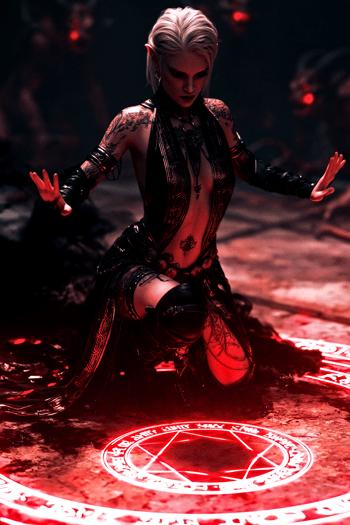
At the absolute foundation of all three practices is the mastery of esoteric magic circles. These complex geometric matrices are not merely symbolic; they are functional conduits of raw, binding willpower that exert total control over the Warlock's summons and creations. Without these circles, the chaotic forces of death, the outer planes, and synthetic life would instantly turn against the practitioner. As a Warlock ascends in power and understanding, the scale, complexity, and sheer efficacy of their circles evolve, transforming from stationary chalk drawings on a stone floor into fluid, dynamic manifestations of arcane authority.
For a novice Warlock, the primary utility of their craft is survival. Early training is dedicated entirely to the etching of static circles of protection. These defensive boundaries serve as absolute barriers, shielding the fledgling caster from the inherent malice of a newly bound ghost or the erratic, violent outbursts of an unstable homunculus. If a novice fails to maintain the perfect symmetry of these protective rings, they risk being instantly destroyed by the very entities they sought to command.
As a Warlock matures into an advanced practitioner, they no longer need to cower behind stationary barriers. Instead, they learn to manifest condensed, glowing circles of control directly about their wrists. These spectral bracers act as steering wheels for the occult, allowing the advanced Warlock to tether their creations to their personal life force. With a mere gesture of their hands, they can dictate complex strategies and guide their horrific entities on precise, long-range missions across the battlefield, projecting their deadly influence far from their actual physical position.
The Warlock in Society
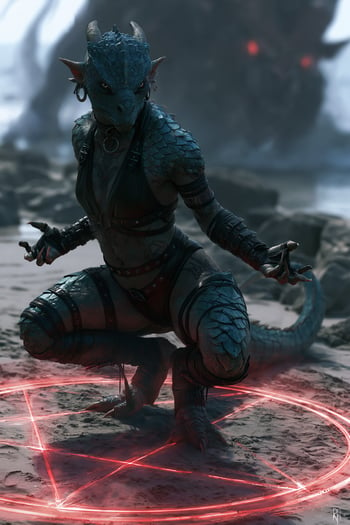
Within the social fabric of Otan, the presence of a Warlock evokes an immediate, instinctual discomfort. They occupy a precarious moral gray area, making the reality of their existence a stark paradox: having a Warlock as a loyal friend is a far better fate than having one as an unrelenting enemy. Their power is undeniable, yet the methods they employ to achieve victory, defiling the resting places of the dead, bartering with fiends, and stitching together artificial flesh, are viewed by the average citizen as a direct affront to decent society.
Consequently, conventional society generally frowns upon a Warlock's methods, treating them with a mixture of quiet revulsion and superstitious dread. However, this moral righteousness is famously fickle. When the outer walls of a settlement are buckling under an overwhelming invasion, and the civilian population faces imminent slaughter, minds change with staggering speed. The moment a Warlock’s massive, unyielding Undead army marches forward to throw themselves into the meat grinder and save the settlement from annihilation, the citizens quickly swallow their prejudice, cheering for the very monsters they previously condemned.
Because their arts are so fundamentally unsettling, Warlocks are typically held in reserve by defensive commanders. They are treated as an absolute worst-case contingency plan, locked away or ignored unless the standard vanguard, comprising elite Knights, frontline Brutes, and advanced Tinkers, fails to keep the settlement's enemies at bay. Only when conventional steel and tactical engineering prove insufficient does the call go out to unleash the Warlocks, forcing the state to rely on dark compromises to ensure its survival.
In sea battles, however, this societal squeamishness is completely abandoned, and Warlock services are rarely kept in reserve. Naval warfare in Otan is a brutal, high-stakes affair where an early advantage is everything. Captains and admirals universally agree that a giant, friendly sea monster summoned to splinter enemy hulls is much better to have sooner rather than later. Yet, regardless of whether they triumph on land or at sea, the tragedy of the Warlock remains the same: when the smoke clears, the bodies are buried, and the battles end, the superficial gratitude fades away, and the cold, isolating prejudice of society inevitably returns.
Warlock Schools
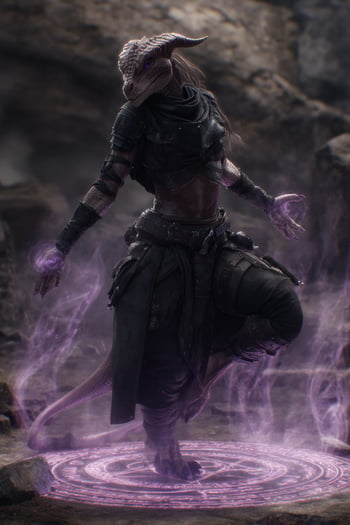
The propagation of Warlock magic relies heavily on a dual structure of written and oral traditions. While the hyper-complex geometry of their controlling circles must be meticulously recorded in dense, ink-stained grimoires, the true "vibe" and dangerous nuances of channeling external entities are passed down through hushed, generational oral warnings. This dark education is divided cleanly among three highly insular Warlock Cults, each dedicated to a specific application of the archetype's core principles.
The Cult of Death: The Cult of Death focuses its grim efforts entirely on necromantic manipulation. Scholars of this cult view the cessation of life not as an end, but as a vast, untapped resource. They study the lingering spiritual echoes left behind in bones and tombs, learning the precise arts required to reanimate skeletal remains, bind weeping specters to physical vessels, and command mindless legions of corpses. Their philosophy treats the dead as a perfect, tireless labor force and an unbreakable vanguard that feels neither pain nor fear.
The Cult of Life: Operating in direct contrast to their necromantic peers, the Cult of Cultivation and Creation, more commonly known as the Cult of Life, channels its circles inward toward the mysteries of organic matter. These Warlocks are the master bio-engineers of Otan. Rather than working with decayed remains, they manipulate the living spark itself, learning to fuse disparate flesh, accelerate cellular synthesis, and brew unstable chemical amalgams. Their classrooms are filled with bubbling vats and stitched organs, all dedicated to the creation of perfectly compliant, artificial constructs.
The Cult of Summoning: The most volatile and intellectually perilous of the three schools is the Cult of Summoning. Practitioners of this discipline look completely beyond the terrestrial bounds of Otan, focusing their minds on the tearing open of dimensional rifts. They memorize the true names, celestial alignments, and specific frequencies required to pierce the veil separating the mortal realm from outer, chaotic dimensions. Through their intricate circles, they pull forth extra-planar entities, binding wild, unpredictable Daemons to their service through sheer, exhausting friction of will.
Warlock Powers
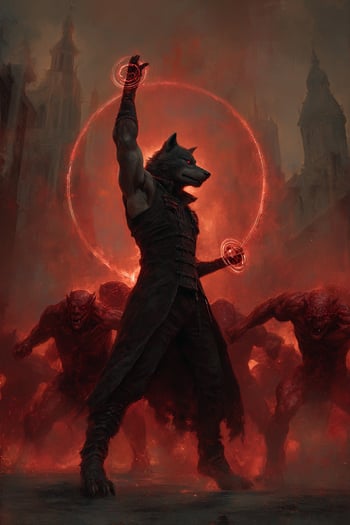
The tactical versatility of a Warlock stems from their ability to systematically bypass the standard rules of engagement by introducing autonomous, supernatural entities to the battlefield. A single Warlock functions as an entire platoon wrapped into one fragile frame. Through their circles, they can spontaneously manifest heavy frontline muscle, agile scouts, or terrifying aerial disruptors, overwhelming opponents through sheer numbers and unnatural physiological advantages.
Their active powers are defined by the entities they deploy. A Warlock can project their consciousness through their creations, allowing them to scout dangerous territory via the eyes of a flying homunculus or strike from behind a wall of shambling, reanimated soldiers. When pushed to the defensive, their powers pivot to reality-warping spatial control; they can detonate their own creations as volatile explosive payloads or siphon the lingering life force of a fallen foe to reinforce their own failing vitality, making them horrifyingly resilient resource managers in long, drawn-out wars of attrition.
Crafting
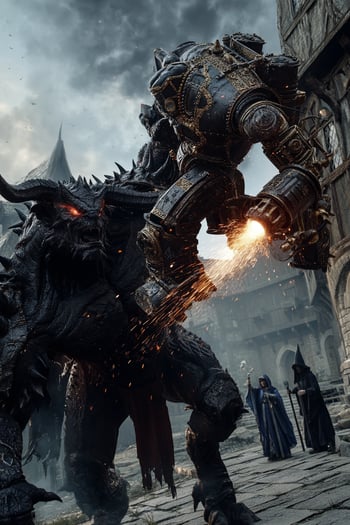
For a Warlock, crafting is a deeply personal, obsessive pursuit that marries physical artistry with occult manipulation. Each of the three distinct cults operates as a specialized crafting guild, producing unique, terrifying assets that cannot be replicated by standard, mundane means or industrial assembly lines. They do not forge steel or shape wood; instead, they sculpt the macabre, the biological, and the ethereal into physical reality.
Death Cultists: These grim artisans focus on the skeletal medium, assembling towering, multi-limbed Bone Horrors. By fusing the remains of various apex predators and reinforcement iron, they craft unyielding monstrosities that operate as biological siege engines.
Life Cultists: These bio-designers spend months in isolation cultivating living, breathing monsters of their own twisted design. They synthesize muscle mass, engorge cardiovascular systems, and graft venomous glands to create hyper-aggressive predators tailored for specific environmental warfare.
Summoning Cultists: The crafters of this school invest their time in exhaustive, historical research. By unearthing ancient texts and cosmic coordinates, they can summon highly specialized Daemons, planar entities with supernatural elements, shifting physics, and devastating magical traits.
The Warlock and Power

The intense spiritual friction and mental toll required to dominate extra-planar minds, dead souls, and artificial flesh takes a massive toll on a Warlock's internal reserves. To completely recharge their magical capabilities and patch the cracks in their psychic armor, a Warlock must retreat far from the distractions of the mundane world to their personal Circle Room.
This sanctuary is a self-built Warlock’s absolute dream; a hyper-isolated, subterranean vault or reinforced tower chamber where every square inch of stone is etched, inlaid, and engraved with a dizzying array of permanent magic circles. Resting within this concentrated, resonant cradle of occult geometry allows their energy to fully realign and replenish over a few days of silent isolation.
When traveling far from their primary sanctuaries, a Warlock cannot access the profound restoration of their Circle Room, but their obsessive nature ensures they are never left entirely depleted. While on the road, they can actively ward off magical exhaustion by engaging in small-scale, portable cultist projects and experiments.
By spending their evenings around a campfire dissecting a local specimen, refining basic alchemical preservatives, or sketching out miniature, experimental circle variants in a travel ledger, a Warlock maintains a light flow of occult energy. These minor rituals keep their vital commanding powers fully functional until they can return to a true facility.
Warlock Factions
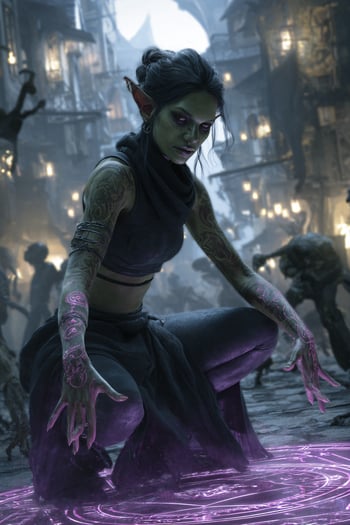
While their inherent creepiness often drives them to the fringes of society, Warlocks frequently organize themselves into highly functional factions to ensure their mutual survival and secure access to fresh materials:
Cults: These are the traditional, highly secretive organizations devoted purely to their specific school of training. They operate as dark academies, pooling forbidden research, guarding ancient grimoires, and occasionally offering collective worship to obscure, Warlock-friendly deities who grant glimpses into the secrets of life and death.
Local Governments: In desperate frontier territories or heavily besieged borderlands, Warlocks are occasionally integrated into local governments. Brought in specifically to set up an absolute, terrifying local line of defense, these civic Warlocks establish permanent bone guards or garrisoned homunculi to deter external threats.
Naval Units: Due to the devastating nature of open-sea warfare, major navies maintain specialized, highly paid Warlock divisions. These oceanic practitioners spend their deployments preparing massive summoning matrices on the decks of warships, ready to call up oversized, aquatic fiends to shatter enemy armadas during maritime engagements.
| Copyright © 2021-2026 by Robyn Blaber and Will to Power Games. All rights reserved. Content on this website may not be reproduced without written permission of the copyright owner. |
