Sogis Grendel

| Scientific Name | Homo Orcus Collinus |
|---|---|
| Plural | Sogis Grendel |
| Possessive | Sogis Grendel |
The Sogis Grendel (Homo Orcus Collinus) are the rugged hill-folk of the Grendel strain and the primary source of the nation’s terrestrial power. While their metropolitan cousins handle the administration of the state, the Sogis provide the overwhelming bulk of the military might, fielding the vast majority of the warriors that defend the Grendel borders. Unlike the urbanized Kalas, they avoid traditional settlements entirely, preferring a decentralized, rural existence scattered across the harsh elevations of the hills.
Survival for the Homo Orcus Collinus is a matter of constant labor, as the difficult terrain makes traditional agriculture nearly impossible. Instead, they sustain themselves by hunting wild game and foraging for whatever plant protein the highlands offer. They are most famous, however, for their mastery of animal husbandry; the Sogis have a unique penchant for raising and breeding Woolly Rhinos in captivity, utilizing these massive beasts as both beasts of burden and formidable assets in times of conflict.
Though they value their independence, the Sogis Grendel regularly seek out brief, intense moments of community. They gather periodically for great congregations where they feast, trade news, and share gossip. These gatherings serve as essential hubs for education and training, featuring rigorous games and spectacles that test their physical strength, riding skills, and prowess at the forge. In these congregations, leadership is informal and fleeting; they acknowledge no permanent rulers, instead paying deference to the "strongest" among them, who acts as a temporary leader and arbiter for the duration of the assembly.
Physical Characteristics

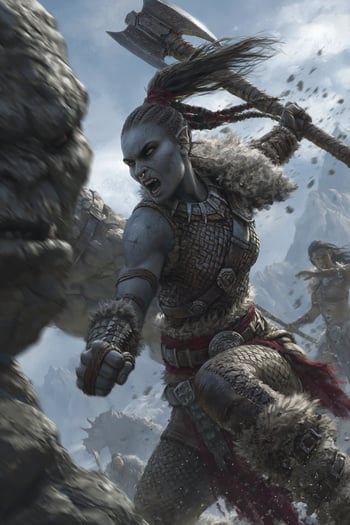
The Sogis Grendel share the imposing physicality of their kin, standing an average of 2 to 4 Kul taller than a typical human and carrying considerably more mass. Their skin may appear in the familiar Grendel range of green, gray, and blue, with centuries of occasional interbreeding producing additional shades. Their pointed ears are less pronounced than those of the Aelfes or Kuulik, but their size and heavy musculature make them unmistakable wherever they travel. Grendel biology is exceptionally resilient, granting them unusual resistance to bitter weather, cold, and disease.
The Sogis seem particularly well suited to the physical demands of their homeland. Their strength is put to practical use in hunting, riding, construction, and the forge, while those who manifest as Brutes become the formidable heavy fighters for which the substrain is known. Sogis Brutes are frequently called upon to defend their rocky territories against intruders, including the Rock Giants that inhabit the surrounding hills. A Sogis does not need to be fearless to be dangerous. They need only be willing to keep going.
Sogis Grendel Culture

Sogis culture is built around self-reliance, preparation, and useful work. They hunt, forage, raise livestock, build roads and villages, and practice agriculture wherever the hills permit it. Their great communal gatherings provide something their scattered way of life otherwise lacks: a place to feast, exchange news and gossip, teach skills, and test themselves through games of strength, riding, strategy, and craftsmanship. Even their leisure has a practical edge. Strategy games are popular because keeping the mind sharp for battle is considered time well spent.
Of all their crafts, none is more closely associated with the Sogis than smithing. Grendel steel is already regarded as the strongest metal known on Otan, but the Sogis approach its production with unusual patience and precision. Their metalworkers produce the refined dark steel for which the Grendel are famous, using the same calculation and methodical planning that characterizes their approach to warfare. Sogis Wizards show a similar practicality. They are not generally interested in artistry for its own sake; their magic is described more aptly as "battle magic," intended to accomplish a task and get the job done.
The Sogis are also among the most carnivorous of the Grendel. Their Hunters pursue large game, sometimes working with hardy swine that can survive encounters with dangerous animals, while their mastery of animal husbandry is most famously expressed in the breeding of Woolly Rhinos. These great beasts serve as working animals and mounts, carrying Sogis Knights into battle and through the difficult terrain of Maercland. The result is a culture in which the forge, the hunt, and the battlefield are not separate worlds. Each is another expression of the same Sogis virtues: preparation, endurance, and getting the job done.
Sogis Grendel Geography
The Sogis occupy the northern hill country of Maercland, where the landscape rises away from the frozen southern swamps. Their homeland is characterized by rolling and rocky hills, with forested areas mixed into the rugged terrain. The environment is harsh and offers little dependable farmland, forcing the Sogis to rely heavily on hunting, foraging, livestock, and whatever agriculture the terrain will tolerate. Unlike the Kalas, they do not concentrate their population into great urban centers. Their communities are scattered across the hills, with villages and smaller settlements connected by roads and the constant movement of people, animals, and goods.
The hills are also a natural defensive frontier. Sogis communities maintain a constant awareness of outsiders and local threats, with Brutes patrolling the territory against human incursions and Rock Giants. The northern hills also play an important role in the wider Grendel economy: massive catches brought in by the nation's fishermen are sent north, where Sogis salt deposits are used to preserve fish for long-term storage and export. In this way, the Sogis homeland is both a defensive stronghold and an important part of the machinery that keeps Maercland fed.
| Copyright © 2021-2026 by Robyn Blaber and Will to Power Games. All rights reserved. Content on this website may not be reproduced without written permission of the copyright owner. |
