Aelfen Language
| General Information | |
|---|---|
| Native Name | Aelfish |
| Language Family | Wordhord |
| Usage | Spoken, Written |
| Speakers | |
| Where Spoken | Aelfgarad, Aelfwode |
| # of Speakers | 7,000,000 |
The Aelfen language belongs to the Wordhord family, a family of tongues that includes several modern Aelfen dialects as well as the much older Elder Aelfen. Only fragments of the Elder language survive, preserved in carvings, ancient legends, and songs whose original meanings can be difficult to understand without the language itself. The Great Erasure destroyed most of the written and spoken record, but Aelfen Sophists have painstakingly reconstructed enough of Elder Aelfen to hold simple conversations. Even then, they must often guess at the original tonality, leaving some ancient phrases open to interpretation.
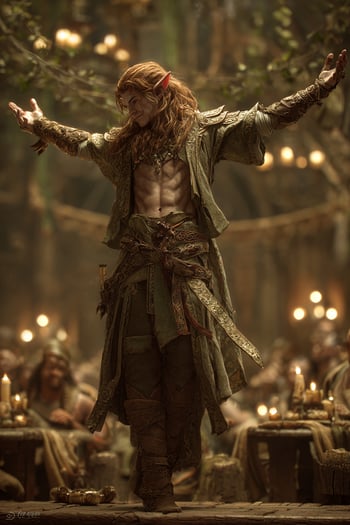
Modern Aelfen is unmistakably lyrical to the ear. Vowels are commonly elongated, and consonants softened, giving even ordinary conversation the quality of a poem being recited. The effect disappears rather dramatically when the language reaches the military. Aelfen soldiers deliberately shorten their vowels into clipped chirps and strike their consonants as hard as flint, proving that even poetry can apparently be issued as an order.
Speakers and Distribution
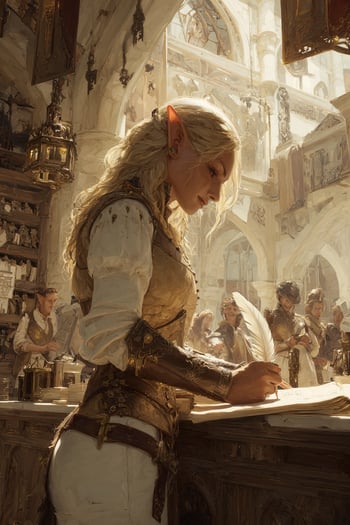
There are roughly 7 million speakers of the Aelfen language when all of its dialects are counted. The largest linguistic communities speak the Friggaelfen and Wodaelfen dialects, reflecting the two great cultural traditions that dominate Aelfen society. While the dialects remain mutually connected, differences in pronunciation, vocabulary, and expression can make the speech of one Aelfen community noticeably different from another.
The language is less common among the other peoples of Otan, though it is certainly not unknown. Traders are among the most frequent outsiders to learn Aelfen, particularly those who do business with Aelfen communities. Others take up the language simply because they have become enamored with Aelfen culture. For some students, apparently, learning the language is merely the first step toward becoming unbearable at dinner parties.
Writing and Literature
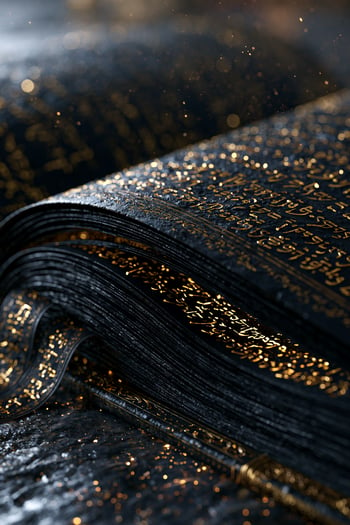
An Aelfen edition of the Book of Woden can be found in virtually every Aelfen temple, but even this venerable work struggles to compete with The Gentleman's Guide to Aelfen Culture, Vol. 1. The enormous tome is the first of a completed set of nine volumes, accompanied by more than one hundred appendices. Its size, expense, and grandeur ensure that many readers who purchase the series never make it beyond the first volume, which is generally considered sufficient to establish the gist of Aelfen culture.
The Guide covers the great schism between the Friggaelfes and Wodaelfes, explaining how each contributes to Aelfen culture in its own fashion. It also devotes considerable attention to the unusual case of the Dunaelfes, along with notes on the contributions of the Wyrmaelfes. Heavily illustrated and produced at considerable expense, the book has itself become something of a cultural artifact. Translations into other languages command impressive sums, allowing the Aelfes to make a respectable amount of money explaining themselves to people who apparently cannot afford the time to simply ask.
| Copyright © 2021-2026 by Robyn Blaber and Will to Power Games. All rights reserved. Content on this website may not be reproduced without written permission of the copyright owner. |
