Karazalikar
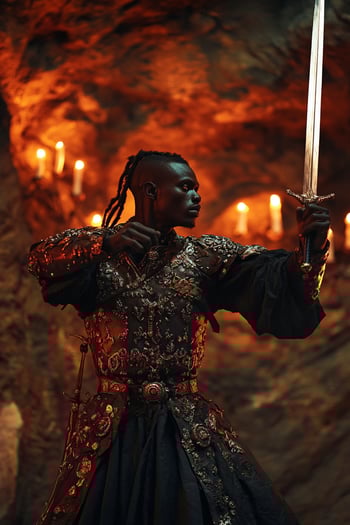
| Scientific Name | Homo Sapiens |
|---|---|
| Plural | Karazalikar |
| Possessive | Karazalikari |
The Karazalikar are the matriarchal heart of southern Otan, a people whose national identity is inextricably bound to a profound and unique spiritual mandate. Their culture is built upon the fundamental belief that females are born with complete, luminous souls, whereas males enter the world with fragmented spirits. This theological distinction dictates the entire social order; men must spend their lives in a disciplined process of study and religious penitence to "collect" the missing parts of their souls. Those who fail this spiritual task are considered "lost," denied both a place beside the gods in the heavens and the possibility of rebirth.
In this society, the elders serve as the vital pillars of the community, acting as the primary educators for males navigating their soul-trials and as supreme advisors for the nation at large. Every matter of importance, from local disputes to national policy, is brought before these seasoned mentors for consultation. At the apex of their political and social structure sits the Queen Mother, a title held by both tribal matriarchs and the sovereign ruler of the entire country. While men are permitted to serve in the bureaucracy and government, they are seldom granted access to the highest echelons of power or ultimate command.
The Karazalikar are physically characterized by deep, resonant skin tones that range from the warmth of cocoa powder to a rich, near-black luster. Their hair is consistently black, and their eyes are a deep brown, though the elders are marked by hair that has transitioned into distinguished shades of grey or stark white. While they utilize the common Otani language for trade, they remain spiritually distinct from their northern neighbors; rather than following Wodenism, they are devoted to the Baksist pantheon, worshipping earth-centric deities such as Ana and Jer.
This devotion to the Baksist gods fosters an intense, reverent connection to the natural world. This bond influences every aspect of Karazalikar's life, including their choice of vocation. When driven to a life of adventure, they have a natural inclination toward the paths of the ranger or the druid. Even in more settled professions, a Karazalikar will almost invariably choose a calling that allows them to exercise power through or maintain a close connection to the living forces of nature, viewing the preservation of the environment as a direct extension of their own spiritual survival.
Physical Characteristics
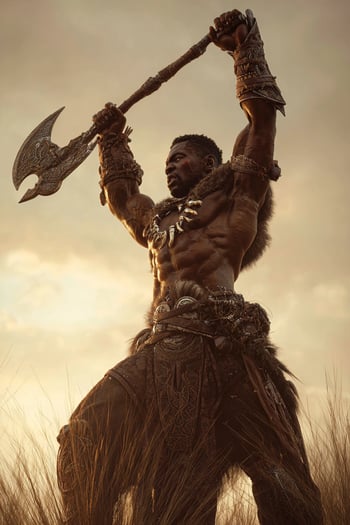
The Karazalikar are generally distinguished by their dark complexions, ranging from rich brown to near-black, with black hair and deep brown eyes. As they age, their hair commonly changes to grey or white, giving the eldest members of the community a particularly recognizable appearance. These traits form the common appearance of the substrain rather than an absolute rule, and individuals may vary considerably.
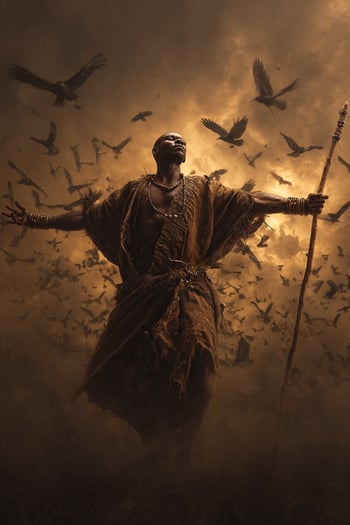
The more important distinction is the Karazalikar relationship with the natural world. Their Baksist faith teaches that the world itself is a living extension of Ana, and this belief has produced a people who tend to work with nature rather than attempt to dominate it. Their Rangers and Druids are especially comfortable in the wilderness, while Hunters have learned to work alongside large predators and other powerful animals.
Karazalikar animal handlers are particularly accomplished. Horses are common, but their expertise extends to impala, water buffalo, elephants, lions, hyenas, and other large animals. This familiarity with powerful beasts is reflected even in their recreational life, where mounted team sports may involve animals that most other cultures would regard as entirely unsuitable for organized competition.
Karazalikar Culture
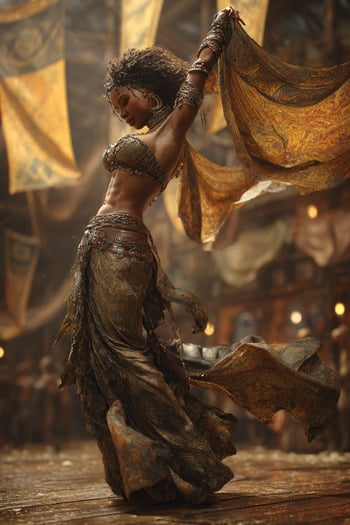
Karazalikar society is organized around the Baksist understanding of the soul. Women are believed to be born spiritually whole, while men must spend their lives collecting the missing fragments of their souls through public duty, education, and personal development. Elders are central to this process, exchanging care and instruction with younger men as they guide them toward spiritual completion. Once a man has regained enough of his soul and completed his education, he may enter positions of leadership, although ultimate authority remains with the Baksist Mothers.
This makes education one of the defining features of Karazalikar life. They regard learning as a form of spiritual growth, and the process continues throughout adulthood. Their elders serve not merely as teachers but as advisors and repositories of accumulated experience. At the regional level, the Princess Mothers—Divines who answer directly to the Queen Mother and the Baksi—combine religious authority with practical administration, spending much of their time among ordinary people rather than remaining secluded in temples.
The Karazalikar have developed an unusually elaborate culture of games and physical competition. Their mounted sports are tactical exercises as much as entertainment, with teams maneuvering animals and riders into complex formations while attempting to achieve objectives before their opponents can react. Impala, water buffalo, horses, and even war elephants may take part. The same patience and tactical thinking appears in their approach to craftsmanship and the Archetypes, whose schools are regarded as exceptionally strong and whose practitioners have access to the resources of a remarkably diverse environment.
Despite their spiritual focus, Karazalik is not isolated. The nation is largely self-sufficient but maintains active trade with the Dweorges, exchanging textiles, grain, spices, wine, and other goods for the metals and gems needed by its smiths, Tinkers, and Archetypes. The result is a culture that can afford to be deliberate: Karazalikar society generally has the time and resources to study a problem, learn from it, and take its time getting things right.
Karazalikar Geography
Karazalik occupies an oblong territory of roughly 153,360 square Gorom in south-central Otan. Its southern edge reaches the sea, including a large peninsula and an offshore island settled long before the Great Erasure. The western border runs along the mountainous Dweorgen Quarrylands, while the eastern frontier meets the Caliphate of Ontustik. To the northeast, Karazalik shares a shorter rugged border with Ortalyk, while the northwest reaches toward neutral, ice-covered mountain territory.
The country contains three distinct ecological regions. The northern and western mountains contain small mining operations that provide iron and stone for local smiths and Tinkers. Immediately below them lies an arid scrubland inhabited by large game and dangerous predators. Farther south, the heartland becomes rolling fertile grassland mixed with dense deciduous forest, before eventually giving way to dense rainforest along the southern coast.
Most Karazalikars live toward the southern end of the country, close to the sea. Coastal fisheries and agricultural trade provide reliable food, while settlements such as Kenzhe and Bayan support a modest urban population. The remainder of the country provides enormous room for hunting, exploration, agriculture, livestock, and the practice of the many Archetypes supported by Karazalikar society.
The geography has also helped preserve the nation's unusually tranquil character. Karazalik has enjoyed roughly 260 years of relative peace, surrounded by neighbors with whom it has maintained stable relations, and has consequently had little need for permanent large-scale military mobilization. Its varied terrain instead gives the Karazalikar something they value greatly: enough land, wildlife, and resources to pursue their spiritual and cultural lives without having to leave home to find adventure.
| Copyright © 2021-2026 by Robyn Blaber and Will to Power Games. All rights reserved. Content on this website may not be reproduced without written permission of the copyright owner. |
