Ontustiker
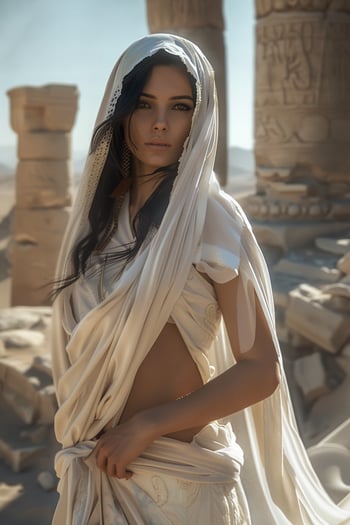
| Scientific Name | Homo Sapiens |
|---|---|
| Plural | Ontustikers |
| Possessive | Ontustiker |
The Ontustikers are the resilient and devout inhabitants of the southern reaches, a people whose identity is forged by the stark extremes of the Caliphate of Ontustik. Their homeland is a country of dramatic contrasts, where lush, verdant riverbeds and fertile lake basins are carved into the heart of vast, unforgiving deserts. This geography has created a society of dual mastery; the Ontustikers are at once expert agriculturalists who coax life from the water’s edge and peerless survivalists capable of navigating the shifting sands of the deep arid wastes.
Physically, the Ontustikers are characterized by a wide spectrum of olive-toned complexions that range from light to exceptionally dark, with these variations appearing randomly across the Caliphate rather than being tied to specific regions. Their hair is typically thick and ranges from deep brown to a lustrous black, though it is often cosmetically or magically altered, and fades into distinguished shades of peppered grey or silver with age.
While their eyes are almost universally a warm, deep brown, the rare occurrence of green or grey irises is whispered to be a sign of a unique destiny. Beyond these cosmetic traits, they possess a distinct physiological advantage over their northern cousins: a remarkable natural resistance to sunstroke and heat exhaustion, allowing them to endure the rigors of the desert sun with a stoicism that baffles outsiders.
The true defining feature of an Ontustiker, however, is not found in their blood but in their soul. They are a people defined by an absolute, visible devotion to Aspan, the god of the sky, and the broader Aspanist pantheon. It is nearly impossible to find an Ontustiker whose clothing or person is not adorned with symbols of their faith. This religious influence creates a fascinating cultural paradox; Aspanist theology teaches both the supreme sovereignty of the gods and the radical responsibility of the individual. An Ontustiker is just as likely to shrug off a tragedy as the "Will of Aspan" as they are to immediately rise and apply their "Will to Power" to rectify the situation.
This balance between divine submission and human agency makes them one of the most stable and focused subcultures in Otan. Whether they are tending to the irrigation of a desert oasis or leading a pilgrimage across the scorched plains, the Ontustikers move with a sense of purpose derived from the belief that they are the chosen stewards of the sky-god’s domain. In the eyes of the Caliphate, the desert is not a barrier, but a sacred proving ground where the strength of one's faith and the sharpness of one's survival instincts are tempered into a single, unbreakable force.
Physical Characteristics

The Ontustikers are generally recognizable by their olive complexions, although their skin tones vary more widely than those of any other Human people on Otan. Individuals may range from light olive to very dark complexions, and these variations are not concentrated in particular regions of the Caliphate. Their hair is normally thick and ranges from dark brown to black, although cosmetic and magical alteration of hair color is common. With age, that hair gradually fades toward peppered grey or silver.
Ontustiker eyes are almost universally deep brown. Green and grey irises do occur, but only rarely. There are few other genetic distinctions separating the Ontustikers from their Human cousins; their most significant natural advantage is their ability to withstand extreme desert conditions with a reduced risk of sunstroke and heat exhaustion. Unlike several other peoples of Otan, they possess no common or unique physical mutations.
This resistance is particularly valuable because desert travel is an ordinary part of Ontustiker life. Their Hunters, Rangers, and other wilderness specialists can cross country where outsiders may struggle simply to remain alive, while agriculturalists have learned to function in the intense heat surrounding the irrigated riverlands. The Ontustiker body is therefore well suited to the environment, but it is their accumulated knowledge of that environment that makes the difference between surviving the desert and mastering it.
Ontustiker Culture
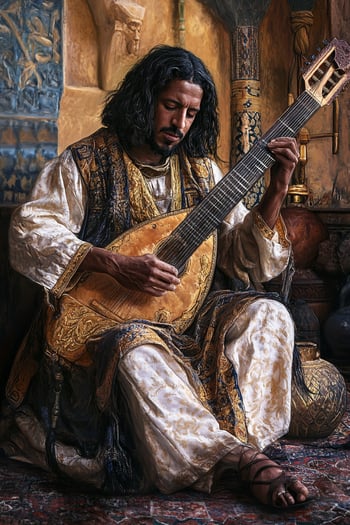
Ontustiker culture is built around a striking contradiction. Aspanist teaching places the gods in a position of supreme authority while simultaneously demanding that human beings accept responsibility for their own lives. An Ontustiker can therefore attribute an event to the Will of Aspan and then immediately set about fixing whatever went wrong. The philosophy produces a culture that accepts hardship without necessarily accepting defeat.
Religion is inseparable from civic life. The Flowers of Aspan form a matriarchal religious hierarchy that also governs the Caliphate, with no meaningful separation between religious and secular authority. The Ninth Lotus of Aspan rules from Anar, while individual settlements are administered by priestesses whose titles and succession form part of the larger sacred hierarchy. The local ziggurat is consequently not merely a temple; it serves as a center for law, mediation, agricultural advice, family matters, and other practical concerns. The culture is explicitly described as both matriarchal and patriarchal, with that apparent contradiction appearing throughout Ontustiker society. The Flowers of Aspan exercise religious and civic authority, while other responsibilities are distributed throughout the population according to the practical demands of life in the Caliphate. Work itself carries a strong religious dimension. The gods are understood as cosmic architects, and human labor is part of the responsibility of maintaining the world they inhabit.
Ontustiker culture also possesses a remarkably deep artistic tradition. Music, elaborate costumes, poetry, and belly dancing are important forms of expression, and the sources describe the resulting traditions as possessing an unusually ancient character despite having developed largely within the 260 years since the Great Erasure. On Holy Week and designated days of rest, this seriousness gives way to large communal feasts featuring foods such as spiced roasted lamb over rice, Ayran, and Aragh Sagi.
There is another tradition that reaches well beyond the borders of the Caliphate. Roughly a century into Ontustik's history, a cache of ancient religious relics was discovered, supposedly delivered by Tun during the god's time walking Otan in the flesh. Many of the most sacred artifacts were missing, and for the last 160 years Divines, Sophists, and elite Hunters have searched across Otan for them. The Caliphate continues to devote considerable wealth and covert agents to recovering these missing pieces.
Ontustiker Geography
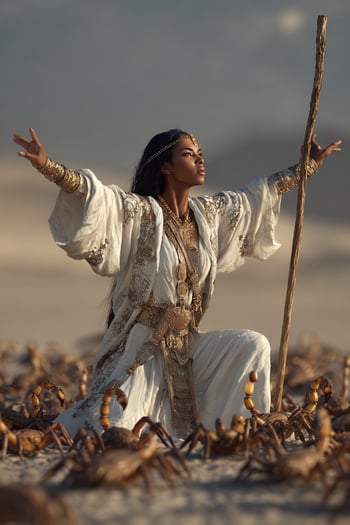
The Caliphate of Ontustik occupies the southern reaches of Otan and is defined by an extreme contrast between desert and water. Vast arid wastes cover much of the country, broken by green riverbeds and fertile lake basins. The desert receives little precipitation and is subject to violent sandstorms, making water the foundation of permanent settlement.
The rivers flowing down from the northern highlands are the lifelines of the Caliphate. Ontustikers divert them into extensive irrigation systems, turning otherwise dry silt into productive agricultural land. Permanent settlements follow these waterways, and the ability to engineer, maintain, and protect the irrigation networks is among the most important practical skills in the country.
The southern waters provide another essential resource. Ontustik has an ancient fishing tradition, drawing a substantial portion of its food from the sea and thereby reducing pressure on the limited arable land. The Caliphate is consequently both a desert civilization and a maritime one, with rivers, lakes, agricultural districts, desert routes, and coastal waters all contributing to its survival.
The landscape is also marked by religion. Every Ontustiker settlement, from small oasis outposts to major trade centers, is dominated by a massive ziggurat dedicated to the sky deities. These structures function as religious, civic, and judicial centers, making the characteristic skyline of Ontustik inseparable from its geography and its faith. The coastal capital of Anar stands at the center of this system, serving as the seat of the Ninth Lotus of Aspan.
| Copyright © 2021-2026 by Robyn Blaber and Will to Power Games. All rights reserved. Content on this website may not be reproduced without written permission of the copyright owner. |
