Uris: Difference between revisions
Robyn.Blaber (talk | contribs) Created page with "{{Infobox substrain | name = Uris | strain = Kuulik | image = https://imagedelivery.net/TNzzP2IqyQLYoHEs2ZN5aQ/2697ff47-b448-45e0-c038-f48e2d37fd00/wiki#.png | caption = For anyone who's had an older sibling, they'll have some insight as to how the Uris (🔊 OO-riss) Kuulik blend into Kuulik society. They are the martial Kuulik members. | scientific = Homo Ingeniosus Bellicus | plural = Uris | possessiv..." |
Robyn.Blaber (talk | contribs) No edit summary |
||
| Line 2: | Line 2: | ||
| name = [[Uris]] | | name = [[Uris]] | ||
| strain = [[Kuulik]] | | strain = [[Kuulik]] | ||
| image = https://imagedelivery.net/TNzzP2IqyQLYoHEs2ZN5aQ/ | | image = https://imagedelivery.net/TNzzP2IqyQLYoHEs2ZN5aQ/83b9c0e0-ec97-4147-9864-97167ae20100/wiki#.png | ||
| caption = For anyone who's had an older sibling, they'll have some insight as to how the [[Uris]] (🔊 OO-riss) [[Kuulik]] blend into [[Kuulik]] society. They are the martial [[Kuulik]] members. | | caption = For anyone who's had an older sibling, they'll have some insight as to how the [[Uris]] (🔊 OO-riss) [[Kuulik]] blend into [[Kuulik]] society. They are the martial [[Kuulik]] members. | ||
| scientific = Homo Ingeniosus Bellicus | | scientific = Homo Ingeniosus Bellicus | ||
| Line 34: | Line 34: | ||
== Physical Characteristics == | == Physical Characteristics == | ||
{{LoreImage|#.png|350px|left}} | {{LoreImage|https://imagedelivery.net/TNzzP2IqyQLYoHEs2ZN5aQ/34f857d5-d775-42b1-4a14-979d19a73700/wiki#.png|350px|left}} | ||
[[Uris]] [[Kuulik]] | [[Uris]] [[Kuulik]] are somewhat larger and more heavily built than their [[Sawdager]] and [[Tenizi]] cousins, standing roughly 9-10 Kul, (130–150 cm) tall. Their faces tend to be more severe, with greyish-green skin that can become quite dark in some individuals. Their greater musculature is not considered a genetic trait, but the inevitable result of a lifetime spent training, fighting, and generally treating physical violence as part of growing up. | ||
Their black hair begins to gray around forty, while male-pattern baldness can appear as early as the thirties. Their eyes may be gold, yellow, orange, or red, giving an already intimidating face an appropriately unsettling finish. Some [[Uris]] possess extended canine teeth, although the old stories about a poisonous bite are simply stories. | |||
The most important [[Uris]] trait is not visible at all. They possess an unusual ability to recognize impending conflict by reading small physical and behavioral cues: clammy palms, changes in heart rate, hostile posture, facial movements, and other signs that most people barely notice. This instinct can even extend to animals, allowing an [[Uris]] to recognize when a creature is preparing to attack. Only a few possess the common [[Kuulik]] ability to see well in low light. | |||
{{-}} | {{-}} | ||
== [[Uris]] Culture == | == [[Uris]] Culture == | ||
{{LoreImage|#.png|350px|left}} | {{LoreImage|https://imagedelivery.net/TNzzP2IqyQLYoHEs2ZN5aQ/0d57d1e0-22ef-401a-7605-7df24ad51f00/wiki#.png|350px|left}} | ||
The [[Uris]] are the martial arm of the [[Kuulik]] Trade Company, but their culture is more disciplined than simply violent. Their central creed is to subdue an opponent with the minimum violence necessary, particularly when protecting their [[Sawdager]] and [[Tenizi]] cousins. An [[Uris]] learns that a fight does not necessarily begin with a weapon; intimidation, disarming an opponent, humiliating a leader, exploiting a weakness, or simply convincing someone that a fight is a bad idea are all legitimate victories. | |||
This tactical mindset begins in childhood and never really ends. [[Uris]] conversations frequently become exercises in strategy, with ordinary situations turning into discussions of what might happen if an enemy attacked, a leader fell, or a particular tactic failed. Their songs celebrate battles, their sculptures honor great warriors, and even their dances can become demonstrations of physical skill. Their idea of entertainment has evidently never been subjected to sufficient adult supervision. | |||
The same discipline extends to their practical life. [[Uris]] maintain a strong sense of community and gather for town-hall meetings to discuss threats, major events, marriages, births, and the deaths of their people. Meals are commonly communal, with food pooled so that no warrior goes hungry and everyone has an opportunity to exchange stories and discuss tactics. Their preferred diet is deliberately practical: lean meats, vegetables, stews, and little interest in sweets or heavy starches. They are also cautious with alcohol when duty calls, since dulling one's senses is generally considered poor preparation for the next fight. | |||
The [[Uris]] have developed a particularly strong tradition of weaponsmithing. Their soldiers' weapons and armor are entrusted to [[Uris]] smiths, whose training begins while they are still young soldiers. Apprentices study the techniques of earlier [[Uris]] smiths as well as the methods of other peoples before serving under a master. Only smiths who achieve the master rank may produce the specialized equipment of [[Uris]] soldiers, while accomplished but non-master smiths produce ordinary tools, goods, architectural metalwork, and items for trade. | |||
Their relationship with the KTC also gives [[Uris]] martial culture an unusual purpose. They are not soldiers seeking territory or glory for themselves; they protect the company's people, property, contracts, and reputation. When a client refuses to pay or a shipment disappears, the [[Uris]] are the ones sent to resolve the matter, generally using skill, subterfuge, and superior numbers rather than attempting to overpower larger opponents directly. Specialized teams may even operate covertly, and some [[Uris]] are trained as spider-mounted assassins, using carefully maintained giant spiders to reach targets that ordinary soldiers cannot. | |||
Religion occupies a surprisingly small place in all this. When [[Uris]] do pray, they favor [[Tiw]], the [[Woden]]ist god of war, asking for clarity in battle and a worthy afterlife. Yet [[Tiw]] appears as a human rather than a [[Kuulik]], and reports that [[Uris]] souls survive after death have done little to settle the matter. Most [[Uris]] seem more comfortable putting their faith in another training session than in an uncertain promise about what comes afterward. Their formal observances are therefore commemorations of fallen warriors and great victories, usually solemn affairs marked by food and a single stiff drink rather than celebration. | |||
{{-}} | {{-}} | ||
== [[Uris]] Geography == | == [[Uris]] Geography == | ||
{{LoreImage|#.png|350px|right}} | {{LoreImage|https://imagedelivery.net/TNzzP2IqyQLYoHEs2ZN5aQ/23b14493-b34c-4073-9c2c-b8dd20b95200/wiki#.png|350px|right}} | ||
The [[Uris]] are concentrated more heavily on [[Kuulik]] territory than either of their cousins. Roughly three-quarters of the substrain lives on the [[Kuulik Peninsula]] and its neighboring islands, where they serve as the principal landward defense against intruders and surprise attacks. The force is not large enough to withstand the full military strength of most major nations indefinitely, but attacking the [[Kuulik]] would still be a costly proposition. | |||
The remainder of the [[Uris]] are scattered throughout [[Otan]] according to the needs of the [[Kuulik]] Trade Company. Some travel in clandestine caravans disguised as merchants, sometimes going so far as to alter their naturally colored noses to complete the disguise. Others establish themselves in major trading centers where their particular skills are needed on a continuing basis. Like the [[Sawdager]] merchants around them, these [[Uris]] eventually learn enough of the local culture to disappear into it when necessary. | |||
Their missions abroad are usually concerned with recovering stolen goods, enforcing contracts, or dealing with people and organizations that have wronged the KTC. They are not simply assassins for hire; they are specialized combat teams operating on behalf of the company, and eliminating a target is only one possible means of accomplishing the mission. The distinction matters to the [[Uris]], whose purpose is ultimately protection of the company rather than violence for its own sake. | |||
The [[Kuulik]]'s wider settlement pattern reinforces this mobility. Their recognized territory consists of the Peninsula and adjacent islands, while [[Kuulik]] communities elsewhere may be scattered through cities, trading centers, inns, warehouses, and other commercial locations. The [[Uris]] therefore occupy an unusual geographic role: they have a physical home to defend, but their work can carry them almost anywhere the KTC has a problem that cannot be solved with a contract, a shipment, or a handshake. | |||
{{-}} | {{-}} | ||
{{Copyright notice}} | {{Copyright notice}} | ||
[[Category:Substrains]] | [[Category:Substrains]] | ||
[[Category:Kuulik Substrains]] | [[Category:Kuulik Substrains]] | ||
Latest revision as of 06:07, 16 September 2026
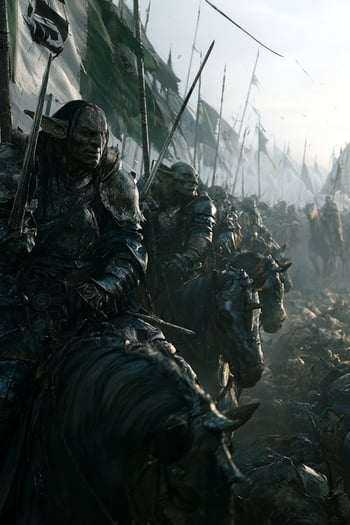
| Scientific Name | Homo Ingeniosus Bellicus |
|---|---|
| Plural | Uris |
| Possessive | Uris |
At a young age, Uris children might challenge one another in a competition of who can hit themselves in the head the hardest with a stick. With encouragement and training from parents and village leaders, they grow to make these competitions more applicable to real life, and heat each other with sticks, and later spells and swords.
There is no time in the life of an Uris Kuulik where some form of violence isn't shaping them. By the time an Uris has been recruited to the battlefield, they will have delivered and received hundreds of small wounds. What an ordinary strain would call "training", the Uris regard as simply "growing up".
When Uris receive their call to adventure, they answer the call with thicker skin than their other Kuulik cousins, having practiced for battle most of their lives. When anyone tells you that they are afraid of the Kuulik, they are most likely imagining an Uris Kuulik, whose martial gaze has the very look of death.
Physical Characteristics
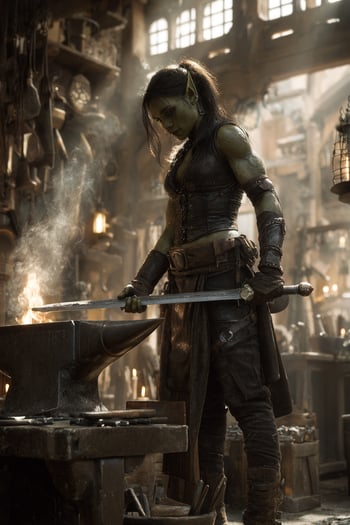
Uris Kuulik are somewhat larger and more heavily built than their Sawdager and Tenizi cousins, standing roughly 9-10 Kul, (130–150 cm) tall. Their faces tend to be more severe, with greyish-green skin that can become quite dark in some individuals. Their greater musculature is not considered a genetic trait, but the inevitable result of a lifetime spent training, fighting, and generally treating physical violence as part of growing up.
Their black hair begins to gray around forty, while male-pattern baldness can appear as early as the thirties. Their eyes may be gold, yellow, orange, or red, giving an already intimidating face an appropriately unsettling finish. Some Uris possess extended canine teeth, although the old stories about a poisonous bite are simply stories.
The most important Uris trait is not visible at all. They possess an unusual ability to recognize impending conflict by reading small physical and behavioral cues: clammy palms, changes in heart rate, hostile posture, facial movements, and other signs that most people barely notice. This instinct can even extend to animals, allowing an Uris to recognize when a creature is preparing to attack. Only a few possess the common Kuulik ability to see well in low light.
Uris Culture
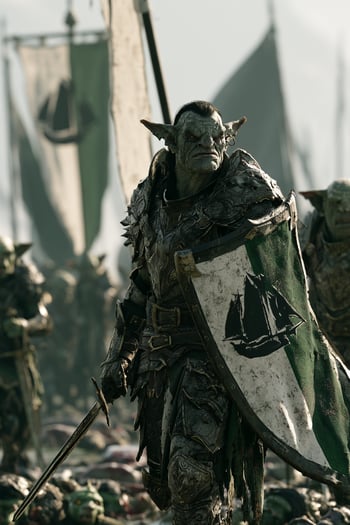
The Uris are the martial arm of the Kuulik Trade Company, but their culture is more disciplined than simply violent. Their central creed is to subdue an opponent with the minimum violence necessary, particularly when protecting their Sawdager and Tenizi cousins. An Uris learns that a fight does not necessarily begin with a weapon; intimidation, disarming an opponent, humiliating a leader, exploiting a weakness, or simply convincing someone that a fight is a bad idea are all legitimate victories.
This tactical mindset begins in childhood and never really ends. Uris conversations frequently become exercises in strategy, with ordinary situations turning into discussions of what might happen if an enemy attacked, a leader fell, or a particular tactic failed. Their songs celebrate battles, their sculptures honor great warriors, and even their dances can become demonstrations of physical skill. Their idea of entertainment has evidently never been subjected to sufficient adult supervision.
The same discipline extends to their practical life. Uris maintain a strong sense of community and gather for town-hall meetings to discuss threats, major events, marriages, births, and the deaths of their people. Meals are commonly communal, with food pooled so that no warrior goes hungry and everyone has an opportunity to exchange stories and discuss tactics. Their preferred diet is deliberately practical: lean meats, vegetables, stews, and little interest in sweets or heavy starches. They are also cautious with alcohol when duty calls, since dulling one's senses is generally considered poor preparation for the next fight.
The Uris have developed a particularly strong tradition of weaponsmithing. Their soldiers' weapons and armor are entrusted to Uris smiths, whose training begins while they are still young soldiers. Apprentices study the techniques of earlier Uris smiths as well as the methods of other peoples before serving under a master. Only smiths who achieve the master rank may produce the specialized equipment of Uris soldiers, while accomplished but non-master smiths produce ordinary tools, goods, architectural metalwork, and items for trade.
Their relationship with the KTC also gives Uris martial culture an unusual purpose. They are not soldiers seeking territory or glory for themselves; they protect the company's people, property, contracts, and reputation. When a client refuses to pay or a shipment disappears, the Uris are the ones sent to resolve the matter, generally using skill, subterfuge, and superior numbers rather than attempting to overpower larger opponents directly. Specialized teams may even operate covertly, and some Uris are trained as spider-mounted assassins, using carefully maintained giant spiders to reach targets that ordinary soldiers cannot.
Religion occupies a surprisingly small place in all this. When Uris do pray, they favor Tiw, the Wodenist god of war, asking for clarity in battle and a worthy afterlife. Yet Tiw appears as a human rather than a Kuulik, and reports that Uris souls survive after death have done little to settle the matter. Most Uris seem more comfortable putting their faith in another training session than in an uncertain promise about what comes afterward. Their formal observances are therefore commemorations of fallen warriors and great victories, usually solemn affairs marked by food and a single stiff drink rather than celebration.
Uris Geography
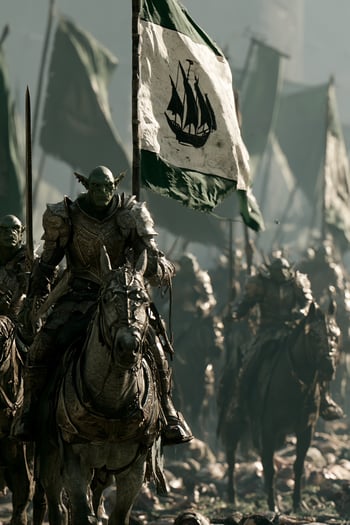
The Uris are concentrated more heavily on Kuulik territory than either of their cousins. Roughly three-quarters of the substrain lives on the Kuulik Peninsula and its neighboring islands, where they serve as the principal landward defense against intruders and surprise attacks. The force is not large enough to withstand the full military strength of most major nations indefinitely, but attacking the Kuulik would still be a costly proposition.
The remainder of the Uris are scattered throughout Otan according to the needs of the Kuulik Trade Company. Some travel in clandestine caravans disguised as merchants, sometimes going so far as to alter their naturally colored noses to complete the disguise. Others establish themselves in major trading centers where their particular skills are needed on a continuing basis. Like the Sawdager merchants around them, these Uris eventually learn enough of the local culture to disappear into it when necessary.
Their missions abroad are usually concerned with recovering stolen goods, enforcing contracts, or dealing with people and organizations that have wronged the KTC. They are not simply assassins for hire; they are specialized combat teams operating on behalf of the company, and eliminating a target is only one possible means of accomplishing the mission. The distinction matters to the Uris, whose purpose is ultimately protection of the company rather than violence for its own sake.
The Kuulik's wider settlement pattern reinforces this mobility. Their recognized territory consists of the Peninsula and adjacent islands, while Kuulik communities elsewhere may be scattered through cities, trading centers, inns, warehouses, and other commercial locations. The Uris therefore occupy an unusual geographic role: they have a physical home to defend, but their work can carry them almost anywhere the KTC has a problem that cannot be solved with a contract, a shipment, or a handshake.
| Copyright © 2021-2026 by Robyn Blaber and Will to Power Games. All rights reserved. Content on this website may not be reproduced without written permission of the copyright owner. |
