Juzuu: Difference between revisions
Robyn.Blaber (talk | contribs) Created page with "{{Infobox substrain | name = Juzuu | strain = Ungir | image = https://imagedelivery.net/TNzzP2IqyQLYoHEs2ZN5aQ/440ccd9e-0cb5-4de1-6464-9a56b15f4100/wiki#.png | caption = The Juzuu (🔊 joo-ZOO-oo) are an aquatic variety of Ungir. They possess the unexplained ability to live underwater indefinitely. and have established underwater settlements. | scientific = Homo Draconiculus Oceanicus | plural = Juzuu | possess..." |
Robyn.Blaber (talk | contribs) No edit summary |
||
| Line 2: | Line 2: | ||
| name = [[Juzuu]] | | name = [[Juzuu]] | ||
| strain = [[Ungir]] | | strain = [[Ungir]] | ||
| image = https://imagedelivery.net/TNzzP2IqyQLYoHEs2ZN5aQ/ | | image = https://imagedelivery.net/TNzzP2IqyQLYoHEs2ZN5aQ/18e59cc4-6081-4d8e-ccc7-b6c5e51c7600/wiki#.png | ||
| caption = The [[Juzuu]] (🔊 joo-ZOO-oo) are an aquatic variety of [[Ungir]]. They possess the unexplained ability to live underwater indefinitely. and have established underwater settlements. | | caption = The [[Juzuu]] (🔊 joo-ZOO-oo) are an aquatic variety of [[Ungir]]. They possess the unexplained ability to live underwater indefinitely. and have established underwater settlements. | ||
| scientific = Homo Draconiculus Oceanicus | | scientific = Homo Draconiculus Oceanicus | ||
| Line 27: | Line 27: | ||
}} | }} | ||
The [[Juzuu]] (Homo Draconiculus Oceanicus) are an exceptionally rare aquatic variety of [[Ungir]] who have mastered the depths of [[Otan]]’s oceans. While they lack visible gills, they possess an internal biological apparatus that allows them to live underwater indefinitely, a feat that remains one of the great mysteries of modern [[ | The [[Juzuu]] (Homo Draconiculus Oceanicus) are an exceptionally rare aquatic variety of [[Ungir]] who have mastered the depths of [[Otan]]’s oceans. While they lack visible gills, they possess an internal biological apparatus that allows them to live underwater indefinitely, a feat that remains one of the great mysteries of modern [[Sophistry]]. | ||
Despite their maritime environment, the [[Juzuu]] remain "tunnellers" at heart. Rather than building structures on the seabed, they carve their elaborate cities into the rock and silt beneath the ocean floor. To an outside observer, an entire [[Juzuu]] metropolis might appear to be nothing more than a stretch of untouched, tranquil seafloor, hiding a bustling civilization beneath the sand. | Despite their maritime environment, the [[Juzuu]] remain "tunnellers" at heart. Rather than building structures on the seabed, they carve their elaborate cities into the rock and silt beneath the ocean floor. To an outside observer, an entire [[Juzuu]] metropolis might appear to be nothing more than a stretch of untouched, tranquil seafloor, hiding a bustling civilization beneath the sand. | ||
| Line 38: | Line 38: | ||
== Physical Characteristics == | == Physical Characteristics == | ||
{{LoreImage|#.png|350px|left}} | {{LoreImage|https://imagedelivery.net/TNzzP2IqyQLYoHEs2ZN5aQ/09f07264-46a7-499d-c9bb-54baa01ad400/wiki#.png|350px|left}} | ||
The [[Juzuu]] share the diminutive stature and distinctive draconic anatomy common to the [[Ungir]]. [[Ungir]] typically stand between 7-9 Kol (105-135 cm) tall and weigh roughly 3-5 Tas (30-50 kg), with bodies covered primarily in skin but marked by clusters of small scales on the hands, feet, limbs, and torso. Their toughened skin provides a natural resistance to cuts and abrasions, a useful trait for a people who spend much of their lives among rock, machinery, and hungry things with teeth. | |||
Their hands carry robust, claw-like nails, while their elongated crocodilian jaws give them a bite considerably more formidable than their size would suggest. Like other [[Ungir]], they possess two to four small fixed horns at the rear of the skull and a short dragon-like tail that provides excellent balance. The tail is capable of grasping and securing objects in some individuals, although it is rarely dexterous enough for delicate work. | |||
The defining [[Juzuu]] trait is their ability to remain underwater indefinitely. [[Sophist]]s have found no conventional respiratory structure that adequately explains the ability, and the mechanism remains one of the more enduring mysteries surrounding [[Ungir]] biology. Whatever its precise nature, the adaptation is entirely natural to the [[Juzuu]] and requires no learned technique or magical preparation. | |||
The [[Juzuu]] are also very much [[Ungir]] in their physical relationship with the world around them. Their small, lightweight frames, clawed hands, strong jaws, balancing tails, and draconic resilience make them well suited to the cramped and demanding environments in which their people live. [[Un]]derwater, these traits combine with their unusual breathing ability to produce a people capable of treating the ocean floor much as their cousins treat the earth above it. | |||
{{-}} | {{-}} | ||
== [[Juzuu]] Culture == | == [[Juzuu]] Culture == | ||
{{LoreImage|#.png|350px|left}} | {{LoreImage|https://imagedelivery.net/TNzzP2IqyQLYoHEs2ZN5aQ/bf7f781d-23e1-420a-5ce2-fbbfb2ba3200/wiki#.png|350px|left}} | ||
The [[Juzuu]] are one of four distinct [[Ungir]] cultures, each shaped largely by the survival strategy adopted by its people. Where the [[Karangi]] retreated underground, and the [[Ustinde ]]remained on the surface, the [[Juzuu]] took to the sea. Their underwater settlements became another expression of the broader [[Ungir]] instinct to hide their communities from those who would do them harm. | |||
Despite living beneath the waves, the [[Juzuu]] have never abandoned the [[Ungir]] tradition of hoarding. Every [[Ungir]] maintains a personal hoard as well as contributing to the hoards of their tribe or community and their nation. For the [[Juzuu]], the ocean provides an extraordinary range of things worth accumulating, including pearls, minerals, corals, and other treasures that can be exchanged with surface-dwellers. | |||
[[Juzuu]] craftsmanship is particularly notable for its ability to solve problems that ought to be rather inconvenient underwater. Smiths have learned to work with natural volcanic caves, alchemical phosphorus, and magic to maintain underwater forges, while simpler work can be performed in forges along the rocky shoreline. Weapons, armor, steel structures, and ordinary metal goods are produced for both local use and trade with surface communities. | |||
The [[Juzuu]] also carry a substantial responsibility for the security of the [[Ungir]] Federation. Their knights and warriors patrol the underwater borders, riding trained sharks into battle when necessary. This is more than colorful military tradition: the [[Juzuu]] are the Federation's eyes beneath the waves, watching for threats that could approach the [[Ungir]] homeland from the sea. | |||
Like other [[Ungir]], the [[Juzuu]] place enormous value on family and community. Their society is generally characterized by unusually high internal trust, communal meals, unlocked homes, and very little crime among [[Ungir]] themselves. Outsiders may be watched carefully, but within the community, a [[Juzuu]] is expected to know that the people around them are part of the same larger hoard—and therefore worth protecting. | |||
{{-}} | {{-}} | ||
== [[Juzuu]] Geography == | == [[Juzuu]] Geography == | ||
{{LoreImage|#.png|350px|right}} | {{LoreImage|https://imagedelivery.net/TNzzP2IqyQLYoHEs2ZN5aQ/cfaee294-eb63-46fb-d675-056346289000/wiki#.png|350px|right}} | ||
The [[Ungirsi Federation]] occupies a strategic buffer between [[Ortalyk]] and the [[Grendel]], with most of its settlements hidden from casual view. Although the Federation is almost landlocked, a small opening reaches the eastern sea. Beyond that narrow coastal access, [[Ungir]] territory continues beneath the waves, where the [[Juzuu]] maintain their underwater settlements. | |||
The [[Juzuu]] settlement pattern reflects the old [[Ungir]] instinct for survival through concealment. Their permanent communities lie beneath the sea, while temporary settlements are established along nearby beaches. These surface settlements provide essential contact with air-breathing traders and can be abandoned quickly when trouble approaches, then rebuilt once the danger has passed. | |||
The coastline is therefore as much a part of [[Juzuu]] territory as the ocean floor itself. Rocky beaches and seaside cliffs serve as trade hubs where [[Juzuu]] smiths can operate conventional forges and exchange weapons, armor, and metal goods for supplies unavailable beneath the waves. The sound of their hammers is one of the few reliable signs that an underwater community is nearby. | |||
Beneath the surface, the [[Juzuu]] occupy a realm that remains largely invisible to the peoples of [[Otan]]. Their population is particularly difficult for foreign census-takers to measure, since the sub-aquatic [[Juzuu]] cannot be counted from the surface with any useful accuracy. The result is a familiar [[Ungir]] paradox: a people whose territory is known to exist, whose communities are known to be substantial, and whose actual numbers remain almost impossible for outsiders to determine. | |||
{{-}} | {{-}} | ||
{{Copyright notice}} | {{Copyright notice}} | ||
[[Category:Substrains]] | [[Category:Substrains]] | ||
[[Category:Ungir Substrains]] | [[Category:Ungir Substrains]] | ||
Latest revision as of 17:29, 16 September 2026
| Scientific Name | Homo Draconiculus Oceanicus |
|---|---|
| Plural | Juzuu |
| Possessive | Juzuuan |
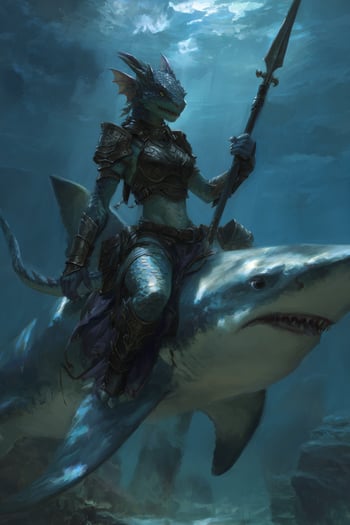
The Juzuu (Homo Draconiculus Oceanicus) are an exceptionally rare aquatic variety of Ungir who have mastered the depths of Otan’s oceans. While they lack visible gills, they possess an internal biological apparatus that allows them to live underwater indefinitely, a feat that remains one of the great mysteries of modern Sophistry.
Despite their maritime environment, the Juzuu remain "tunnellers" at heart. Rather than building structures on the seabed, they carve their elaborate cities into the rock and silt beneath the ocean floor. To an outside observer, an entire Juzuu metropolis might appear to be nothing more than a stretch of untouched, tranquil seafloor, hiding a bustling civilization beneath the sand.
These aquatic Ungir lead a distinctive dual life, bridging the gap between the deep trenches and the sunlit coasts. They frequently establish temporary markets on secluded beaches to trade ocean-harvested treasures, such as rare pearls, deep-sea minerals, and unique corals, for goods from the surface world.
When it comes to defense and travel, the Juzuu exhibit the same talent for animal husbandry seen in other dragon-descended strains, though their focus is decidedly more predatory; they patrol their territorial waters from the backs of great sharks, which they train with a firm and expert hand.
The Juzuu are far from isolated, maintaining regular and sophisticated lines of communication with their terrestrial Ungir cousins. They act as the "eyes beneath the waves" for the broader Ungir population, serving as a first line of defense against seaborne threats. By patrolling the coastlines and securing the submerged portions of coastal tunnel systems, the Juzuu ensure that Ungir shores remain impenetrable to any enemy foolish enough to approach from the sea.
Physical Characteristics
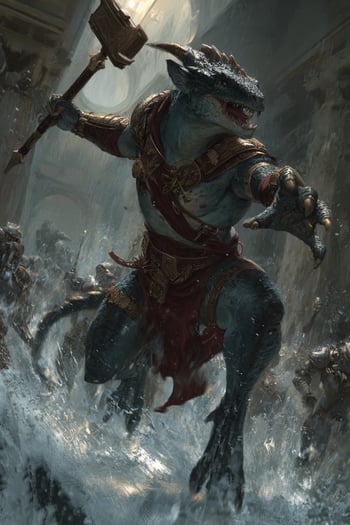
The Juzuu share the diminutive stature and distinctive draconic anatomy common to the Ungir. Ungir typically stand between 7-9 Kol (105-135 cm) tall and weigh roughly 3-5 Tas (30-50 kg), with bodies covered primarily in skin but marked by clusters of small scales on the hands, feet, limbs, and torso. Their toughened skin provides a natural resistance to cuts and abrasions, a useful trait for a people who spend much of their lives among rock, machinery, and hungry things with teeth.
Their hands carry robust, claw-like nails, while their elongated crocodilian jaws give them a bite considerably more formidable than their size would suggest. Like other Ungir, they possess two to four small fixed horns at the rear of the skull and a short dragon-like tail that provides excellent balance. The tail is capable of grasping and securing objects in some individuals, although it is rarely dexterous enough for delicate work.
The defining Juzuu trait is their ability to remain underwater indefinitely. Sophists have found no conventional respiratory structure that adequately explains the ability, and the mechanism remains one of the more enduring mysteries surrounding Ungir biology. Whatever its precise nature, the adaptation is entirely natural to the Juzuu and requires no learned technique or magical preparation.
The Juzuu are also very much Ungir in their physical relationship with the world around them. Their small, lightweight frames, clawed hands, strong jaws, balancing tails, and draconic resilience make them well suited to the cramped and demanding environments in which their people live. Underwater, these traits combine with their unusual breathing ability to produce a people capable of treating the ocean floor much as their cousins treat the earth above it.
Juzuu Culture
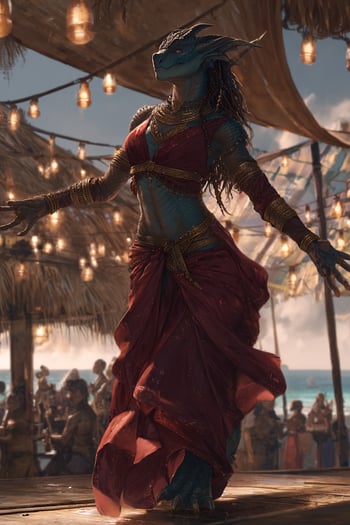
The Juzuu are one of four distinct Ungir cultures, each shaped largely by the survival strategy adopted by its people. Where the Karangi retreated underground, and the Ustinde remained on the surface, the Juzuu took to the sea. Their underwater settlements became another expression of the broader Ungir instinct to hide their communities from those who would do them harm.
Despite living beneath the waves, the Juzuu have never abandoned the Ungir tradition of hoarding. Every Ungir maintains a personal hoard as well as contributing to the hoards of their tribe or community and their nation. For the Juzuu, the ocean provides an extraordinary range of things worth accumulating, including pearls, minerals, corals, and other treasures that can be exchanged with surface-dwellers.
Juzuu craftsmanship is particularly notable for its ability to solve problems that ought to be rather inconvenient underwater. Smiths have learned to work with natural volcanic caves, alchemical phosphorus, and magic to maintain underwater forges, while simpler work can be performed in forges along the rocky shoreline. Weapons, armor, steel structures, and ordinary metal goods are produced for both local use and trade with surface communities.
The Juzuu also carry a substantial responsibility for the security of the Ungir Federation. Their knights and warriors patrol the underwater borders, riding trained sharks into battle when necessary. This is more than colorful military tradition: the Juzuu are the Federation's eyes beneath the waves, watching for threats that could approach the Ungir homeland from the sea.
Like other Ungir, the Juzuu place enormous value on family and community. Their society is generally characterized by unusually high internal trust, communal meals, unlocked homes, and very little crime among Ungir themselves. Outsiders may be watched carefully, but within the community, a Juzuu is expected to know that the people around them are part of the same larger hoard—and therefore worth protecting.
Juzuu Geography
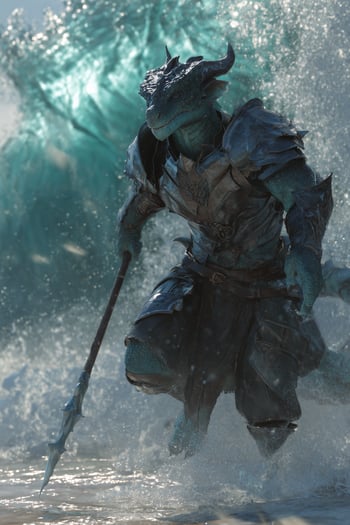
The Ungirsi Federation occupies a strategic buffer between Ortalyk and the Grendel, with most of its settlements hidden from casual view. Although the Federation is almost landlocked, a small opening reaches the eastern sea. Beyond that narrow coastal access, Ungir territory continues beneath the waves, where the Juzuu maintain their underwater settlements.
The Juzuu settlement pattern reflects the old Ungir instinct for survival through concealment. Their permanent communities lie beneath the sea, while temporary settlements are established along nearby beaches. These surface settlements provide essential contact with air-breathing traders and can be abandoned quickly when trouble approaches, then rebuilt once the danger has passed.
The coastline is therefore as much a part of Juzuu territory as the ocean floor itself. Rocky beaches and seaside cliffs serve as trade hubs where Juzuu smiths can operate conventional forges and exchange weapons, armor, and metal goods for supplies unavailable beneath the waves. The sound of their hammers is one of the few reliable signs that an underwater community is nearby.
Beneath the surface, the Juzuu occupy a realm that remains largely invisible to the peoples of Otan. Their population is particularly difficult for foreign census-takers to measure, since the sub-aquatic Juzuu cannot be counted from the surface with any useful accuracy. The result is a familiar Ungir paradox: a people whose territory is known to exist, whose communities are known to be substantial, and whose actual numbers remain almost impossible for outsiders to determine.
| Copyright © 2021-2026 by Robyn Blaber and Will to Power Games. All rights reserved. Content on this website may not be reproduced without written permission of the copyright owner. |
