School of Drama
| Training for | Bard |
|---|
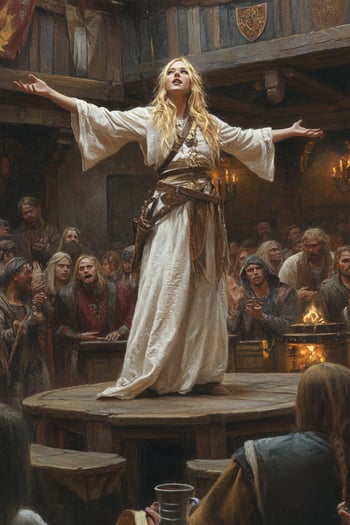
While the dancer moves the body and the musician moves the air, the practitioner of the School of Drama moves the very soul of the observer. This school prepares the Bard for levels of rhetorical intrigue that no other class can possess. While other archetypes may influence the will of an individual or a crowd through brute force or magical compulsion, the dramatic Bard uses the "theatrical will" to finely tune the beliefs of their audience.
Properly trained, a dramatist can incite a riot in a peaceful square, charm the most cynical skeptic, or fool the oblivious into seeing exactly what the Bard desires. These are not merely stage tricks; for those with Bardic Powers, the performance becomes a reality-bending force. It is no coincidence that many of Otan’s most influential advisors and figures of authority are alumni of this school, having mastered the art of "rewriting the scene" to suit their ambitions.
Teaching Methods

Drama is an art of transmission; while every student has the capacity to pass on what they have learned, formal Academies of Drama are typically centralized in major national and regional capitals. In the sprawling urban centers, early skills and foundational techniques are taught in large classrooms or within "Small Companies." These sessions are often crowded, as non-powered thespians, actors seeking only the craft without the Power, frequently study alongside Bards to sharpen their unpowered performance.
As the Bard progresses to more intensive and reality-altering Powers, however, the environment shifts. Such advanced tutelage is almost always one-on-one. While these high-level lessons can be passed from any skilled Bard in an informal setting, the presence of a live stage and even a small, unwitting audience acts as a catalyst, significantly accelerating the student’s mastery of the power.
| Copyright © 2021-2026 by Robyn Blaber and Will to Power Games. All rights reserved. Content on this website may not be reproduced without written permission of the copyright owner. |
