Ustinde
| Scientific Name | Homo Draconiculus Praefectus |
|---|---|
| Plural | Ustindes |
| Possessive | Ustindean |
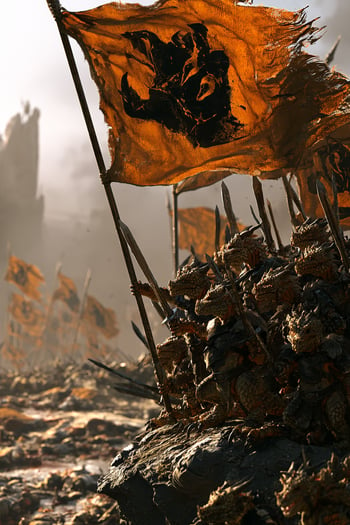
The Ustinde (Homo Draconiculus Praefectus) serve as the terrestrial face of the Ungir, occupying the precarious surface-level territories of their homeland. Unlike their cousins, they possess no biological escape route; they cannot retreat into the deep earth like the Karangi, vanish into the waves like the Juzuu, or take to the skies like the Usatin.
This permanent presence on the ground forces them to face their enemies directly, standing as the frontline shield for the entire Ungir race. They are easily identified by their striking orange-tinted skin and the characteristic industriousness that defines their lineage, even in the face of constant external pressure.
Life for the Ustinde is a grueling exercise in survival. They are deeply despised by the neighboring Ortalykshilar Humans, many of whom still harbor the bitter prejudices of the Grendel War and view the dragon-blooded Ungir as remnants of that dark era. Consequently, Ustinde settlements are frequent targets of human raids. Being physically small and slight, they are no match for the crushing weight of human cavalry in a direct engagement. To prevent being overrun, they have become the world’s foremost experts in defensive engineering, utilizing extremely clever traps, layered fortifications, and landscape-altering defenses that turn their rocky terrain into a death trap for mounted invaders.
They find little sympathy from their more powerful draconic relatives, the Aydahar. These larger, more formidable beings generally view the Ustinde as unworthy of their notice or assistance. To the Aydahar, the monumental effort required to engage the Ortalyk Army on a traditional battlefield is simply not worth the survival of their smaller cousins.
This abandonment has forced the Ustinde to develop a fierce self-reliance and a sophisticated diplomatic network. They have become the primary coordinators of the Ungir Federation, weaving the disparate aquatic, subterranean, and aerial substrains into a unified political body that protects their collective interests. The Ungirsi Federation is truly more grand than the sum of its parts.
Despite inhabiting a dry, rocky territory that yields little natural wealth, the Ustinde have managed to build a burgeoning economy through sheer perseverance. They leverage their most significant advantage: a population that is among the fastest-growing in Otan. By mobilizing their massive numbers and coordinating the trade of resources between the other Ungir substrains, the Ustinde ensure that their nation remains a rising power. They prove every day that while they may be the most vulnerable branch of the draconic tree, they are also the most resilient, holding their ground when the rest of the world expects them to crumble.
Physical Characteristics
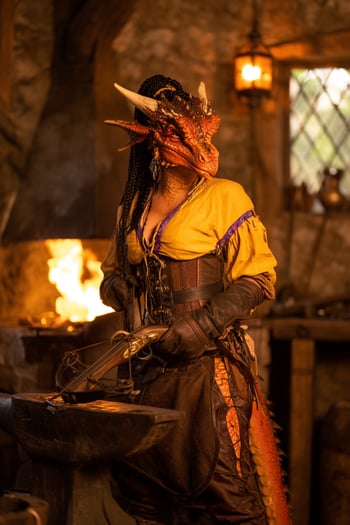
The Ustinde possess the compact, draconic body common to the Ungir, with toughened skin reinforced by small, flexible scales. Their hands end in durable, claw-like nails, their faces carry the elongated jaw of their dragon ancestry, and every Ustinde bears two to four small fixed horns toward the rear of the skull. A short dragon-like tail provides balance and can serve as a secondary grip, although most lack the fine control needed for delicate work.
Ustinde are generally brown to orange in coloration, with the familiar orange-brushed appearance making them the most recognizable Ungir to outsiders. Their bodies are small and relatively slight compared with most other humanoid strains, a disadvantage that becomes particularly obvious when confronted by mounted opponents. What they lack in physical size, they compensate for with coordination, climbing ability, and an instinctive talent for turning their surroundings into useful tools.
The Ustinde retain the Ungir aptitude for physical work and construction. Their claws are evolutionary remnants of a people whose ancestors were diggers, but modern Ustinde rarely need to excavate with their hands. Their real advantage is the combination of small stature, dexterity, tireless industry, and a willingness to put an unreasonable number of people on a problem until the problem gives up.
Ustinde Culture
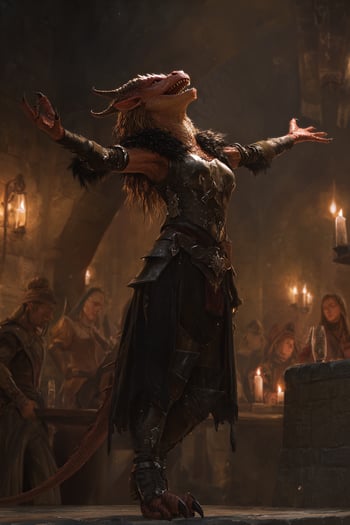
The Ustinde are the most openly social of the Ungir cultures and the part of the Federation most often encountered by outsiders. They retain strong cultural ties to the old Aydahar traditions of surface life, but their circumstances have forced those traditions into something more practical and defensive. Their settlements must be ready for trouble, and so Ustinde culture prizes preparation, cooperation, and the ability to turn limited resources into something useful.
Ustinde naturally gravitate toward leadership, diplomacy, and commerce. They are often found representing the Federation in political matters, but leadership does not necessarily mean government; an Ustinde might just as easily own a bakery, tannery, smithy, or other small business and happily manage a staff rather than negotiate treaties. Their instinct is organizational: when many small hands are available, someone needs to decide where those hands should go.
Hoarding remains central to Ustinde life, as it does among all Ungir. Political power traditionally follows the size of one's hoard, while exceptional service to the community can be represented by tokens that add political weight to an otherwise modest collection of wealth. For the Ustinde, however, hoarding has acquired a practical quality; possessions may be kept on carts inside easily abandoned buildings, ready to be moved should a settlement become unsafe.
The Ustinde are also the great coordinators of the Ungir Federation. Representatives of the four cultures meet at Negizi Ungir to discuss trade, territorial defense, and the common interests of the Ungir people, and the Ustinde provide much of the political machinery that keeps those interests aligned. Their diplomacy is not merely an exercise in polite conversation; it is a survival strategy for a small people surrounded by larger and often hostile neighbors.
Their economic life reflects the same pragmatism. The Ustinde operate farms, markets, workshops, and surface businesses while moving resources between the four Ungir cultures, drawing upon the products of the Karangi underground markets and the Juzuu trading ports. They are also merchants, innkeepers, blacksmiths, hostlers, and other tradespeople, with some turning their small stature into an advantage by organizing large amounts of work through tightly coordinated communities.
Ustinde Geography
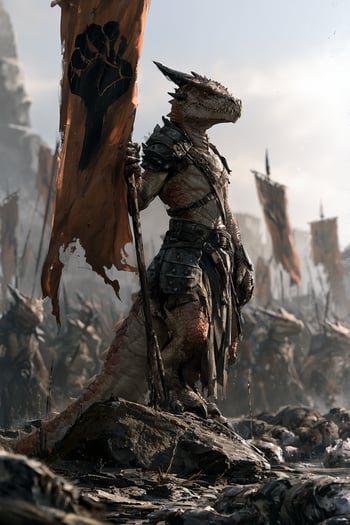
The Ustinde occupy the surface of the Ungirsi Federation and form the visible face of the nation. Their territory lies between the larger powers of Ortalyk and the Grendel, making the Federation a natural buffer between them. While the Karangi disappear beneath the ground, the Juzuu beneath the eastern sea, and the Usatin into the western mountains, the Ustinde remain in the towns and cities that outsiders actually see.
Their homeland is not especially generous. The Federation was settled in lands regarded as largely desolate, with little valuable farmland or timber and few natural resources to attract foreign powers. The Ustinde nevertheless built towns and cities from the raw materials available to them, establishing a permanent civilization in territory that other peoples had little interest in claiming.
Ustinde settlements are consequently built for both productivity and survival. Their cities contain farms, markets, workshops, and substantial stonework, while their defensive engineering turns the surrounding landscape into another part of the settlement itself. Fortifications, traps, and other carefully prepared defenses compensate for the physical disadvantages of a population that cannot hope to meet human cavalry on equal terms.
The surface settlements also serve as the connective tissue of the Federation. Goods arriving from the Juzuu ports can move inland toward Ustinde markets, while resources and supplies can be exchanged with the subterranean Karangi. Beneath and beyond these visible communities lies the much larger hidden network of Ungir passageways, giving the surface cities access to a nation that is considerably larger than an outsider might suspect.
The result is a geography that can be deceptive. An outsider may enter an Ustinde city and believe they have seen the Ungirsi Federation, when they have really seen only its front door. The farms, streets, markets, defenses, and bustling workshops belong to the Ustinde, but the nation continues below the ground, along the coast, and high in the western peaks.
| Copyright © 2021-2026 by Robyn Blaber and Will to Power Games. All rights reserved. Content on this website may not be reproduced without written permission of the copyright owner. |
