Aspanism

| Possessive | Aspanist |
|---|---|
| Religion Type | Polythesitic |
| Followed by | Ontustikers |
| Deities | Aspan, Bostiq, Jur, Sogis, Suu, Tun, Tun |
Aspanism is the heartbeat of the Caliphate of Ontustik, centered on the foundational union of the three Great Personifications: Aspan (the Sky), Suu (the Waters), and Jur (the Ground). While Aspan is the supreme creator and the personification of the infinite blue above, the faith is far from a cold, distant monotheism. The average citizen of Ontustik lives their life in the colorful, dramatic shadow of the "Intercessors"; deities born from the primordial trio specifically to walk, love, and work alongside humanity.
The people and the all-female clergy, known as the Flowers of Aspan, find their true connection to the divine through Tun and Kun. These divinities do not serve as the abstract concepts of creation; they are rather the celestial mirrors of the human experience. Tun, goddess of the night and love, presides over the mysteries of the heart and the intimacy of the dark. Her counterpart, Kun, is the vibrant god of the sun, day, and industry, the patron of every laborer, merchant, and builder under the sun.
The creators gave life to the intercessors to permit humans access to the divine. These more relatable gods can better understand us on a human level, making the divine feel like a shared partner in the struggle and joy of existence. This relationship is physically anchored by the massive ziggurats that dominate the horizon of every Ontustik settlement. These towering structures are the social and spiritual hubs of the community.
Managing these structures and the people who worship there are the Flowers of Aspan. They lead rituals that celebrate the "higher-type" sensuality and industry that define civilization. Under the guidance of the Ninth Lotus, the clergy teaches that the drive to build, to groom oneself, and to create beauty is a sacred reflection of the gods' own nature. In the Caliphate, to be civilized is to be godly, and to be human is to be in constant conversation with the sky and the sun.
Aspanist Tenets
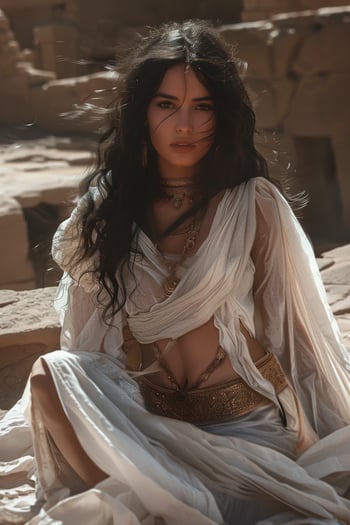
The tenets of Aspanism function as a practical blueprint for a prosperous existence, guiding the faithful through every facet of the human experience. These instructions, meticulously curated and disseminated by the Flowers of Aspan, are not merely abstract spiritual goals but actionable commandments for a flourishing society.
The "Living Papyri", jokingly called the "Tiri Papiri" by clergy insiders, cover the breadth of civil life. They prescribe methods for cultivating the arid lands of Ontustik, governing the ethics of commerce and lending, and outlining the social obligations of friendship and family. Much of this wisdom is anchored in the Sezim Taldik, derived from the many parables within the Legend of Batir. Through the hero-king's triumphs and frequent, messy failures, the Aspanist clergy illustrates that a "better life" is built on the pursuit of beauty, the maintenance of order, and the mastery of the physical world under the living and loving sky.
Aspanist Clergy
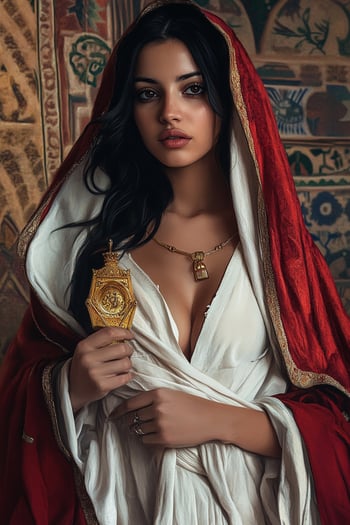
The clergy of Aspanism, known collectively as the Flowers of Aspan, represent a seamless union of spiritual authority and civic governance. In the Caliphate of Ontustik, there is no distinction between church and state; the Flowers are both the keepers of the divine blueprint and the administrators of the law. This sacred hierarchy is anchored in the capital city of Anar, where the Ninth Lotus of Aspan reigns as the nation’s supreme divine leader.
From her seat of power, the Ninth Lotus of Aspan commands the faith and the country, ensuring that the civilization-building principles of Aspanism are upheld across every province. Throughout the settlements of Ontustik, she appoints specific floral designations, creating a lineage of living icons. Each settlement is thus governed by a single high-ranking priestess whose title is tied to her location and her place in an unbroken succession.
The Fourteenth Rose of Karakat, for example, serves as the absolute authority in her region; upon her passing, her successor is consecrated as the Fifteenth Rose. These women are far more than mere bureaucrats; they are the physical intercessors for their people, embodying the beauty, industry, and order that Aspanism demands of all humans. Under their guidance, the massive ziggurats of the Caliphate function as the literal and metaphorical centers of the world, where the Flowers cultivate both the land and the souls of the faithful.
Creation

The creation of Otan was not a cold act of shaping clay or uttering commands, but a primal act of passion between the great personifications. In the beginning, Aspan (the Sky) and Jur (the Ground) came together in a divine union, their lovemaking spanning the horizons. As they moved, Suu (the Waters) stood as the witness to the union, flowing around and between them to cool the heat of their contact and provide the fluid spark of life. From this cosmic intimacy, the world of Otan was born, and with it, the first human strains emerged like wildflowers after a storm.
However, once the world was populated, the Great Personifications looked down and saw that their children were adrift, lacking the structure to build anything lasting. The Sky was too vast to hear every prayer, and the Earth too solid to answer them. To bridge this gap, the Intercessors, Tun, Kun, and Kures, were brought into being.
These "relatable" gods were fashioned specifically to interpret the blueprints of the universe for humanity. They were given the task of providing the guidance, industry, and passion necessary to transform a wild world into a civilization, ensuring that the people of Otan would never have to walk the path of existence alone.
Aspanist Observances
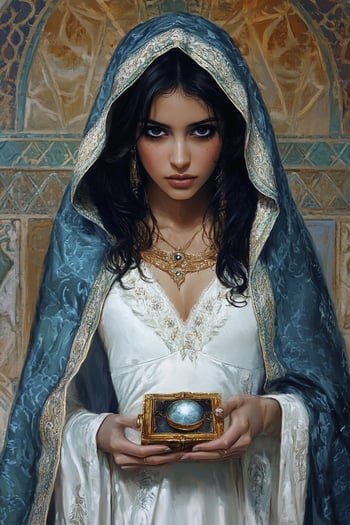
In the Caliphate of Ontustik, the local ziggurat is far more than a house of worship; it is the bustling civic and judicial heart of every settlement. Throughout the week, the faithful bring their daily concerns to the Flowers of Aspan, seeking mediation for contract disputes, guidance on agricultural management, or counsel on family matters.
The clergy acts as the ultimate authority on secular order, ensuring that the "blueprint for life" is applied to the mundane realities of trade and law. By positioning the ziggurat as a center for both spiritual and practical administration, Aspanism ensures that the divine influence of the sky is woven into the very fabric of the marketplace and the courtroom.
This secular bustle falls silent on Senbi, the holy day of the week, when the ziggurat is reserved exclusively for the sacred. On Senbi, the focus shifts from the law of the land to the state of the soul. The penitent gather to offer donations to the temple and undergo rituals of purification intended to cleanse the spirit of sin and "stagnation."
For those burdened by more serious spiritual weight, this cleansing takes a physical form through sacred sexual congress with the clergy, a practice rooted in the belief that sensual vitality is the ultimate cleanser of the spirit. This unique aspect of the faith ensures that the people of Ontustik are remarkably diligent in their religious observances, frequently seeking the temple's intercession to ensure their souls remain "absolutely spotless."
Aspanist Pantheon
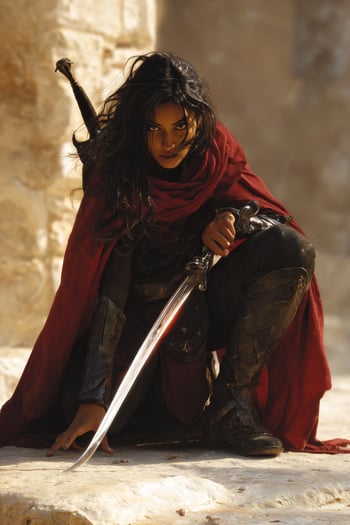
The Aspanist pantheon is a rigid yet vibrant hierarchy that mirrors the structure of the Caliphate itself. At the apex sit the three Great Personifications: Aspan (Sky), Suu (Water), and Jur (Ground). These are the primordial architects of Otan. Beneath them serve the Intercessors, Tun and Kun, who were fashioned with human-like temperaments to provide the guidance and drive necessary for civilization to flourish.
These intercessors are joined by Kures, the god of war, who oversees the inevitable conflicts born of human ambition. Communication between these high powers and the mortal realm is carried out by The Messengers; birds, sudden weather shifts, and the roar of thunder are never viewed as mere natural phenomena, but as urgent portents and omens sent to the Flowers of Aspan to interpret.
While the Intercessors focus on life and industry, the pantheon is shadowed by the presence of Bostiq, the Goddess of the Void. Bostiq is the personification of entropy, representing the inevitable silence and nothingness that waits beyond the reach of the sky.
Aspanist Foklore
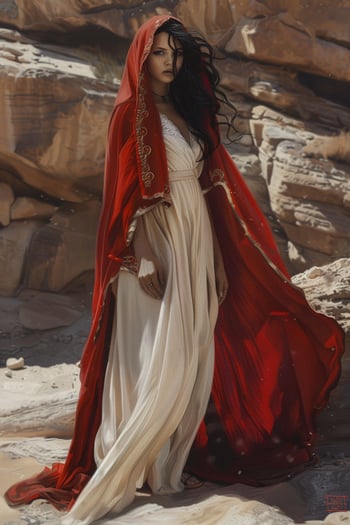
In the sacred pages of the Sezim Taldik, the line between history and myth blurs within the many chronicles of the legendary King Batir. The most pivotal of these tales recounts an encounter between Batir and the god Kun, whom the king found uncharacteristically harried and laboring to bury a collection of crystal tablets within a deep fissure in the earth.
In the most celebrated cycle of the Sezim Taldik, the god Kun is portrayed not just as the god of industry, but as a divine rebel. It is written that when Aspan authored the 64 Memes, he intended them to remain hidden, a perfect blueprint of the universe that no mortal eye was ever meant to behold. Aspan believed that for humans to know "everything" would be to make them gods, upsetting the balance of the cosmic order.
Kun, however, looked upon the struggling people of Otan with a different heart. In a defiance reminiscent of the ancient fire-bringers, Kun stole the crystal tablets from the heavens. He believed that if humanity were to work together, they deserved the chance to reach for the divine. But he was no fool; he knew that if he handed the full collection to one man, it would lead to tyranny and destruction. Instead, he shattered the "all-knowing" archive, distributing the tablets to the four corners of Otan.
As Kun was frantically burying the final cache of tablets to avoid detection by the other gods, he was discovered by King Batir. It was here that the god shared his vision: humanity would only possess the full blueprint of the universe when they had evolved enough to unite across the world to find and share in the power of these artefacts.
Batir, recognizing the weight of this gift, founded the Flowers of Aspan to safeguard the fragments he could recover and to act as the primary stewards of Kun’s stolen wisdom. To this day, the tablets rumored to be within the Tree of Anar are seen as "stolen light," a constant reminder that the people of Ontustik have a divine mandate to build, learn, and eventually, reunite the pieces of the world.
Writings & Artefacts
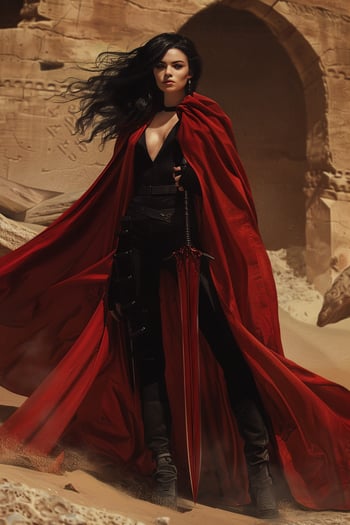
Sacred Writings and Artefacts The Sezim Taldik (The Thousand Stories): This is the central religious text of Aspanism and is widely circulated throughout the Caliphate. It is a massive compendium containing a thousand stories of gods, kings, and morality, most famously the Legend of Batir. While it is considered "common knowledge" and the foundation of Aspanist life, physical copies are exquisite works of art, often bound in fine leathers or silk, making them expensive to own and highly prized as family heirlooms.
The Memes of Aspan: These sixty-four crystal tablets are the stuff of high legend and deep mystery. Said to be the literal, unedited blueprints of the universe authored by Aspan himself, they were stolen and scattered across Otan by the god Kun. While the Flowers of Aspan are rumored to possess a small number of these tablets within the Tree of Anar, the existence of the remaining tablets is a matter of intense debate among scholars and theologians, with many believing they remain hidden in the four corners of the world, waiting for humanity to unite.
| Copyright © 2021-2026 by Robyn Blaber and Will to Power Games. All rights reserved. Content on this website may not be reproduced without written permission of the copyright owner. |
