Otani Language
| General Information | |
|---|---|
| Native Name | Ortalysh |
| Language Family | Ortaluyk Til |
| Usage | Spoken, Written |
| Speakers | |
| Where Spoken | Ortalyk, Soltustic, throughout Otan |
| # of Speakers | 13,000,000 |
The Ortalyk Language, more commonly called Otani, is the most widely spoken language on Otan, although its use is considerably more common in the eastern half of the continent than in the west. It belongs to the Ortaluyk Til family of languages, a linguistic family whose origins reach back beyond the Great Erasure. The oldest surviving examples of the language are found as inscriptions on a small number of rare artefacts that somehow escaped the destruction of the Great Erasure. These fragments preserve the older form of the elder language, often called Old Otani, whose grammar is considerably more complex than that of its modern descendant.
Modern Ortalyk is, in many respects, a linguistic thief. Centuries of contact with neighboring peoples have left it littered with borrowed words, expressions, and even entire phrases, with recognizable contributions from the Aelfen, Dweorgen, and Aydahari languages appearing in ordinary speech. Rather than resisting these intrusions, Ortalyk has gradually streamlined its grammar to accommodate them, producing a language that is easier to learn but considerably less orderly than its ancient predecessor. To an unfamiliar ear, Ortalyk has the broad character of an auctioneer: a steady, flowing rhythm punctuated by firm consonants, with frequent guttural or back-of-the-throat sounds and vowels that can give long sentences a rolling, almost musical quality.
Speakers and Distribution
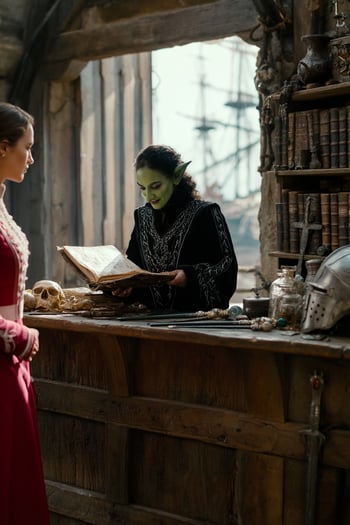
Ortalyk is ubiquitous throughout Ortalyk itself and is commonly spoken in the surrounding nations of Batis, Altinquor, Ontustik, Soltustik, and Aelfwode. Its usefulness as a common language has made it particularly valuable to merchants, travelers, soldiers, and diplomats who regularly cross political and cultural boundaries. Even where another language dominates daily life, a working knowledge of Ortalyk is often useful for dealing with outsiders.
The Kuulik Trade Company has helped cement Ortalyk's position as the practical language of commerce. KTC outlets throughout Otan commonly maintain their records and books in Ortalyk, allowing accounts, contracts, inventories, and correspondence to travel between distant branches without requiring translation at every step. An estimated 13 million people speak Ortalyk, making it the closest thing Otan has to a continental lingua franca.
Writing and Literature
The most widespread work written in Ortalyk is the Book of Woden. Copies can be found in virtually every settlement where the name of Woden is spoken, including nations where Ortalyk itself is used by only a small minority. The book therefore serves not merely as a religious text, but as one of the strongest forces maintaining a common written language across otherwise distant cultures.
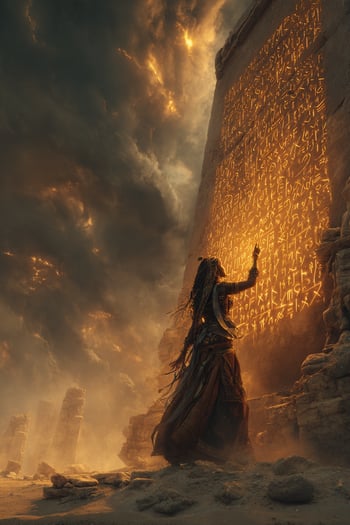
The Ortalyk script is fundamentally phonetic, with its symbols representing the sounds of the spoken language. They are not, however, merely functional marks. Traditional meanings have accumulated around many of the symbols, drawing associations from religion, inherited custom, and the zodiac that forms part of the modern Otani calendar. As a result, written Ortalyk carries layers of meaning that can be invisible to someone who has learned only how to pronounce the words.
| Copyright © 2021-2026 by Robyn Blaber and Will to Power Games. All rights reserved. Content on this website may not be reproduced without written permission of the copyright owner. |
