Aydahari Language
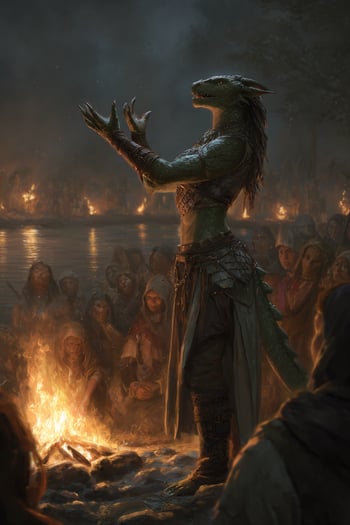
| General Information | |
|---|---|
| Native Name | Aydaharish |
| Language Family | Ortaluyk Til |
| Usage | Spoken, Written |
| Speakers | |
| Where Spoken | Altinqor |
| # of Speakers | 5,000,000 |
The Aydahari Language is more an adaptation of a common tongue than a wholly separate language. The elongated Aydahar skull, longer and more agile tongue, and lips that do not form as tight a seal as those of most humanoids have gradually pushed the language away from consonants that require closed lips, particularly the hard “b” and “p” sounds. The result remains close enough to the common Otani language that a careful Ortalyk speaker can sometimes make out individual words in an otherwise unfamiliar Aydahari sentence. To the untrained ear, however, the distinction is rather less academic: Aydahari sounds like cats or snakes arguing over a musical arrangement of breathy vowels, hisses, and tongue-formed consonants.
Aydahari has also borrowed naturally from the Draconic Language spoken by the True Dragons. Dragon speech can convey extraordinary amounts of information in a single sound pattern, sometimes compressing what would be an entire sentence into a single word. Dragons nevertheless employ certain single-word expressions as part of their linguistic protocol, and these have been adopted enthusiastically by the Aydahar. The result is a language that retains recognizable Otani grammar and inflection while carrying unmistakable traces of its draconic inheritance.
Speakers and Distribution
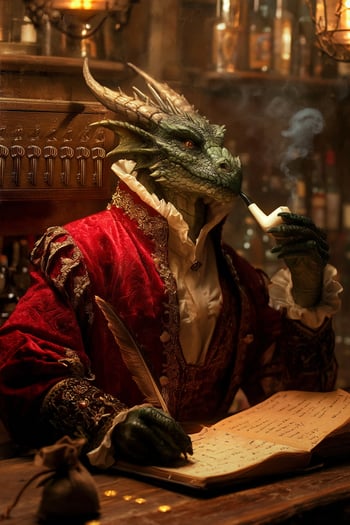
Nearly five million speakers use Aydahari every day, primarily within the nation of Altinqor. As with many languages on Otan, Aydahari divides into several dialects corresponding broadly with the six Aydahar substrains. These dialects can themselves break into smaller regional forms, particularly in remote communities such as the high-altitude settlements of the Aq Aydahar.
Despite these differences, the common language remains sufficiently unified for Aydahar from different regions to communicate without great difficulty. The Jazil Aydahar have perhaps the most distinctive dialect. Their aquatic tendencies have shaped not only pronunciation but also much of their vocabulary, with slang, popular idioms, and curses drawing freely from the freshwater lakes and rivers that define their homeland.
At the opposite end of the spectrum is the Altin dialect, regarded by Aydahar as the gold standard of diction. It is precise, formal, and somewhat stilted, which makes it particularly appropriate for government and ceremonial speech in the capital of Kazinasi. Elsewhere, most speakers have little reason to sound like the Council of Six Elders when they could simply sound like themselves.
Writing and Literature
Written Aydahari is readily understood by anyone capable of reading the Ortalyk language, reflecting the close relationship between the two. The written forms are similar in almost every practical respect, although modern Aydahari has softened some of the popping consonants of older speech, and this evolution is sometimes represented in writing. The language therefore presents considerably fewer difficulties on the page than it does when spoken aloud.
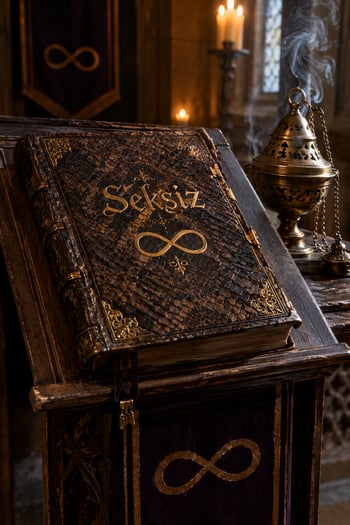
The most common book in Altinqor is Seksiz, or The Infinite. It follows the Book of Woden, but retells its religious themes through the eyes of Jormungandr, the World Snake. Additional chapters turn toward the science, mathematics, and philosophy of infinity, exploring a concept that Aydahar tradition holds can only truly be understood in the afterlife, embraced within the infinite coils of Jormungandr. It is therefore both a religious work and an intellectual one, reflecting the peculiar place that infinity occupies in Aydahari belief.
The most popular secular work in Altinqor is undoubtedly A Geniology of Dragons, by the famed Sophist Akmaral Astiq and numerous contributors. This massive work proceeds backward from the present toward the period before the Great Erasure in an attempt to unravel the origins of the Aydahar and their Dragon progenitors.
How much of the work represents recovered history and how much is philosophical fancy is difficult to determine, but Aydahari Sophists stand firmly behind it. With hundreds of contributors, the book has become less the work of a single author than a continuing attempt to reconstruct a past that the Great Erasure made deliberately inconvenient.
| Copyright © 2021-2026 by Robyn Blaber and Will to Power Games. All rights reserved. Content on this website may not be reproduced without written permission of the copyright owner. |
