Baksism

| Possessive | Baksist |
|---|---|
| Religion Type | Polythistic |
| Followed by | Ortalykshilar |
| Deities | Adidi, Ana, Awa, Buzaki, Ferma, Jer, Nayza, Teniz |
Baksism is the primary animistic and polytheistic faith of the Karazalikar people, a human substrain characterized by their resilience and deep connection to the arid terrains they inhabit. At its core, the religion operates on the principle of universal vitality, asserting that all components of the natural world, from the smallest desert shrub to the most imposing mountain peaks, possess a divine soul or spirit.
Unlike the more rigid, "bookish" dogmas found in other corners of Otan, Baksism is a living, oral tradition that emphasizes a practical, reciprocal relationship between humanity and the environment. Practitioners do not merely worship the divine; they negotiate with it, seeking to appease or influence spirits to ensure a safe journey, a successful harvest, or the calming of turbulent waters.
The theological framework of the faith is centered on Ana, the World Mother, who brought the physical and spiritual world into existence through the act of birth. This foundational belief reinforces a strict matriarchal hierarchy within the culture, asserting that women are born with "perfect spirits," while men enter the world with incomplete souls that require extensive cultivation.
While the Creator remains an ineffable force too large for direct communion, she later gave birth to seven children, the Baksi, who act as vital intercessors. These deities govern the essential avenues of human endeavor, ranging from agriculture and the elements to the complexities of war and justice, providing a bridge between the mortal realm and the divine will of the Mother.
Baksist Tenets
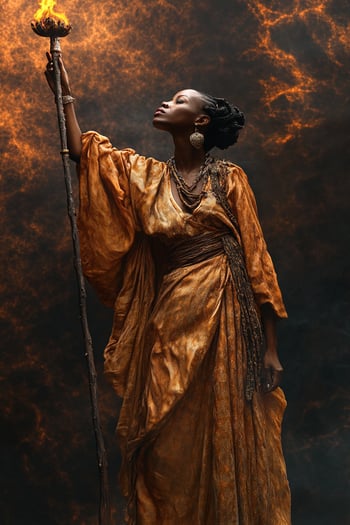
The central moral and metaphysical imperative of Baksism is the pursuit of spiritual completion, a journey dictated by a fundamental biological and spiritual disparity between the sexes. In Baksist theology, women are born with "perfect spirits," possessing an inherent wholeness that allows them to serve as natural vessels for divine wisdom and leaders of the faith’s matriarchal hierarchy. Men, conversely, are viewed as entering the world with "incomplete spirits," a condition that renders them ineligible for the cycle of reincarnation without significant intervention.
To rectify their inherent frailty, males must commit to a lifetime of rigorous spiritual education, where they are mentored by the community’s elders. These elders, who have already mastered the recited oral tradition, act as both keymasters and gatekeepers to the soul. Because Baksism eschews written scripture in favor of oral preservation, the relationship between teacher and student is both sacred and transactional.
The persistent recital of the oral tradition serves a dual purpose: it sharpens the spiritual acuity of the elders while slowly "completing" the spirits of the male students through the absorption of divine lore. This path to completeness is not a gift; it is a social and economic contract. Over the course of their long education, male practitioners are expected to provide continuous offerings of food, goods, and labor to the elders.
These tenets serve multiple purposes. The journey to complete one's soul not only ensures the survival of the clergy but also reinforces the Karazalikar social order. Spiritual worth is directly tied to one's commitment to the community’s health and welfare as much as it is used to reinforce a shared memory to honor the "World Mother," Ana.
Baksist Clergy
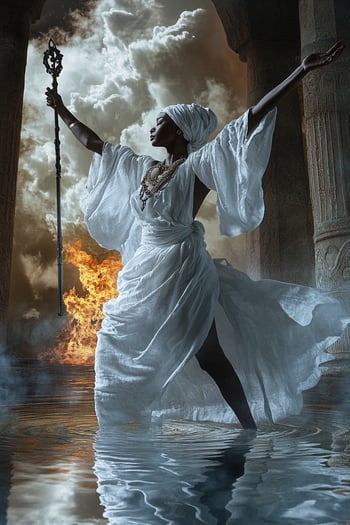
The Baksist clergy is defined by a rigid matriarchal hierarchy that serves as the backbone of both religious and civil life in Karazalik. At the apex of this structure sits the Queen Mother, the sole and undisputed spiritual leader whose authority is absolute. While the Queen Mother does not formally lead the secular government, her influence is so pervasive that the state rarely enacts significant policy without her explicit blessing.
Beneath the Queen Mother, the clergy is composed of elders, mostly female, who manage the spiritual health of their respective settlements. These elders are viewed as the primary conduits for the "World Mother," Ana, utilizing their perfect spirits to interpret the will of the intercessors and maintain the oral tradition that sustains the faith.
The daily operations of the clergy focus heavily on the mediation between the physical and spiritual worlds. Clergy members are not merely liturgical leaders but practical negotiators who assist practitioners in speaking to the souls of the land, from calming rivers for crossing to encouraging crops to thrive.
This spiritual labor is supported by a system of tithes provided by the male population. Because men must undergo lifelong spiritual education to complete their spirits for reincarnation, they are expected to provide constant gifts of food, crafted goods, and labor to the elders in exchange for this essential guidance. This creates a self-sustaining cycle where the clergy maintains the cultural memory of Otan while the laity provides the material resources necessary for their survival.
Creation
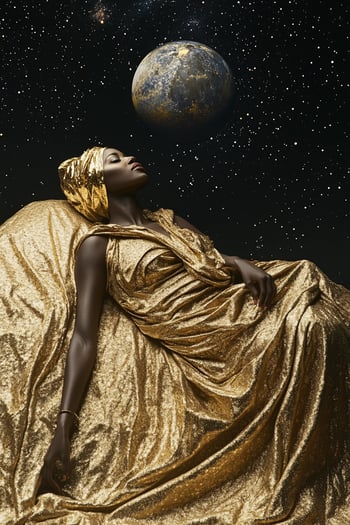
The Baksist understanding of existence is defined by a singular, visceral truth: Otan was not constructed, but born. The Creator, Ana, is viewed as the ultimate Mother who brought the firmament into being through divine labor, imbuing every stone, river, and creature with a fragment of her own soul.
To the Karazalikar, the world is a living, breathing kinsman; a practitioner does not merely observe nature, but negotiates with it. Whether whispering to a river to calm its currents for a crossing or thanking a desert flower for its bloom, the faithful recognize that all things possess a divine will they inherited directly from Ana.
As the first people spread across the land, the "World Mother" saw that the gap between her infinite nature and the fragile lives of humans was too vast for direct communion. To bridge this divide, she gave birth to seven intercessors. These intercessors, the Baksi, were tasked with a vital domain of human life.
While the first six children were born to bring order through the rain, the soil, and the laws of justice, the final birth was Buzaki, the Baksi of the Unpredictable. As the Trickster and the foil to the static order of his siblings, Buzaki was a necessary addition to the pantheon. Baksists believe that without the chaos and challenge he provides, humanity would grow stagnant and soft. He is the divine catalyst, ensuring that the people of Otan remain sharp, resilient, and ready for a world that is as dangerous as it is sacred.
Baksist Observances
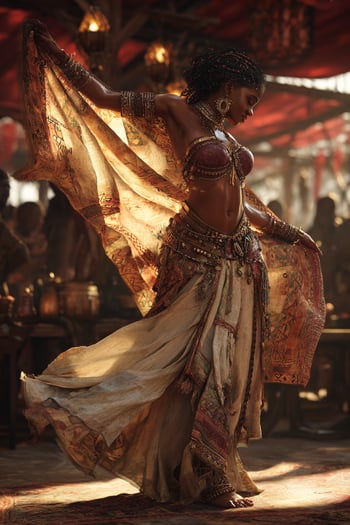
For the Baksists, every sunrise is considered a quiet celebration of Ana’s labor, but this gratitude finds its loudest expression on the holy day of Senbi. During these times of communal gathering, the atmosphere is defined by public feasts where the air is thick with the scent of roasted local game and the sound of rhythmic praise.
Singers and dancers take to the center of these gatherings, not to worship distant abstractions, but to honor the Elders and the Queen Mother. In Baksism, the clergy are the living vessels of the oral tradition; to praise them is to celebrate the very bridge that connects the Karazalikar to the "perfect spirit" of the World Mother.
This devotion intensifies significantly during the Holy Week, a period where the cycle of life is honored without pause. Each of the first six days is dedicated to one of the six Baksi of order, transforming the week into a rolling tapestry of elemental and social recognition, from the rains of Janbir to the iron of Nayza.
For six days, the music never stops, and the dancers rotate in shifts, ensuring that the praise of Ana’s children is constant. Interestingly, the week concludes before the malevolent influence of Buzaki can disrupt the harmony. The celebration concludes on the first day of the new year, when the community gathers one last time to consolidate the spiritual strength they have gained, readying themselves for the unpredictability of the year ahead.
Baksist Pantheon
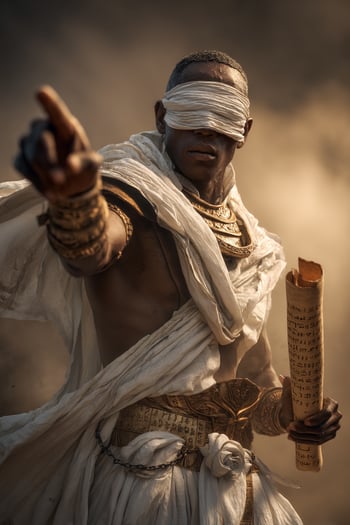
In the Baksist faith, the divine hierarchy is a family tree that mirrors the natural and social order of Karazalik. The pantheon begins with the Mother and extends through her children, the Baksi, who serve as the active guardians of the world's various domains.
The Creator Ana (The World Mother): The progenitor of all existence. From her celestial realm, she gave birth to the planet Otan and every living soul upon it. She is the ultimate mother figure, embodying birth and the inherent sanctity of life.
The Seven Baksi (The Intercessors) To maintain the world she created, Ana gave birth to eight children. These deities are the champions of specific elements, professions, and moral concepts:
Adidi (The Blind God): The firstborn Baksi and the god of Justice and Lightning. He is the champion of the weak, known to intercede and "turn the tables" on those who act unjustly.
Awa (The Winged Goddess): The second Baksi, she governs the Air. She is the protector of flighted creatures and takes a keen interest in those who dwell among the clouds or navigate the skies.
Ferma (The Flowering Goddess): The third Baksi and guardian of the Forests, Trees, Fruits, and Flowers. She is a fierce protector of the woods and is said to be vengeful toward those who destroy the natural greenery.
Nayza (The Iron God): The fourth Baksi and the god of War. It was Nayza who bestowed the gift of iron upon the Karazalikar, providing them the tools to forge weapons and master the art of conflict.
Jer (The Seed Maiden): The fifth Baksi and goddess of the Soil and Harvest. She ensures the fertility of the earth and the vitality of the farmers who till it, making her central to the survival of the community.
Teniz (The Tranquil Goddess): The sixth Baksi, governing the Water, Oceans, and Rivers. She is believed to dwell silently beneath the waves of southern Karazalik, acting as the patron of fishermen and a guide for those lost at sea.
Buzaki (The Spider God): The seventh Baksi and the god of Uncertainty. Known as the Trickster, his role is to introduce chaos. While he finds his cruel jokes hilarious, the Karazalikar view his influence with caution, as his "tricks" often carry grave consequences.
Other Divine Figures
The Messengers: In this animistic faith, nearly any object or creature (such as a bird or even a geographic feature) can serve as a vessel for a soul to deliver a helpful message or warning from the gods.
Baksist Foklore
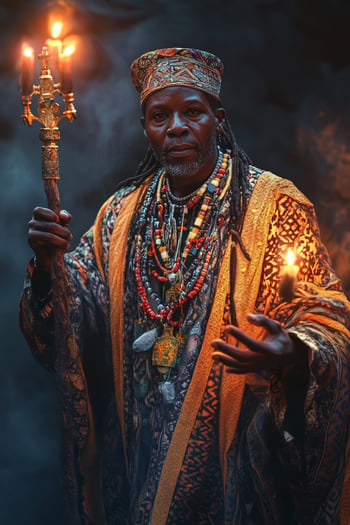
In the Baksist oral tradition, the figure of Buzaki dominates the narrative landscape, accounting for a full two-thirds of all recorded folklore. These tales are the lifeblood of Karazalikar social gatherings, favored by storytellers for their dark wit and the sheer hilarity of the Spider God’s convoluted schemes. While the endings are often cruel, frequently resulting in the accidental demise of a mortal or the deep humiliation of a fellow Baksi, the "fun" lies in the cleverness of the trap.
These stories of Buzaki serve as a cultural pressure valve, allowing the faithful to laugh at the absurdity of a world that can be both sacred and deeply unfair, even if the punchline is explicitly tragic. They provide a moral compass for the listener by underscoring severe consequences that may come with immoral or antisocial behavior.
Beyond the antics of the Trickster, Baksist folklore is underpinned by a subtle but persistent "will to power." Rather than preaching passivity or humble submission, the stories suggest that the pursuit of influence and the mastery of one’s circumstances are divine virtues.
These myths often feature heroes who negotiate their way out of disaster or seize power through decisive, bold action, mirroring the belief that Ana gave her children the world to test their strength, not just their obedience. In the eyes of the Karazalikar, to sharpen one's will and exert it upon the world is the highest form of worship, as it proves that the mortal spirit is truly a shard of the Mother’s own creative force.
Writings & Artefacts
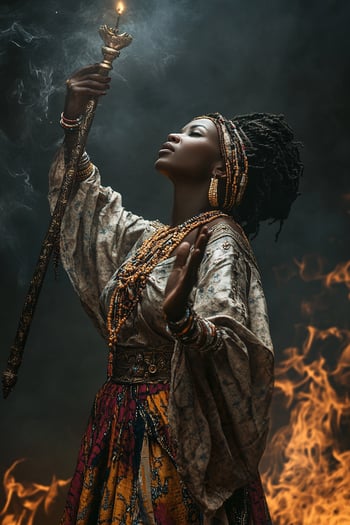
Baksism is a religion of the tangible and the tactile, existing in a striking state of duality: while the Karazalikar possess almost no written scripture, their society is awash in a sea of sacred artifacts. To a Baksist, truth is not found in the ink of a scroll, but in the weight of a ritual vessel or the grain of a consecrated staff.
This absence of text is intentional, reinforcing the oral tradition and ensuring that the faith remains a living, breathing experience rather than a stagnant law. Every household is a gallery of divine presence, filled with charms and fetishes that act as anchors for the spirits of the world, turning every domestic space into a microcosm of Otan itself.
Many of these items are far more than mere symbols; they are potent conduits of power that demand respect and careful handling. Masks are used by elders and Psychics to literally "wear" the perspective of a Baksi, while staves may be used to channel the lightning of Adidi or the winds of Awa.
Because these objects are the primary vessels for the divine, they are often intricately crafted from materials that honor the specific deity they represent, iron for Nayza, polished river stones for Teniz, or hardened silk for Buzaki. In a land without books, these artifacts serve as the "text" of the religion, their histories and powers passed down through the stories told by those who carry them.
| Copyright © 2021-2026 by Robyn Blaber and Will to Power Games. All rights reserved. Content on this website may not be reproduced without written permission of the copyright owner. |
