Sweardaelfen Language
| General Information | |
|---|---|
| Native Name | Sweardish |
| Language Family | Sweardaelfen Language |
| Usage | Spoken, Written |
| Speakers | |
| Where Spoken | Kiskentay |
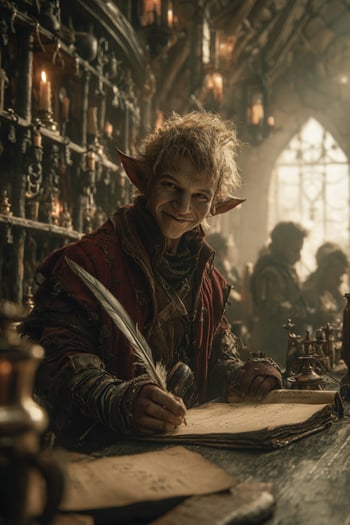
The Sweardaelf language has no cousins elsewhere on Otan. It belongs to its own family, consisting of four principal dialects spoken primarily by the four Sweardaelf substrains. The Borgainaelf and Geardaelf dialects are the closest in timber and flow, while the more isolated Fyrthaelf and Scraefaelf communities have allowed their speech to develop in more distinct directions. Unlike most languages on Otan, however, the most remarkable feature of Sweardaelf is not its vocabulary or grammar, but a grammatical protocol completely foreign to the rest of the continent.
Every utterance is “received” by the hearer with an utterance of their own. To outsiders, this sounds remarkably like laughter. Specific portions of the response indicate whether the preceding statement was heard, followed by a form indicating that it was understood, and finally a flourish showing whether the listener finds the statement agreeable or disagreeable.
An “Oh-ho” might mean something like “possibly improperly heard, but mostly agreeable,” while “Ha ha ha” could convey that the message was heard, understood, and heartily agreeable. There are hundreds, perhaps thousands, of possible variations, making the protocol considerably more difficult for some outsiders to master than the language itself. To a non-speaker, an ordinary Sweardaelf conversation can sound like an endless exchange of jokes, with the constant laughter giving the unfortunate impression that everyone is making fun of everyone else.
Speakers and Distribution
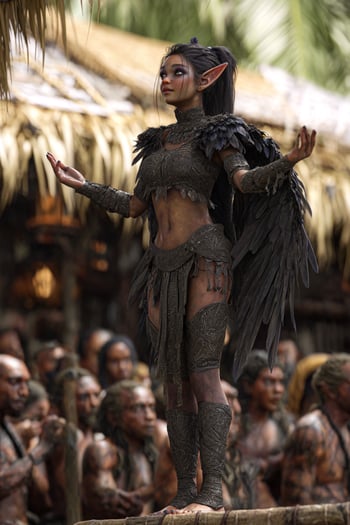
There are just over 3 million speakers of Sweardaelf, divided primarily among the four substrains and their associated dialects. The boundaries are not particularly firm, however. Borgainaelfes and Geardaelfes frequently live and work alongside one another, particularly in the agricultural shanty towns and settlements surrounding some of Kiskentay’s cities. These communities have produced numerous mid-dialects, with vocabulary and pronunciation shifting gradually between the two parent forms.
The Fyrthaelfes and Scraefaelfes have had rather more freedom to carry their dialects away from the linguistic center. Fyrthaelf communities are scattered through the rainforest, while Scraefaelf communities exist in the secluded subterranean world beneath Kiskentay. Each generation introduces new words, slang, and expressions, some of which eventually find their way into more common usage.
Other changes remain local, and the differences can become substantial enough that even another Sweardaelf may respond with the nervous laughter of the protocol simply because they have no idea what was just said. Given enough time, the more isolated dialects may drift toward something that is, for practical purposes, another language.
Writing and Literature
There is, naturally, a Sweardaelf translation of the Book of Woden. It serves an unusual secondary purpose as a linguistic reference for those attempting to understand Sweardaelf or, in the opposite direction, the Otani languages. The translation is useful precisely because the written language cannot reproduce all of the conversational protocol with perfect ease. A reader may understand the words and still be left wondering whether the speaker was pleased, offended, amused, or merely pretending to be.
Sweardaelf literature is therefore more demonstrative than most literary traditions on Otan, and the short play is its favored form of exposition. Long stretches of ordinary prose are difficult for Sweardaelfes to endure when the same information can be conveyed through dialogue, reaction, and the proper sequence of laughter. A typical exchange might amount to “I love you,” followed by the appropriate response, followed by another little flourish indicating whether the sentiment has been accepted with affection, embarrassment, suspicion, or some combination of the three. To a non-Sweardaelf reader, the result is less a conversation than a prolonged attempt to determine whether everyone has lost their minds.
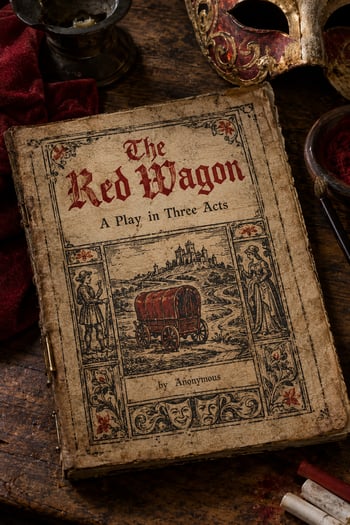
The anonymous play A Red Wagon is considered essential reading for anyone wishing to understand the Sweardaelf concept of borrowerism. The story follows a red wagon as it passes through a succession of hands before eventually being reunited with its original owner. The play is notoriously difficult for non-speakers to read because every line carries the full weight of the Sweardaelf conversational protocol, but Borgainaelfes regard it as a minor literary treasure. It is, in effect, borrowerism explained through theater: nothing is stolen, nobody is particularly surprised, and eventually everyone has a wagon to discuss.
| Copyright © 2021-2026 by Robyn Blaber and Will to Power Games. All rights reserved. Content on this website may not be reproduced without written permission of the copyright owner. |
