Shaman
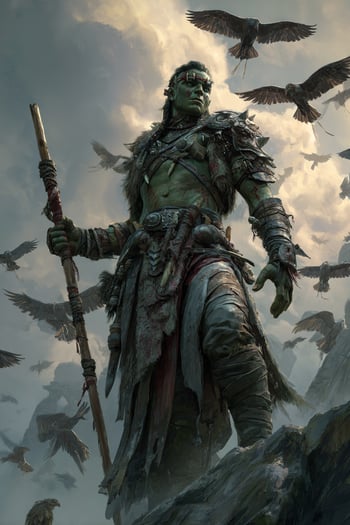
| Power of | Nature |
|---|---|
| Shaman Schools | Circle of Attraction, Circle of Life, Circle of Restoration |
In the vast and varied tapestry of Otan, the Shaman stands as a sentinel of the natural order. Far from the sterile laboratories of the Aether Wizards or the structured, mirror-lined halls of the urban Bard academies, Shamans find their purpose woven directly into the living ecosystem. They operate as the central figures of their respective communities, shifting effortlessly between the roles of spiritual guides, community anchors, and fierce defenders of the wild spaces they call home.
While a Shaman’s influence can occasionally be felt within the sprawling stone walls of Otan's larger cities, their hearts and powers remain tethered to the untamed wilderness. Even when assuming a protective role for urban populations, a Shaman will rarely reside within city limits, choosing instead to establish their domain in the surrounding forests, swamps, or mountains. To a Shaman, the stone and brick of civilization are mere interruptions in the grand, continuous flow of nature.
As protectors, their methods are as brilliant as they are chaotic to the uninitiated. Rather than relying on cold steel or destructive elemental incantations, a Shaman turns the environment itself against hostile forces. Intruders crossing into a Shaman's territory often find themselves relentlessly harassed by local wildlife, from aggressive swarms of insects to coordinated strikes by territorial apex predators.
For threats that ordinary tooth and claw cannot deter, truly powerful Shamans possess the ability to pierce the veil between the physical world and the spiritual realm. In times of existential crisis, they can summon magnificent Spirit Animals. These ethereal guardians possess formidable supernatural strength, manifesting to defend both the Shaman and the communities under their sworn protection.
The Shaman in Society

The journey of a Shaman invariably begins with an innate, unyielding affinity for the natural world. Long before they ever claim their archetype, these individuals can be found marveling at the intricate flora and fauna of Otan. They are obsessive observers, paying meticulous attention to the subtle, symbiotic interactions between species, the shifting of the seasons, and the whispers of the earth. This deep-seated curiosity eventually matures into a profound spiritual bond, transforming a simple naturalist into a true conduit of nature's will.
Consequently, larger settlements across Otan are decidedly Shaman-less. Cities boast their own host of specialized civic services, temples, and academic institutions, rendering the holistic, all-encompassing nature of the Shaman redundant to urban minds. In stark contrast, within the smaller, isolated frontier communities, the Shaman is the invaluable glue that holds society together. Without the luxury of metropolitan infrastructure, these rural settlements look to the Shaman as their primary anchor against the harsh realities of the wild.
In these tight-knit villages, the Shaman is universally relied upon for medical, agricultural, and practical advice. They are the ultimate health influencers for all things living; a villager will consult the local Shaman for everything from a child's sudden fever, to a pet kitten's broken leg, to the health of the upcoming spring crops. Their word carries the weight of law in matters of survival, balancing the needs of the community with the temperament of the surrounding ecosystem.
Shaman Schools

The training and lineage of the Shaman rely entirely on deep-rooted oral and spiritual traditions. Lacking formal textbooks or rigid collegiate registration, knowledge is passed down from master to apprentice through generations of storytelling, strictly guarded rituals, and direct communion with ancestral spirits. Central to this oral curriculum is the mastery of the three fundamental Shamanic Circles, each representing a distinct phase of nature's eternal cycle.
The Circle of Attraction: The first phase of a Shaman's education focuses heavily on the Circle of Attraction. This discipline teaches the initiate how to project their spirit outward to resonate with the consciousness of living creatures. By mastering this circle, the Shaman learns to draw wildlife to their side, projecting a calming aura that pacifies aggressive beasts and encourages local fauna to act as their eyes, ears, and frontline scouts.
The Circle of Life: At the core of the archetype lies the Circle of Life. This circle governs the active manipulation of biological growth and organic vitality. Shamans utilizing this circle can accelerate the maturation of plants, bolster the health of livestock, and intimately read the physical conditions of living organisms. It is the circle most commonly invoked during their day-to-day duties as rural community guardians and agricultural stewards.
The Circle of Regeneration: The final, most profound discipline is the Circle of Regeneration. Where the Circle of Life guides natural growth, the Circle of Regeneration actively fights back against death and decay. It allows the Shaman to channel raw, restorative spiritual energy to mend severed flesh, purge deadly toxins, and breathe renewed vitality into shattered bodies. It is an exhausting, sacred art that can wrench a dying soul back from the very brink of the afterlife.
Shaman Powers

The practical manifestation of a Shaman's power is a striking blend of conjuration, organic alteration, and pure restoration. At a moment's notice, a Shaman can call upon the surrounding wilderness to provide reinforcements, summoning packs of animals to turn the tide of a skirmish or invoking spirit beasts to smash through enemy lines. Their magic is inherently adaptive, shifting seamlessly from offensive crowd control via summoned wildlife to life-saving defensive intervention.
Beyond fauna, their authority extends deep into the strange, liminal spaces of biology. A Shaman can command flora to bind foes or manipulate primitive organisms to alter the battlefield. When combat ceases, their energy pivots entirely to healing and restoring. They possess the rare, invaluable gift to erase trauma from flesh and bone, making them some of the most sought-after battlefield medics and survival experts in all of Otan.
Crafting

One of the most fascinating and scientifically distinct aspects of Shamanic crafting is the cultivation of customized slimes and jellies. By combining rare botanical extracts, enriched soil samples, and localized spiritual energy, a Shaman can breed semi-sentient oozes. These gelatinous entities are entirely customized by their creator, engineered with specific biological traits tailored to meet the immediate needs of the Shaman's community or traveling party.
The utility of these engineered oozes is remarkably vast. A Shaman might brew a thick, acidic jade jelly designed to cling to choke points and corrode the armor of invading forces. Alternatively, they can cultivate translucent, ambient slimes infused with properties from the Circle of Regeneration; these benevolent jellies can be applied directly to open wounds, acting as a living, self-sealing bandage that actively purges infection and accelerates cellular repair.
The Shaman and Power

The spiritual energies that fuel Shamanic magic are deeply tied to the land, and maintaining this power requires deliberate upkeep. To completely recharge their spiritual reserves after intense spellcasting or crafting, a Shaman must retreat entirely from civilization to their sanctuary Preserve. This Preserve is a highly secure, self-styled sanctuary of the Shaman's own meticulous design, typically manifesting as a pristine forest grove hidden by dense foliage, or an overgrown, bio-luminescent cave system rich with elemental moisture. Within this personalized cradle of nature, their spirit realigns with the earth, completely restoring their magical capabilities over a few days of undisturbed isolation.
When traveling far from their sanctuaries, a Shaman cannot access the profound restoration of their Preserve, but they are far from helpless. While on the road, they can actively prevent magical exhaustion by performing minor communions with the local environment. By pausing to meditate under an ancient tree, wading through a rushing river, or spending a few quiet hours listening to the rhythm of the wind, a Shaman can absorb small fragments of ambient natural energy, keeping their vital survival powers functional until they can return to a true sanctuary.
Shaman Factions

While many Shamans prefer lives of quiet isolation, societal needs often draw them into organized structures. When they choose to integrate with the wider world, they typically align with one of three distinct functional factions:
Civil Defense Units: In these configurations, Shamans act as specialized magical artillery and perimeter security for larger, vulnerable settlements. Stationed along the deep frontiers or outer walls, their primary duty is utilizing large-scale animal summoning and territorial manipulation to harass, disorient, and smash invading forces before they can breach civilian sectors.
Local Governments: Because of their central role in small-scale rural life, many Shamans are systematically elected to formal political office. It is common to find a seasoned Shaman occupying a critical seat on a town council or serving as a village mayor, drawing on their deep community trust and resource management skills to guide civic growth.
Military Units: During times of continental warfare, major armies will go to great lengths to recruit or contract Shamans exclusively for frontline deployment. Embedded within standard infantry units, these Shamans operate as elite combat healers, utilizing their profound regenerative powers to keep soldiers fighting and drastically reducing mortality rates in active war zones.
| Copyright © 2021-2026 by Robyn Blaber and Will to Power Games. All rights reserved. Content on this website may not be reproduced without written permission of the copyright owner. |
