Infernal Tozakh
| Scientific Name | Homo Cornutus Caprinus |
|---|---|
| Plural | Infernal Tozakh |
| Possessive | Infernal Tozakh |
| Patron Deity | Loki |
| Religion | Wodenism |
| Languages | Otani Language |
| Eyesight | Low Light Vision |
| Worlds | Otan |
| Countries | Shuwalu |
| Climate | Arctic/Polar |
| Terrain | Mountains, Coastal, Plains |
| Build | Average |
| Skin Color | Fair to Tan |
| Hair Color | Blonde, Black, Brown, Red |
| Eye Color | Blue, Green, Hazel, Brown, Grey |
| Distinctions | Basline Human, Ram Horns |
| Disposition | Nocturnal |
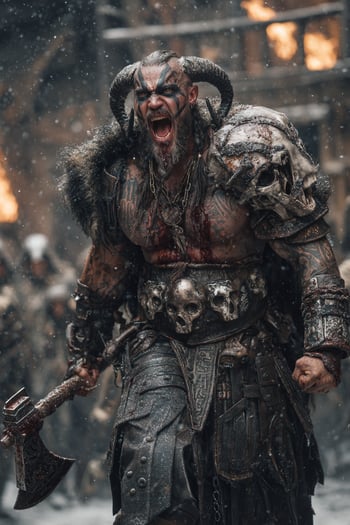
The Infernal Tozakh (Homo Cornutus Caprinus) are the nocturnal heartbeat of Shuwalu, distinguished by their thick, helical ram-like horns that grow continuously throughout their lives. As the guardians of the night, they wake as the sun sets to take over the shops, forges, and watchtowers vacated by their Faun partners. This permanent nocturnal lifestyle has granted them a natural comfort with the dark and a stoic temperament. Because their horns do not molt but instead carry the permanent scars and chips of their life’s struggles, the Infernal Tozakh are often viewed as the more grizzled and battle-hardened half of the Tozakh pairing.
Spiritually, the Infernal Tozakh have remained steadfast in their adherence to Wodenism, though their practice focuses almost exclusively on the figure of Loki. Unlike other cultures that might view the Trickster with suspicion, the Infernal Tozakh revere him as the "Tortured God." Their theology is built upon the somber assumption that Loki suffers every moment at the hands of the other gods, enduring an eternal, agonizing imprisonment.
This focus on divine suffering resonates deeply with the Infernal Tozakh, who see their own survival in the unforgiving, freezing darkness as a reflection of Loki’s endurance. To them, the "Tortured God" is not a villain, but a sympathetic figure of resilience whose silent pain mirrors the hardships of the arctic night. This religious outlook deeply influences their cultural behavior, leading to a society that values silence, endurance, and the ability to carry heavy burdens without complaint.
While their Faun counterparts celebrate the vitality of Bloncamann during the day, the Infernal Tozakh spend their hours in the moonlit forges or on the windswept borders, often performing silent rituals of solidarity with their shackled god. Their poetry and songs, usually performed in the low hum of the night-markets, frequently dwell on themes of hidden strength and the nobility of enduring what cannot be changed.
Physical Characteristics
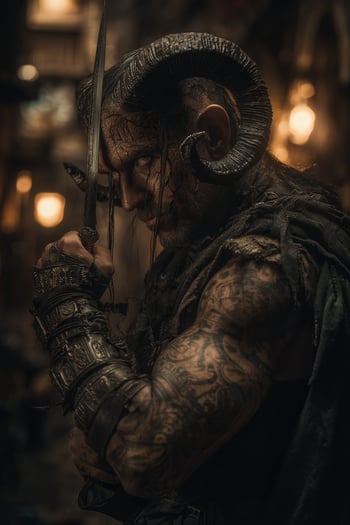
The Infernal Tozakh are physically indistinguishable from baseline humans except for their distinctive horns. Their thick, helical ram-like horns grow continuously throughout their lives and do not regenerate if damaged. A chipped or broken horn therefore remains that way permanently, turning every scar and missing section into a visible record of the individual's life.
Like the Faun Tozakh, the Infernal possess a natural resistance to the brutal arctic conditions of Shuwalu. Their bodies remain capable of precise activity in temperatures that would leave ordinary humans and Aelfes struggling to function. The defining advantage of their nocturnal existence is superior low-light vision, allowing them to navigate the darkness and treacherous ice of the northern wastes with remarkable confidence.
The Infernal also share the Tozakh's remarkable instinct for animal husbandry. Their connection with animals is largely wordless, allowing them to raise horses and beasts of burden that are unusually hardy, intelligent, and loyal. This talent is not simply a Faun specialty; it is one of the few characteristics that binds the two halves of Tozakh society together beneath all their differences.
Infernal Tozakh Culture
The Infernal Tozakh own the night. When the sun sets, they take over the shops, forges, watchtowers, and other workplaces maintained by their Faun counterparts during the day. This arrangement is possible because Tozakh settlements are designed for continuous use, with each half of society assuming responsibility for the same physical world on its own schedule. The result is a civilization that wastes remarkably little and rarely has to stop simply because the sun has gone down.
The transition between day and night is managed during a short daily crossover period. Faun and Infernal partners exchange information, update ledgers, discuss unfinished work, and pass along whatever the other needs to know. This makes the practice of pairing central to Infernal life, since a partner is not merely a spouse or colleague but the person responsible for maintaining half of a shared existence. The loss of such a partner can leave the survivor struggling for years to rebuild a life that suddenly feels incomplete.
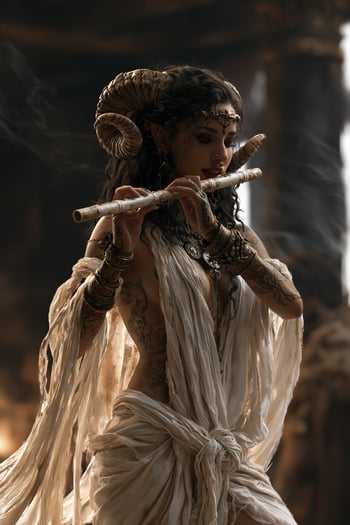
Infernal culture places considerable value on endurance, directness, and physical capability. Their music is louder and more percussive than that of any other strain, while their poetry favors blunt statements over elaborate metaphor. The style reflects their broader character: the Infernal have little patience for disguising hardship beneath pretty words. Even their art tends toward the raw and wild, a quality they regard with considerable pride despite the Aelfen tendency to find it somewhat alarming.
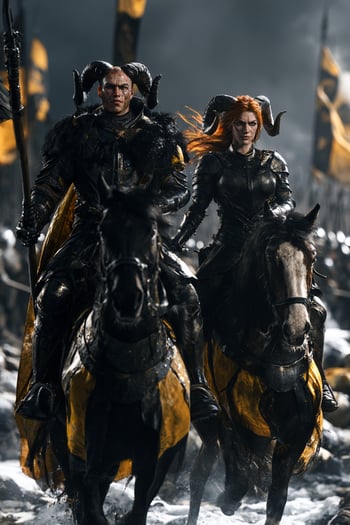
The night also belongs to their military tradition. Because the Faun and Infernal cycles overlap, Shuwalu can maintain fresh, fully awake defenders at virtually any hour, eliminating the usual weakness of exhausted sentries and nighttime rotations. Specialized galley wagons even accompany military forces, providing hot meals to troops during extended operations. The result is a society capable of maintaining an extraordinary operational tempo without requiring either half of the population to abandon its natural sleep cycle.
The Infernal maintain a particularly strong connection to Loki within Wodenism. They regard him as the Tortured God, identifying with a deity whose suffering and endurance mirror their own understanding of life in the frozen darkness. This stands in deliberate contrast to the Faun devotion to Bloncamann, making the religious divide another expression of the larger day-and-night division that shapes Tozakh civilization.
Infernal Tozakh Geography
The Infernal Tozakh inhabit the same homeland as their Faun counterparts: the northern nation of Shuwalu. The country covers approximately 31,172 Gorom sq. and is divided into four principal regions—the Gehenna Peninsula, Hades Reservation, Kur Reservation, and Sheol Reservation. The northern frontier meets only the sea and thick ocean ice, while Batis and Soltustik form the principal southern and eastern approaches.
Shuwalu is a rocky land densely covered in pine forests, with three major rivers cutting through the country from south to north. The greatest of these is the Cloudfall River, which feeds the basin surrounding Dis, the capital of Shuwalu. Most of the nation's other major settlements lie along the coastline, giving the Tozakh dependable access to rich fishing grounds throughout the year.
Winter changes the shape of the country in a very literal sense. As the sea freezes, the Tozakh claim portions of the ocean ice and establish seasonal camps for ice fishing. The additional seafood brought in during these months reduces their dependence on imported food from Batis. For the Infernal, these frozen expanses are not an obstacle to be endured but another part of the landscape they have learned to use.
The settlements of Shuwalu are built around the same principle as the people themselves: nothing should have to stop merely because the light has changed. Ports, workshops, roads, watchtowers, and other infrastructure remain active through the combined efforts of Faun and Infernal crews. Even mobile commercial operations use paired teams, with bakeries, taverns, and forges traveling alongside major construction projects so that both workers and administrators can be supplied around the clock.
Despite their reputation for hostility and isolation, the Infernal are not entirely cut off from the rest of Otan. Shuwalu permits foreign trade ships to enter its ports, while a small number of highly capable patrol vessels guard the coastline. These ships are crewed by day-and-night pairs, allowing them to operate for unusually long periods without the limitations imposed by conventional crews. The Tozakh have deliberately chosen not to maintain an expansive navy, preferring instead to make their own frozen homeland difficult enough to reach that few outsiders feel inclined to test them.
| Copyright © 2021-2026 by Robyn Blaber and Will to Power Games. All rights reserved. Content on this website may not be reproduced without written permission of the copyright owner. |
