Fyldweorg
| Scientific Name | Homo Pumilius Agrestis |
|---|---|
| Plural | Fyldweorges |
| Possessive | Fyldweorgen |
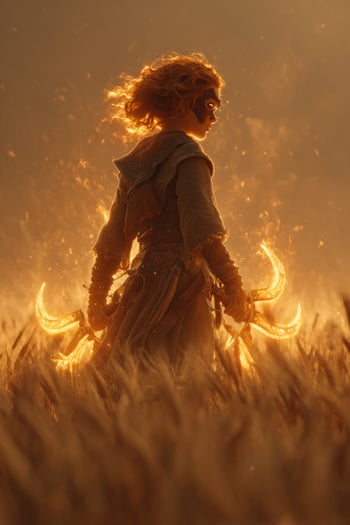
The Fyldweorg (Homo Mechanicus Agrestis) are the most populous and widespread of the Dweorgen substrains, serving as the foundational demographic of south-central Otan. Unlike their deep-mining kin, the Fyldweorg prefer the open air, establishing sprawling cities on flat plains and throughout the rolling hills.
They are the masters of the "surface world" within Dweorgen territory, balancing their industrious nature with a heavy reliance on large-scale agriculture. While they maintain the ancestral drive to mine, they rarely delve into the lightless depths of the earth, preferring instead the methods of quarrying, pit mining, and strip mining to extract Otan's mineral wealth.
Culturally, the Fyldweorg are renowned for a level of hospitality that is both warm and relentless, making a quiet night in one of their local taverns a rare occurrence. Their social lives are steeped in music, dance, and communal gathering, where "badass" bards and lively festivities are the standard.
This hospitable nature extends to their economy, as they are expert traders who have turned their territory into a vital hub for commodities, textiles, and manufactured goods. Whether managing a surface-level quarry or tending to their vast agricultural lands, the Fyldweorg remain the heart of Dweorgen society, characterized by a tireless work ethic and a celebratory spirit.
Physical Characteristics
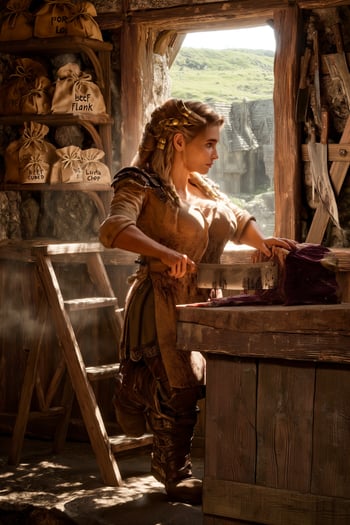
Fyldweorges share the characteristic build of their Dweorgen kin: short, stout, and heavily built, typically standing at roughly three-quarters the height of an average human. Their bodies tend toward an endomorphic physique, with broad frames and limbs that appear unusually muscular for their size. Their complexions vary considerably, as they do among Dweorgen substrains, and their hair and eye colors range from blonde through black.
Unlike the more specialized Oradweorges and Beodweorges, there is little about the Fyldweorg physique that immediately marks them as creatures of a particular environment. They are built for work rather than extremes. A Fyldweorg might spend the morning behind a plow, the afternoon repairing a wagon, and the evening helping at the village smithy without considering any of it unusual. Their compact strength serves them equally well in the fields, workshops, and when called upon to defend their homeland.
Fyldweorg Culture

The Fyldweorges are the most openly social of the Dweorgen substrains. Their communities revolve around farms, villages, towns, and cities where work and social life are closely intertwined. Hospitality is taken seriously, and a traveler who accepts an invitation to an inn or tavern should be prepared for good food, strong drink, music, and considerably more company than they expected.
Music is central to Fyldweorg life. Pipes, fiddles, and drums accompany celebrations and dances, while the mournful sound of the pipes is also used to remember those who have died. In wartime, pipers and drummers set the cadence of marching soldiers; in peacetime, they are more likely to set the cadence of a dance. Their festivals celebrate the bounty of the earth through organized celebrations and agricultural fairs, often with the characteristically Dweorgen emphasis on measurable achievement.
Much of Fyldweorg society is built around agriculture and the trades that support it. Farmers and herders produce grain, fruits, vegetables, and livestock, while village butchers, bakers, blacksmiths, carpenters, tailors, cobblers, and merchants turn that bounty into the necessities of everyday life. Their agricultural wealth also binds them closely to their Dweorgen kin: surface-grown food is traded to the subterranean Oradweorges, while ore and gemstones from below find their way into Fyldweorg workshops.
For all their friendliness, the Fyldweorg should not be mistaken for soft folk. Those who do not farm may serve in the Dweorg army, and Fyldweorg Knights are described as fearless and formidable, often fighting from horseback and sometimes leading entire armies. When war threatens the Quarrylands, the farms, smithies, workshops, and markets that normally sustain peaceful communities can be turned with remarkable efficiency toward supplying an army.
Fyldweorg Geography
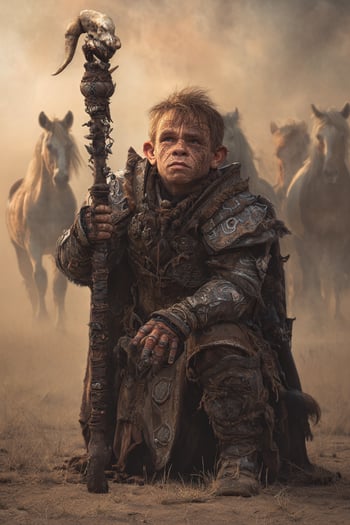
Fyldweorges occupy the southern third of the Quarrylands, where the mountains give way to fertile lowlands, broad fields, rolling hills, and grassy dales. This is the most easily traversed portion of Dweorgen territory and, consequently, the part most visitors associate with the Dweorges themselves. Major settlements, farming communities, markets, and roads are concentrated here, with Fyldweorges making up the bulk of the population in the accessible regions.
The landscape supports nearly everything the Fyldweorg need. Wheat and other grains grow across the fertile fields, while sheep and cattle graze across the hills and dales. Rivers and lakes provide fish, and the surrounding countryside supplies fruits, vegetables, and other foodstuffs that find their way into the markets, bakeries, inns, and taverns of the region.
Fyldweorg settlements are generally practical places of stone and timber, surrounded by the farms, pastures, workshops, and small businesses that keep them alive. Surface quarries and shallow mines provide iron, gold, silver, copper, and gemstones, while the deeper ores of their Oradweorg cousins supplement what can be extracted closer to the surface. The result is a landscape where agriculture and industry exist side by side: fields beside quarries, villages beside smithies, and roads busy with both livestock and trade.
The southern lowlands are also the natural meeting ground of the Dweorgen substrains. Fyldweorges dominate the surface, while their Oradweorg kin may live beneath it and Beodweorg settlements rise farther into the mountains. The three are not isolated populations but parts of the same interconnected society, with the Fyldweorg providing much of the food and manufactured goods that allow their more specialized cousins to thrive.
| Copyright © 2021-2026 by Robyn Blaber and Will to Power Games. All rights reserved. Content on this website may not be reproduced without written permission of the copyright owner. |
