Tenizi
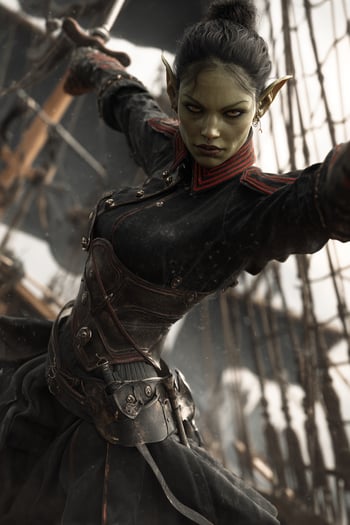
| Scientific Name | Homo Ingeniosus Perigrinus |
|---|---|
| Plural | Tenizi |
| Possessive | Tenizi |
The Tenizi (Homo Ingeniosus Portitor) operate as the relentless, high-stakes logistics arm of the Kuulik Trade Company, where an individual’s social standing and self-worth are measured purely by the efficiency and punctuality of their shipments. For a Tenizi, "On Time" is not a goal; it is a sacred vow. Growing up away from the water is as unthinkable to a Tenizi child as an Ungir child avoiding the dirt; their very biology and culture are anchored to the rhythmic demands of the tide and the ticking of the clock.
The Tenizi's obsession with precision makes them the perfect operational partners for their Sawdager cousins. While the Sawdagers act as the "orchestrating" faces of trade, opening markets and brokering deals, the Tenizi provide the iron-clad distribution network that ensures those promises are fulfilled. Their relationship with the Uris as enforcers is also key to their ability to stay on time. The Uris love to crush anything or anyone who gets in the way of a Tenizi schedule.
Tenizi ambitions diverge sharply from the terrestrial greed common to other Otani strains. While a Human noble or a Grendel might lust after stone keeps and sprawling land-tracts, a Tenizi’s dreams are measured in tonnage and knots. The pinnacle of Tenizi success is the construction of a Floating Fortress; massive, self-sustaining maritime hubs that circle the coastal waters of Otan like nomadic city-states.
These fortresses serve as vital "tax-free" refuges for their Sawdager kin and traders from around the globe, allowing for the exchange of rare and restricted items away from the prying eyes of continental authorities. Within these steel and timber leviatans, the Tenizi maintain a culture of peak industrial efficiency, ensuring that the KTC’s supply chain remains unbroken, no matter how turbulent the seas of Otan become.
Physical Characteristics
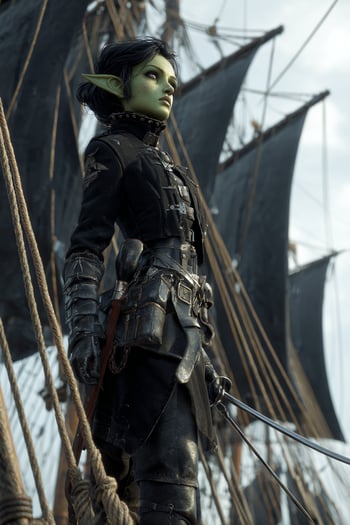
The Tenizi share the diminutive proportions common to the Kuulik, standing around 8 Kul (120cm) tall. Their olive-green skin is uniform across the body, sometimes contrasted by darker lips, while their hair is uniformly black. Male-pattern baldness can begin surprisingly early, sometimes by twenty, and both sexes commonly begin to gray around forty. Despite their small stature, Tenizi tend to remain slim, agile, and physically capable well into old age.
Their most notable advantages are less obvious than their coloring. Tenizi possess an uncanny sense of direction, seemingly able to determine which way is which whether traveling in daylight or darkness, above ground or below it. They also have an unusual sensitivity to weather, allowing them to anticipate changes in wind, rain, and other conditions with a reliability that approaches the supernatural without actually requiring magic. Their resistance to motion sickness makes them particularly well suited to the ships and airships that serve as their homes and workplaces.
Like some other Kuulik, certain Tenizi possess the ability to see in low light. Taken together with their natural sense of direction, weather awareness, agility, and resistance to motion sickness, these traits make the Tenizi remarkably well adapted to a life in transit. They are not merely Kuulik who happen to travel. They are a people whose bodies seem to have agreed with the arrangement.
Tenizi Culture
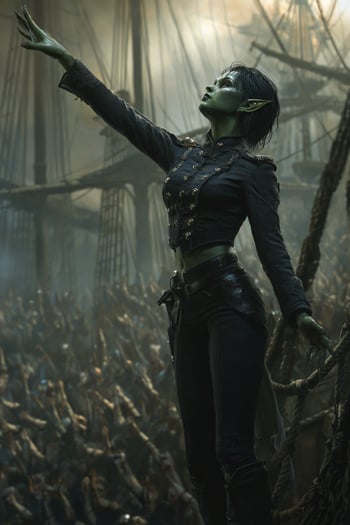
Travel is the defining fact of Tenizi life. They are reluctant to accumulate physical possessions because everything they own must eventually be carried somewhere else. Wealth can be accumulated and stored, but a good song or story is often considered a better gift than an object, since it weighs nothing and can accompany its recipient across the world. The Tenizi have consequently developed a strong oral tradition, with songs, stories, sayings, and performances forming an important part of life aboard ships, airships, and caravans.
Their reputation for precision is nearly as important as their wanderlust. For a Tenizi, being on time is treated almost as a sacred obligation, and this makes them the natural logistical counterpart to their Sawdager cousins. The Sawdagers find the markets and make the arrangements; the Tenizi move the goods and make certain that the promises actually arrive where and when they are supposed to. The Uris provide the unpleasant incentive when someone gets in the way.
Superstition is woven deeply into this way of life. Before trusting a Wizard's ward, a Witch's spell, or a Divine's blessing, a Tenizi is likely to perform some private ritual of their own. A lucky shirt, a repeated poem, a particular song, a turn in a circle, or a carefully chosen oath may all be considered necessary before a voyage begins. Their religious practice is similarly practical: Woden may be honored, but a sailor might also pray to Mujit, the Araldar sea god, while an airship sailor might appeal to Lyftwynn. If there is a god who might help, the Tenizi see little reason not to ask.
The performing arts are therefore more than entertainment. A good crew is expected to have good musicians, and Tenizi songs have spread throughout Kuulik culture. Seagoing Tenizi become connoisseurs of fresh seafood and spend their shore leave wishing their hotel beds would stop moving. Those traveling by land hunt fresh game and become accomplished storytellers and collectors of gossip, while airborne Tenizi adapt the songs of their maritime cousins to life among the clouds.
Despite their reputation for commerce, the Tenizi are not simply merchants at sea. Their own wealth is tied to movement, adventure, and the expansion of the Kuulik Trade Company's reach. The Tenizi ideal is expressed in tonnage and knots rather than acres and castles, with the ultimate ambition being the creation of Floating Fortresses: self-sustaining maritime hubs that can roam the coastal waters of Otan while serving as refuges and trading centers for Kuulik and foreign merchants alike.
Tenizi Geography
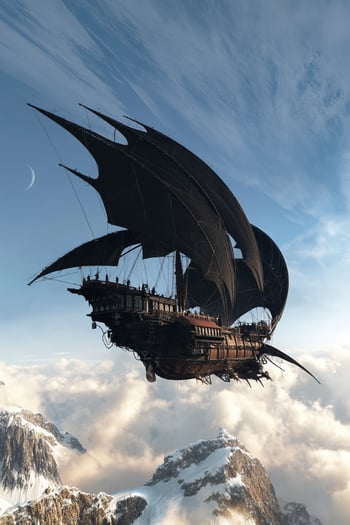
The Tenizi have no homeland in the conventional sense. They live and travel almost everywhere in Otan, and their settlements are ships, airships, travelling camps, caravans, inns, and whatever temporary accommodations can be found along the routes of the Kuulik Trade Company. Entire families may travel together, although an adventurer whose work is particularly dangerous may leave their family safely behind on Kuulik territory.
Their greatest concentration is therefore found wherever transportation and trade converge. Tenizi operate the bulk of the Kuulik Merchant Navy and Merchant Air Force, and they maintain a network of inns in ports willing to accommodate them. These establishments serve as more than places to sleep: a traveler looking for a captain, a ship, a crew, or passage can often begin the search at a Tenizi inn. Even where the Kuulik are unwelcome, there may be a Tenizi presence operating quietly enough that only someone who knows where to look will find it.
The Tenizi also have a role in defending the only territory the Kuulik formally possess. The Kuulik Peninsula and its adjacent islands are the recognized territory of the Kuulik Trade Company, while the Uris enforce its borders by land and the Tenizi enforce its sovereignty by sea. Their military forces are not expected to overpower the great armies of Otan. Instead, the Kuulik rely heavily on the economic consequences of disrupting their trade network; a nation that makes war on the Kuulik risks finding important goods suddenly unavailable.
The Tenizi ideal lies beyond even these scattered ports and routes. Their greatest ambition is the Floating Fortress, a roaming maritime city-state capable of carrying people, goods, industry, and commerce without depending upon any single nation. These enormous steel-and-timber vessels provide places where Kuulik merchants and others can conduct business beyond the reach of continental authorities, while allowing the Tenizi to keep the KTC's supply lines moving even when the seas themselves become dangerous. For a people who regard permanent settlement as almost an inconvenience, a city that can simply sail away is perhaps the most appropriate city imaginable.
| Copyright © 2021-2026 by Robyn Blaber and Will to Power Games. All rights reserved. Content on this website may not be reproduced without written permission of the copyright owner. |
