Aristan
| Scientific Name | Homo Felinus Leoninus |
|---|---|
| Plural | Aristan |
| Possessive | Aristani |
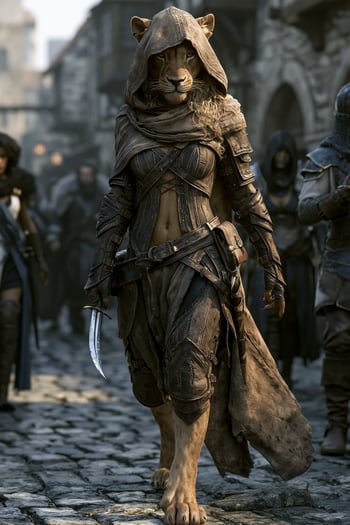
The Aristan (Homo Felis Leo) represent the most gregarious and physically imposing of the Misiq substrains. Distinguished by their leonine features, including thick manes on the males and broad, powerful frames, they are defined by their specialization as apex pack hunters. Unlike their more solitary cousins, the Aristan possess a social biology driven by a taste for "Big Game."
This dietary imperative has fostered a highly coordinated society where individuals hunt in pride-like packs, utilizing sophisticated flanking maneuvers to bring down massive beasts that would be insurmountable for a lone hunter. This reputation is so well-established that other Misiq tribes frequently summon Aristan war-parties to dispatch oversized "pests" or predators threatening their borders.
Despite a reputation among outsiders for being nearly feral, the Aristan possess a keen, practical intelligence that has allowed them to adapt through brief, often transactional encounters with travelers and other human strains. They have moved beyond primitive survival to master specialized crafts that complement their martial lifestyle. Most notably, they have developed a unique form of "scale-craft," fashioning rudimentary but highly effective armor from the chitin and hides of the very monsters they cull.
This technological evolution extends to the forge. Aristan encampments, once simple temporary shelters, now often play host to skilled weapon and armor smiths. These artisans specialize in heavy, high-impact weaponry designed to pierce the thick hides of legendary beasts. By merging their natural leonine strength with these acquired smithing skills, the Aristan have transformed from simple hunters into the de facto heavy infantry and monster-slayers of the Misiq people, providing a vital shield for their kin in an increasingly hostile world.
Physical Characteristics
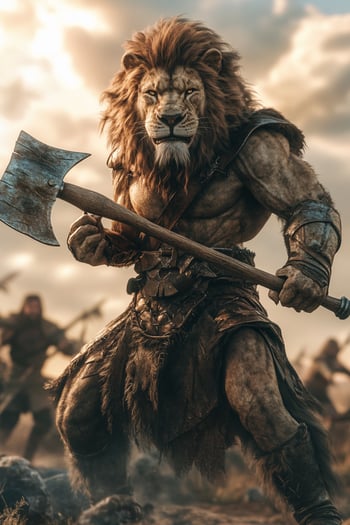
Like all Misiq, the Aristan carry the core feline markers of the strain: an extended snout, highly mobile rotatable ears capable of hearing well beyond the range of their human neighbors, and clawed, paw-like feet that most find impossible to properly shoe. Despite these feline extremities, the Aristan maintain the same upright, bipedal gait shared across all four substrains, and their underlying skeletal structure and internal anatomy remain close enough to the human baseline that they can comfortably use the same tools, doorways, and saddles as their neighbors.
Where the Aristan diverge sharply from their kin is in raw scale. Broader and more heavily muscled than the sleek Baris or the wind-thin Sileysin, an adult Aristan typically stands taller and heavier than the average human, a fact that has done as much to cement their reputation as their claws and teeth. Males carry the substrain's signature trait, a thick mane running from the crown of the head down across the shoulders, its color ranging from pale gold to a deep, smoke-tinged umber. Females lack the mane entirely, presenting a leaner and more streamlined silhouette better suited to the sustained pursuit work of the pride hunt.
This is a body built for power over subtlety. Unlike the Baris and Jolbaris, who have adapted a low, ground-hugging crawl for stalking prey, the Aristan have no comparable stealth posture; their bulk simply isn't suited to it, and their hunting method has never required it. What they lack in low-profile stealth, they make up for in raw physical output, sustained ferocity, and a bite and claw that can down game most other Misiq wouldn't dare approach alone.
It's this same physical profile, restless and overbuilt for a life of idle rest, that has pushed the Aristan toward the forge in the first place. A frame this large and this strong needs to be worked, and between hunts, that surplus strength finds its outlet swinging a hammer as readily as a blade.
Aristan Culture
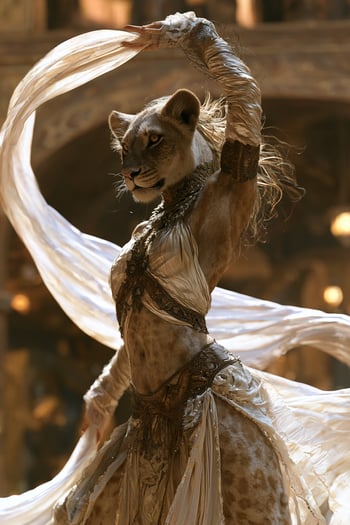
Aristan culture is, at its core, a culture of the pride: kinship isn't drawn along strict bloodlines so much as along who hunts, eats, and fights alongside whom. This communal instinct extends outward into the wider Misiq gatherings as well, where the Aristan are the ones who host the contests of raw power, tests of strength that double as both entertainment and a none-too-subtle reminder of why other tribes call on them when something dangerous needs killing.
That same instinct toward direct action has found a formal outlet in the Hellions, a clique of Aristan Rogues answering to the ruling body of Tosenis. Where a Baris might resolve a dispute through the slow work of politics, the Hellions exist to intervene quickly and quietly, stamping out civil unrest and smaller threats before they can distract the Misiq from the one conflict that actually matters: survival against the Batis.
This preference for the direct and the physical carries through to how individual Aristan find their calling. Brutes and Knights are the archetypes the Aristan produce in the greatest numbers and with the least effort, a natural extension of a body already built for close, punishing combat. Rogues are a more surprising specialty; despite their size, a startling number of Aristan take to stealth work, proof that the strain's reputation for being "all muscle" undersells them.
Magic follows the same tactile bent. Aristan wizards are rare, and the few who exist favor spells that require getting uncomfortably close to their target rather than the safer, distanced varieties other strains prefer. Witches are far more common, seeming to draw their hex-craft directly from the land around them, a fitting gift for a people who rarely stay in one place long enough to build a permanent workshop.
Between hunts and skirmishes, Aristan social life centers on food, drink, and story. Their taverns and inns are crude by the standards of other strains, mud-walled, grass-roofed buildings built quickly with whatever the plains provide, but they're rarely empty. Bards hold court in the common room with tales of past hunts and battles, ale brewed from foraged grain and fermented fruit flows freely, and meat, always meat, is served alongside simple flatbread. It's a culture that doesn't dress itself up, because it doesn't need to; the Aristan measure a good gathering by the company and the story, not the china.
Aristan Geography
The Aristan are, above all, a people of the open plain. Where much of Tosenis is described as a mosaic of pine forest and grassland, the Aristan gravitate hardest toward the driest, most exposed grassland reaches, arid country baked hard by the sun for most of the year and briefly, violently, brought to life when the rainy season fills the dry riverbeds. It's a harsh homeland, but one that suits a people who hunt "Big Game" for a living; there's nowhere for a beast that size to hide, and nowhere for an Aristan pride to be caught off guard either.
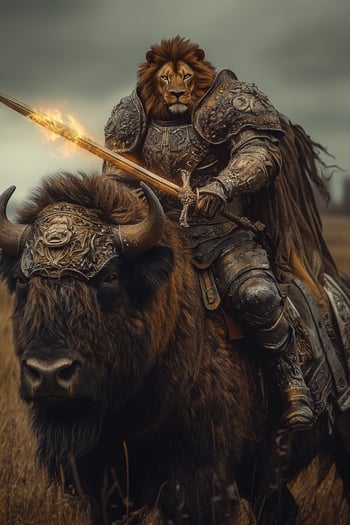
True to broader Misiq custom, Aristan settlements are not built to last. They practice the same "vanishing settlement" discipline as the rest of their people, ready to strike camp and disappear at the first sign of Batis incursion. What structures they do raise reflect this transience: adobe clay walls, roofs thatched from native grasses, stables built for the bison and water buffalo that serve as their draft animals and mounts. Practical, fast to build, and just as fast to abandon.
Demographically, the Aristan make up roughly a fifth of the fewer than 200,000 Misiq counted across Otan, a population on par with the Sileysin. Unlike the reclusive Jolbaris, who keep to bivouacs on the outskirts of settlements, the Aristan mix freely and constantly with the Baris and Sileysin, sharing work, meals, and leisure across substrain lines within the same communities. This willingness to intermingle is likely part of why their culture reads as the most outward-facing of the four, even as the plains they call home remain some of the most isolated ground in Tosenis.
Whether the Aristan have any presence among the small, uncounted population of Misiq known to live far to the north in Karazalik remains an open question. No word has reached Tosenis of that lost tribe's fate or composition, and for now, whether any lion-folk number among them is simply unknown.
| Copyright © 2021-2026 by Robyn Blaber and Will to Power Games. All rights reserved. Content on this website may not be reproduced without written permission of the copyright owner. |
